

438
9 AUTOCHTHONOUS SEDIMENTS
Phosphates occur interbedded with Upper Cretaceous and Eocene chalks and cherts.
There can be little doubt that these phosphates resulted from the upwelling of oceanic
currents from Tethys onto the broad continental shelves along its southern shore. Another feature responsible for the accumulation of phosphates at this time is believed to
be a warm humid climate. It has been argued that this increased the rate of continental
weathering and raised the amount of phosphate transported into the sea by rivers (Follini, 1996).
The Phosphoria Formation (Permian), which contains some of the main phosphate
rocks of the USA, occurs in a similar setting. This formation extends across about
260,000 km 2 of Idaho, Wyoming, and Utah. It was deposited on a marine shelf bounded
by the Cordilleran trough to the west. The phosphorites occur interbedded with dolomite and chert. Chert and mudstone increase westward into the Cordilleran foredeep.
The dolomites grade eastward into red beds and evaporites (Campbell, 1962; McKelvey, 1967).
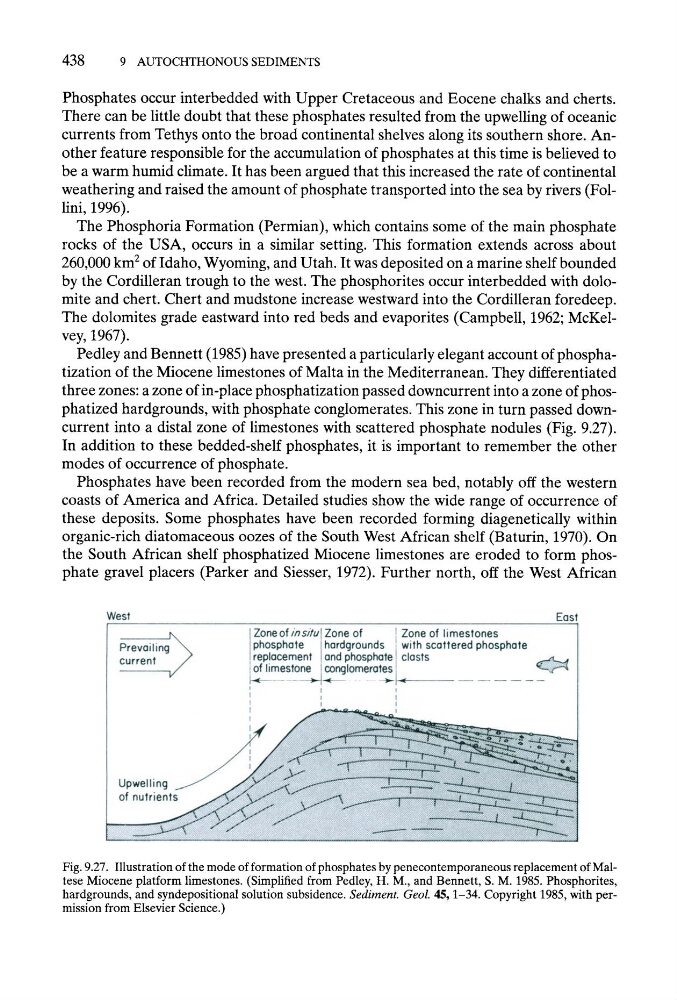
Pedley and Bennett (1985) have presented a particularly elegant account of phosphatization of the Miocene limestones of Malta in the Mediterranean. They differentiated
three zones: a zone of in-place phosphatization passed downcurrent into a zone of phosphatized hardgrounds, with phosphate conglomerates. This zone in turn passed downcurrent into a distal zone of limestones with scattered phosphate nodules (Fig. 9.27).
In addition to these bedded-shelf phosphates, it is important to remember the other
modes of occurrence of phosphate.
Phosphates have been recorded from the modern sea bed, notably off the western
coasts of America and Africa. Detailed studies show the wide range of occurrence of
these deposits. Some phosphates have been recorded forming diagenetically within
organic-rich diatomaceous oozes of the South West African shelf (Baturin, 1970). On
the South African shelf phosphatized Miocene limestones are eroded to form phosphate gravel placers (Parker and Siesser, 1972). Further north, off the West African
Fig. 9.27. Illustration of the mode of formation of phosphates by penecontemporaneous replacement of Maltese Miocene platform limestones. (Simplified from Pedley, H. M., and Bennett, S. M. 1985. Phosphorites,
hardgrounds, and syndepositional solution subsidence. Sediment. Geol. 45, 1-34. Copyright 1985, with permission from Elsevier Science.)
9 AUTOCHTHONOUS SEDIMENTS
Phosphates occur interbedded with Upper Cretaceous and Eocene chalks and cherts.
There can be little doubt that these phosphates resulted from the upwelling of oceanic
currents from Tethys onto the broad continental shelves along its southern shore. Another feature responsible for the accumulation of phosphates at this time is believed to
be a warm humid climate. It has been argued that this increased the rate of continental
weathering and raised the amount of phosphate transported into the sea by rivers (Follini, 1996).
The Phosphoria Formation (Permian), which contains some of the main phosphate
rocks of the USA, occurs in a similar setting. This formation extends across about
260,000 km 2 of Idaho, Wyoming, and Utah. It was deposited on a marine shelf bounded
by the Cordilleran trough to the west. The phosphorites occur interbedded with dolomite and chert. Chert and mudstone increase westward into the Cordilleran foredeep.
The dolomites grade eastward into red beds and evaporites (Campbell, 1962; McKelvey, 1967).
Pedley and Bennett (1985) have presented a particularly elegant account of phosphatization of the Miocene limestones of Malta in the Mediterranean. They differentiated
three zones: a zone of in-place phosphatization passed downcurrent into a zone of phosphatized hardgrounds, with phosphate conglomerates. This zone in turn passed downcurrent into a distal zone of limestones with scattered phosphate nodules (Fig. 9.27).
In addition to these bedded-shelf phosphates, it is important to remember the other
modes of occurrence of phosphate.
Phosphates have been recorded from the modern sea bed, notably off the western
coasts of America and Africa. Detailed studies show the wide range of occurrence of
these deposits. Some phosphates have been recorded forming diagenetically within
organic-rich diatomaceous oozes of the South West African shelf (Baturin, 1970). On
the South African shelf phosphatized Miocene limestones are eroded to form phosphate gravel placers (Parker and Siesser, 1972). Further north, off the West African
Fig. 9.27. Illustration of the mode of formation of phosphates by penecontemporaneous replacement of Maltese Miocene platform limestones. (Simplified from Pedley, H. M., and Bennett, S. M. 1985. Phosphorites,
hardgrounds, and syndepositional solution subsidence. Sediment. Geol. 45, 1-34. Copyright 1985, with permission from Elsevier Science.)