

9.2 CARBONATES
423
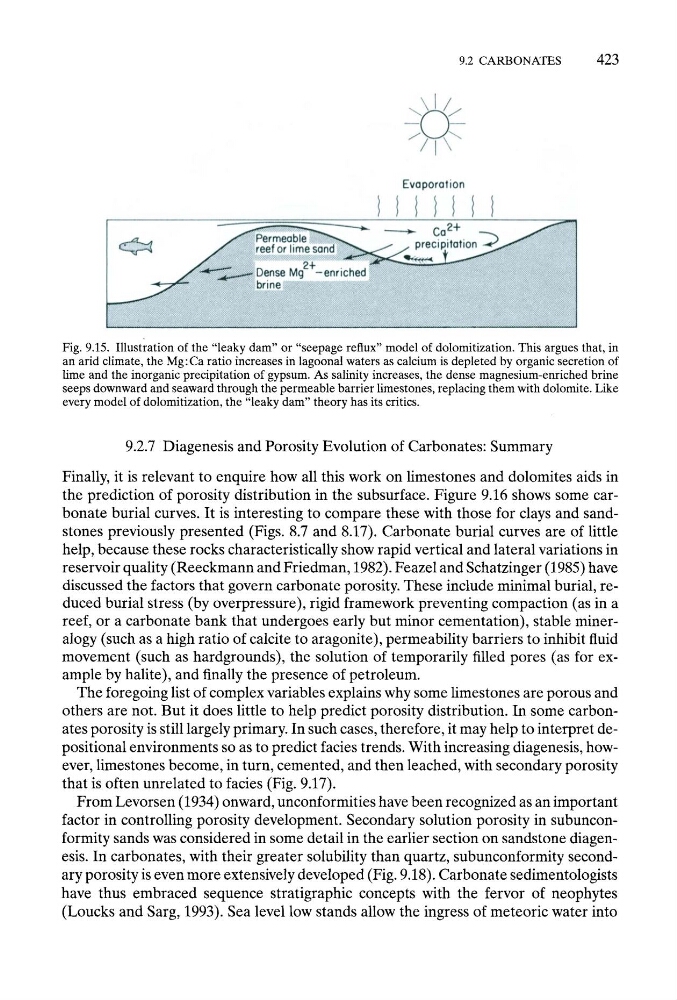
Fig. 9.15. Illustration of the "leaky dam" or "seepage reflux" model of dolomitization. This argues that, in
an arid climate, the Mg:Ca ratio increases in lagoonal waters as calcium is depleted by organic secretion of
lime and the inorganic precipitation of gypsum. As salinity increases, the dense magnesium-enriched brine
seeps downward and seaward through the permeable barrier limestones, replacing them with dolomite. Like
every model of dolomitization, the "leaky dam" theory has its critics.
9.2.7 Diagenesis and Porosity Evolution of Carbonates: Summary
Finally, it is relevant to enquire how all this work on limestones and dolomites aids in
the prediction of porosity distribution in the subsurface. Figure 9.16 shows some carbonate burial curves. It is interesting to compare these with those for clays and sandstones previously presented (Figs. 8.7 and 8.17). Carbonate burial curves are of little
help, because these rocks characteristically show rapid vertical and lateral variations in
reservoir quality (Reeckmann and Friedman, 1982). Feazel and Schatzinger (1985) have
discussed the factors that govern carbonate porosity. These include minimal burial, reduced burial stress (by overpressure), rigid framework preventing compaction (as in a
reef, or a carbonate bank that undergoes early but minor cementation), stable mineralogy (such as a high ratio of calcite to aragonite), permeability barriers to inhibit fluid
movement (such as hardgrounds), the solution of temporarily filled pores (as for example by halite), and finally the presence of petroleum.
The foregoing list of complex variables explains why some limestones are porous and
others are not. But it does little to help predict porosity distribution. In some carbonates porosity is still largely primary. In such cases, therefore, it may help to interpret depositional environments so as to predict facies trends. With increasing diagenesis, however, limestones become, in turn, cemented, and then leached, with secondary porosity
that is often unrelated to facies (Fig. 9.17).
From Levorsen (1934) onward, unconformities have been recognized as an important
factor in controlling porosity development. Secondary solution porosity in subunconformity sands was considered in some detail in the earlier section on sandstone diagenesis. In carbonates, with their greater solubility than quartz, subunconformity secondary porosity is even more extensively developed (Fig. 9.18). Carbonate sedimentologists
have thus embraced sequence stratigraphic concepts with the fervor of neophytes
(Loucks and Sarg, 1993). Sea level low stands allow the ingress of meteoric water into
423
Fig. 9.15. Illustration of the "leaky dam" or "seepage reflux" model of dolomitization. This argues that, in
an arid climate, the Mg:Ca ratio increases in lagoonal waters as calcium is depleted by organic secretion of
lime and the inorganic precipitation of gypsum. As salinity increases, the dense magnesium-enriched brine
seeps downward and seaward through the permeable barrier limestones, replacing them with dolomite. Like
every model of dolomitization, the "leaky dam" theory has its critics.
9.2.7 Diagenesis and Porosity Evolution of Carbonates: Summary
Finally, it is relevant to enquire how all this work on limestones and dolomites aids in
the prediction of porosity distribution in the subsurface. Figure 9.16 shows some carbonate burial curves. It is interesting to compare these with those for clays and sandstones previously presented (Figs. 8.7 and 8.17). Carbonate burial curves are of little
help, because these rocks characteristically show rapid vertical and lateral variations in
reservoir quality (Reeckmann and Friedman, 1982). Feazel and Schatzinger (1985) have
discussed the factors that govern carbonate porosity. These include minimal burial, reduced burial stress (by overpressure), rigid framework preventing compaction (as in a
reef, or a carbonate bank that undergoes early but minor cementation), stable mineralogy (such as a high ratio of calcite to aragonite), permeability barriers to inhibit fluid
movement (such as hardgrounds), the solution of temporarily filled pores (as for example by halite), and finally the presence of petroleum.
The foregoing list of complex variables explains why some limestones are porous and
others are not. But it does little to help predict porosity distribution. In some carbonates porosity is still largely primary. In such cases, therefore, it may help to interpret depositional environments so as to predict facies trends. With increasing diagenesis, however, limestones become, in turn, cemented, and then leached, with secondary porosity
that is often unrelated to facies (Fig. 9.17).
From Levorsen (1934) onward, unconformities have been recognized as an important
factor in controlling porosity development. Secondary solution porosity in subunconformity sands was considered in some detail in the earlier section on sandstone diagenesis. In carbonates, with their greater solubility than quartz, subunconformity secondary porosity is even more extensively developed (Fig. 9.18). Carbonate sedimentologists
have thus embraced sequence stratigraphic concepts with the fervor of neophytes
(Loucks and Sarg, 1993). Sea level low stands allow the ingress of meteoric water into