

9.2 CARBONATES
397
Table 9.2
Mineralogy of the Main Carbonate-Secreting Organisms a
Taxon
Aragonite
Calcite
Algae
Red
C
Green
A
Coccoliths
C
Foraminifera
Benthonic
(A)
C
Planktonic
C
Sponges
(A)
C
Coelenterates
Stromatoporoids
A
C?
Corals
Rugosa
C
Tabulata
C
Scleractinia
(A)
C
Alcyonaria
(A)
C
Bryozoa
(A)
C
Brachiopods
C
Mollusks
Lamellibranchs
A
C
Gastropods
A
C
Pteropods
A
Cephalopods (Ammonite opercula)
A
(C)
Belemnoids
C
Annelids
A
C
Arthropods
C
Echinoderms
C
aBrackets denote minor occurrence. Note that some groups secrete both aragonite
and calcite. High and low magnesian calcite varieties not distinguished. The original
composition of the stromatoporoids is questionable because they are now extinct.
Based on Scholle (1978), with some simplifications and embellishments.
kaline reducing conditions (Fig. 8.22). Table 9.3 summarizes the salient features of the
main carbonate minerals.
To conclude this brief summary of a large topic, the following points are important.
The principal carbonate minerals are the calcium carbonates, calcite and its unstable
polymorph aragonite; and dolomite, calcium magnesium carbonate. Modern carbonate
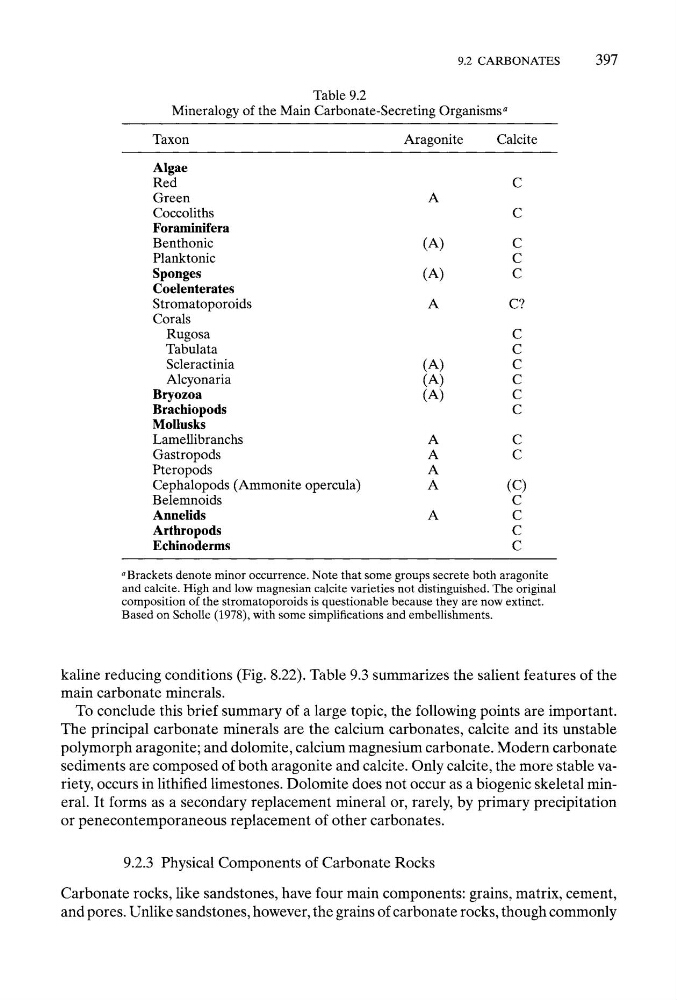
sediments are composed of both aragonite and calcite. Only calcite, the more stable variety, occurs in lithified limestones. Dolomite does not occur as a biogenic skeletal mineral. It forms as a secondary replacement mineral or, rarely, by primary precipitation
or penecontemporaneous replacement of other carbonates.
9.2.3 Physical Components of Carbonate Rocks
Carbonate rocks, like sandstones, have four main components: grains, matrix, cement,
and pores. Unlike sandstones, however, the grains of carbonate rocks, though commonly
397
Table 9.2
Mineralogy of the Main Carbonate-Secreting Organisms a
Taxon
Aragonite
Calcite
Algae
Red
C
Green
A
Coccoliths
C
Foraminifera
Benthonic
(A)
C
Planktonic
C
Sponges
(A)
C
Coelenterates
Stromatoporoids
A
C?
Corals
Rugosa
C
Tabulata
C
Scleractinia
(A)
C
Alcyonaria
(A)
C
Bryozoa
(A)
C
Brachiopods
C
Mollusks
Lamellibranchs
A
C
Gastropods
A
C
Pteropods
A
Cephalopods (Ammonite opercula)
A
(C)
Belemnoids
C
Annelids
A
C
Arthropods
C
Echinoderms
C
aBrackets denote minor occurrence. Note that some groups secrete both aragonite
and calcite. High and low magnesian calcite varieties not distinguished. The original
composition of the stromatoporoids is questionable because they are now extinct.
Based on Scholle (1978), with some simplifications and embellishments.
kaline reducing conditions (Fig. 8.22). Table 9.3 summarizes the salient features of the
main carbonate minerals.
To conclude this brief summary of a large topic, the following points are important.
The principal carbonate minerals are the calcium carbonates, calcite and its unstable
polymorph aragonite; and dolomite, calcium magnesium carbonate. Modern carbonate
sediments are composed of both aragonite and calcite. Only calcite, the more stable variety, occurs in lithified limestones. Dolomite does not occur as a biogenic skeletal mineral. It forms as a secondary replacement mineral or, rarely, by primary precipitation
or penecontemporaneous replacement of other carbonates.
9.2.3 Physical Components of Carbonate Rocks
Carbonate rocks, like sandstones, have four main components: grains, matrix, cement,
and pores. Unlike sandstones, however, the grains of carbonate rocks, though commonly