

9.2 CARBONATES
395
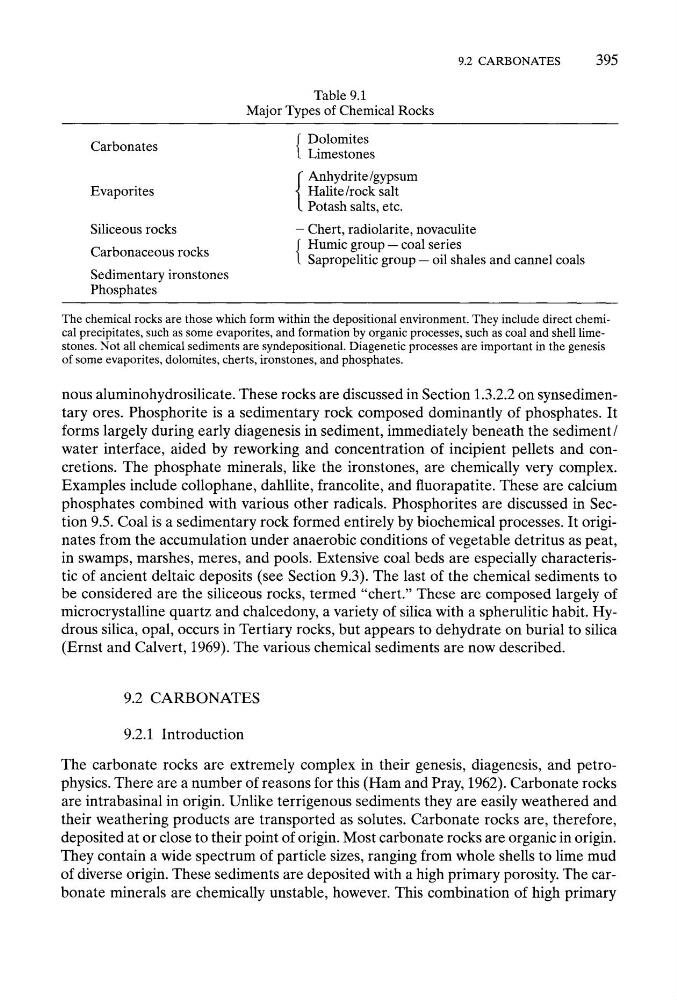
Table 9.1
Major Types of Chemical Rocks
Carbonates
Evaporites
Siliceous rocks
Carbonaceous rocks
Sedimentary ironstones
Phosphates
Dolomites
Limestones
Anhydrite/gypsum
Halite/rock salt
Potash salts, etc.
-
Chert, radiolarite, novaculite
Humic group -- coal series
Sapropelitic group- oil shales and cannel coals
The chemical rocks are those which form within the depositional environment. They include direct chemical precipitates, such as some evaporites, and formation by organic processes, such as coal and shell limestones. Not all chemical sediments are syndepositional. Diagenetic processes are important in the genesis
of some evaporites, dolomites, cherts, ironstones, and phosphates.
nous aluminohydrosilicate. These rocks are discussed in Section 1.3.2.2 on synsedimentary ores. Phosphorite is a sedimentary rock composed dominantly of phosphates. It
forms largely during early diagenesis in sediment, immediately beneath the sediment/
water interface, aided by reworking and concentration of incipient pellets and concretions. The phosphate minerals, like the ironstones, are chemically very complex.
Examples include collophane, dahllite, francolite, and fluorapatite. These are calcium
phosphates combined with various other radicals. Phosphorites are discussed in Section 9.5. Coal is a sedimentary rock formed entirely by biochemical processes. It originates from the accumulation under anaerobic conditions of vegetable detritus as peat,
in swamps, marshes, meres, and pools. Extensive coal beds are especially characteristic of ancient deltaic deposits (see Section 9.3). The last of the chemical sediments to
be considered are the siliceous rocks, termed "chert." These are composed largely of
microcrystalline quartz and chalcedony, a variety of silica with a spherulitic habit. Hydrous silica, opal, occurs in Tertiary rocks, but appears to dehydrate on burial to silica
(Ernst and Calvert, 1969). The various chemical sediments are now described.
9.2 CARBONATES
9.2.1 Introduction
The carbonate rocks are extremely complex in their genesis, diagenesis, and petrophysics. There are a number of reasons for this (Ham and Pray, 1962). Carbonate rocks
are intrabasinal in origin. Unlike terrigenous sediments they are easily weathered and
their weathering products are transported as solutes. Carbonate rocks are, therefore,
deposited at or close to their point of origin. Most carbonate rocks are organic in origin.
They contain a wide spectrum of particle sizes, ranging from whole shells to lime mud
of diverse origin. These sediments are deposited with a high primary porosity. The carbonate minerals are chemically unstable, however. This combination of high primary
395
Table 9.1
Major Types of Chemical Rocks
Carbonates
Evaporites
Siliceous rocks
Carbonaceous rocks
Sedimentary ironstones
Phosphates
Dolomites
Limestones
Anhydrite/gypsum
Halite/rock salt
Potash salts, etc.
-
Chert, radiolarite, novaculite
Humic group -- coal series
Sapropelitic group- oil shales and cannel coals
The chemical rocks are those which form within the depositional environment. They include direct chemical precipitates, such as some evaporites, and formation by organic processes, such as coal and shell limestones. Not all chemical sediments are syndepositional. Diagenetic processes are important in the genesis
of some evaporites, dolomites, cherts, ironstones, and phosphates.
nous aluminohydrosilicate. These rocks are discussed in Section 1.3.2.2 on synsedimentary ores. Phosphorite is a sedimentary rock composed dominantly of phosphates. It
forms largely during early diagenesis in sediment, immediately beneath the sediment/
water interface, aided by reworking and concentration of incipient pellets and concretions. The phosphate minerals, like the ironstones, are chemically very complex.
Examples include collophane, dahllite, francolite, and fluorapatite. These are calcium
phosphates combined with various other radicals. Phosphorites are discussed in Section 9.5. Coal is a sedimentary rock formed entirely by biochemical processes. It originates from the accumulation under anaerobic conditions of vegetable detritus as peat,
in swamps, marshes, meres, and pools. Extensive coal beds are especially characteristic of ancient deltaic deposits (see Section 9.3). The last of the chemical sediments to
be considered are the siliceous rocks, termed "chert." These are composed largely of
microcrystalline quartz and chalcedony, a variety of silica with a spherulitic habit. Hydrous silica, opal, occurs in Tertiary rocks, but appears to dehydrate on burial to silica
(Ernst and Calvert, 1969). The various chemical sediments are now described.
9.2 CARBONATES
9.2.1 Introduction
The carbonate rocks are extremely complex in their genesis, diagenesis, and petrophysics. There are a number of reasons for this (Ham and Pray, 1962). Carbonate rocks
are intrabasinal in origin. Unlike terrigenous sediments they are easily weathered and
their weathering products are transported as solutes. Carbonate rocks are, therefore,
deposited at or close to their point of origin. Most carbonate rocks are organic in origin.
They contain a wide spectrum of particle sizes, ranging from whole shells to lime mud
of diverse origin. These sediments are deposited with a high primary porosity. The carbonate minerals are chemically unstable, however. This combination of high primary