

8.6 RUDACEOUS ROCKS
385
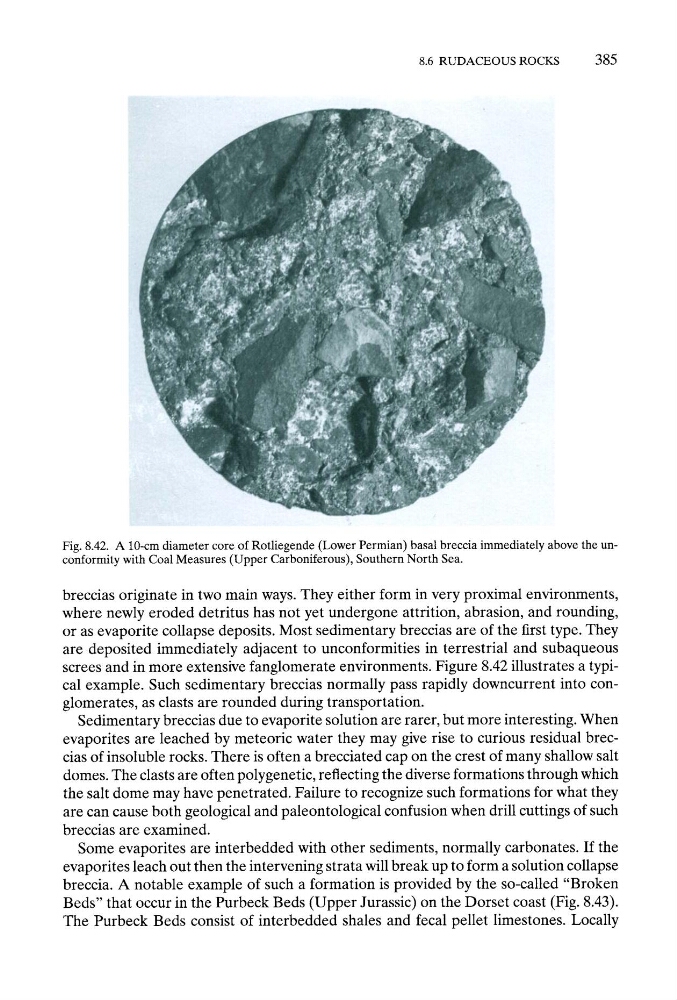
Fig. 8.42. A 10-cm diameter core of Rotliegende (Lower Permian) basal breccia immediately above the unconformity with Coal Measures (Upper Carboniferous), Southern North Sea.
breccias originate in two main ways. They either form in very proximal environments,
where newly eroded detritus has not yet undergone attrition, abrasion, and rounding,
or as evaporite collapse deposits. Most sedimentary breccias are of the first type. They
are deposited immediately adjacent to unconformities in terrestrial and subaqueous
screes and in more extensive fanglomerate environments. Figure 8.42 illustrates a typical example. Such sedimentary breccias normally pass rapidly downcurrent into conglomerates, as clasts are rounded during transportation.
Sedimentary breccias due to evaporite solution are rarer, but more interesting. When
evaporites are leached by meteoric water they may give rise to curious residual breccias of insoluble rocks. There is often a brecciated cap on the crest of many shallow salt
domes. The clasts are often polygenetic, reflecting the diverse formations through which
the salt dome may have penetrated. Failure to recognize such formations for what they
are can cause both geological and paleontological confusion when drill cuttings of such
breccias are examined.
Some evaporites are interbedded with other sediments, normally carbonates. If the
evaporites leach out then the intervening strata will break up to form a solution collapse
breccia. A notable example of such a formation is provided by the so-called "Broken
Beds" that occur in the Purbeck Beds (Upper Jurassic) on the Dorset coast (Fig. 8.43).
The Purbeck Beds consist of interbedded shales and fecal pellet limestones. Locally
385
Fig. 8.42. A 10-cm diameter core of Rotliegende (Lower Permian) basal breccia immediately above the unconformity with Coal Measures (Upper Carboniferous), Southern North Sea.
breccias originate in two main ways. They either form in very proximal environments,
where newly eroded detritus has not yet undergone attrition, abrasion, and rounding,
or as evaporite collapse deposits. Most sedimentary breccias are of the first type. They
are deposited immediately adjacent to unconformities in terrestrial and subaqueous
screes and in more extensive fanglomerate environments. Figure 8.42 illustrates a typical example. Such sedimentary breccias normally pass rapidly downcurrent into conglomerates, as clasts are rounded during transportation.
Sedimentary breccias due to evaporite solution are rarer, but more interesting. When
evaporites are leached by meteoric water they may give rise to curious residual breccias of insoluble rocks. There is often a brecciated cap on the crest of many shallow salt
domes. The clasts are often polygenetic, reflecting the diverse formations through which
the salt dome may have penetrated. Failure to recognize such formations for what they
are can cause both geological and paleontological confusion when drill cuttings of such
breccias are examined.
Some evaporites are interbedded with other sediments, normally carbonates. If the
evaporites leach out then the intervening strata will break up to form a solution collapse
breccia. A notable example of such a formation is provided by the so-called "Broken
Beds" that occur in the Purbeck Beds (Upper Jurassic) on the Dorset coast (Fig. 8.43).
The Purbeck Beds consist of interbedded shales and fecal pellet limestones. Locally