

8.6 RUDACEOUS ROCKS
381
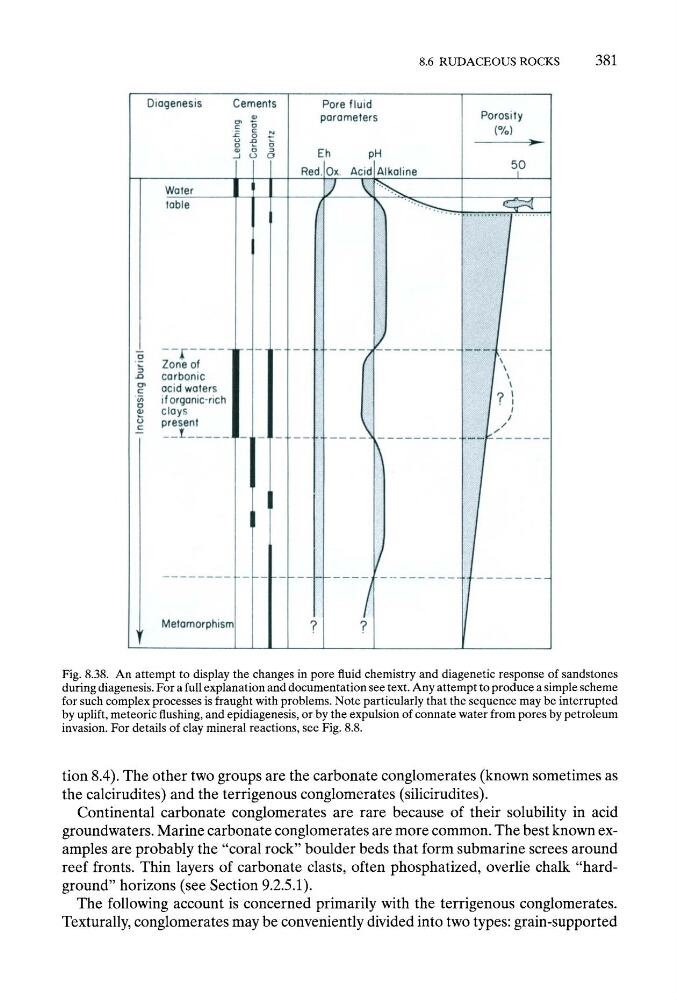
Fig. 8.38. An attempt to display the changes in pore fluid chemistry and diagenetic response of sandstones
during diagenesis. For a full explanation and documentation see text. Any attempt to produce a simple scheme
for such complex processes is fraught with problems. Note particularly that the sequence may be interrupted
by uplift, meteoric flushing, and epidiagenesis, or by the expulsion of connate water from pores by petroleum
invasion. For details of clay mineral reactions, see Fig. 8.8.
tion 8.4). The other two groups are the carbonate conglomerates (known sometimes as
the calcirudites) and the terrigenous conglomerates (silicirudites).
Continental carbonate conglomerates are rare because of their solubility in acid
groundwaters. Marine carbonate conglomerates are more common. The best known examples are probably the "coral rock" boulder beds that form submarine screes around
reef fronts. Thin layers of carbonate clasts, often phosphatized, overlie chalk "hardground" horizons (see Section 9.2.5.1).
The following account is concerned primarily with the terrigenous conglomerates.
Texturally, conglomerates may be conveniently divided into two types: grain-supported
381
Fig. 8.38. An attempt to display the changes in pore fluid chemistry and diagenetic response of sandstones
during diagenesis. For a full explanation and documentation see text. Any attempt to produce a simple scheme
for such complex processes is fraught with problems. Note particularly that the sequence may be interrupted
by uplift, meteoric flushing, and epidiagenesis, or by the expulsion of connate water from pores by petroleum
invasion. For details of clay mineral reactions, see Fig. 8.8.
tion 8.4). The other two groups are the carbonate conglomerates (known sometimes as
the calcirudites) and the terrigenous conglomerates (silicirudites).
Continental carbonate conglomerates are rare because of their solubility in acid
groundwaters. Marine carbonate conglomerates are more common. The best known examples are probably the "coral rock" boulder beds that form submarine screes around
reef fronts. Thin layers of carbonate clasts, often phosphatized, overlie chalk "hardground" horizons (see Section 9.2.5.1).
The following account is concerned primarily with the terrigenous conglomerates.
Texturally, conglomerates may be conveniently divided into two types: grain-supported