

28
2 WEATHERING AND THE SEDIMENTARY CYCLE
curious range of minerals that result from the evaporation of camel urine. Analogous
rhizoconcretions due to dinosaur micturation are avidly sought. Duricrusts are of several chemical types. The most common are the "kankars" and "caliches" composed of
calcite and dolomite; these are sometimes termed ealeretes (Chapman, 1974; Semeniuk,
1986; Wright and Tucker, 1990). Less common are the siliceous duricrusts, termed
silerete, generally composed of chalcedony (Milnes and Thiry, 1992). Ferruginous duffcrusts are termed ferrierete. In low-lying waterlogged areas in arid climates the duricrust is formed of evaporite minerals. These occur in salt marshes (sabkhas, see Section 6.3.2.7.4) both inland and at the seaside. Humid tropical climates form soils that
are very rich in iron and kaolinite. The composition and origin of |aterite, as these ferruginous soils are called, are described in more detail shortly in Section 2.33 on chemical weathering.
This review of modern soils, though brief, should be sufficient to show how significant
climate is in weathering and how it therefore helps to determine which type of sediment
is produced in a particular area.
2.3.1.2 Fossil Soils
Ancient soil horizons occur throughout the geological record (Thiry and SimonCoincon, 1999). Paleosols, as they are termed, often define sequence boundaries and
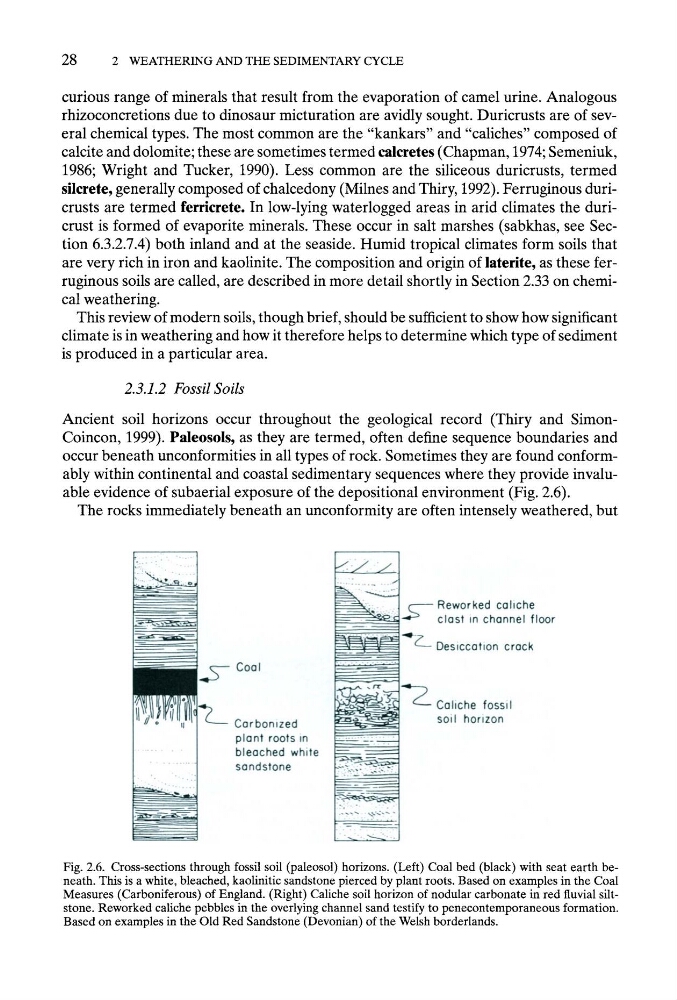
occur beneath unconformities in all types of rock. Sometimes they are found conformably within continental and coastal sedimentary sequences where they provide invaluable evidence of subaerial exposure of the depositional environment (Fig. 2.6).
The rocks immediately beneath an unconformity are often intensely weathered, but
Fig. 2.6. Cross-sections through fossil soil (paleosol) horizons. (Left) Coal bed (black) with seat earth beneath. This is a white, bleached, kaolinitic sandstone pierced by plant roots. Based on examples in the Coal
Measures (Carboniferous) of England. (Right) Caliche soil horizon of nodular carbonate in red fluvial siltstone. Reworked caliche pebbles in the overlying channel sand testify to penecontemporaneous formation.
Based on examples in the Old Red Sandstone (Devonian) of the Welsh borderlands.
2 WEATHERING AND THE SEDIMENTARY CYCLE
curious range of minerals that result from the evaporation of camel urine. Analogous
rhizoconcretions due to dinosaur micturation are avidly sought. Duricrusts are of several chemical types. The most common are the "kankars" and "caliches" composed of
calcite and dolomite; these are sometimes termed ealeretes (Chapman, 1974; Semeniuk,
1986; Wright and Tucker, 1990). Less common are the siliceous duricrusts, termed
silerete, generally composed of chalcedony (Milnes and Thiry, 1992). Ferruginous duffcrusts are termed ferrierete. In low-lying waterlogged areas in arid climates the duricrust is formed of evaporite minerals. These occur in salt marshes (sabkhas, see Section 6.3.2.7.4) both inland and at the seaside. Humid tropical climates form soils that
are very rich in iron and kaolinite. The composition and origin of |aterite, as these ferruginous soils are called, are described in more detail shortly in Section 2.33 on chemical weathering.
This review of modern soils, though brief, should be sufficient to show how significant
climate is in weathering and how it therefore helps to determine which type of sediment
is produced in a particular area.
2.3.1.2 Fossil Soils
Ancient soil horizons occur throughout the geological record (Thiry and SimonCoincon, 1999). Paleosols, as they are termed, often define sequence boundaries and
occur beneath unconformities in all types of rock. Sometimes they are found conformably within continental and coastal sedimentary sequences where they provide invaluable evidence of subaerial exposure of the depositional environment (Fig. 2.6).
The rocks immediately beneath an unconformity are often intensely weathered, but
Fig. 2.6. Cross-sections through fossil soil (paleosol) horizons. (Left) Coal bed (black) with seat earth beneath. This is a white, bleached, kaolinitic sandstone pierced by plant roots. Based on examples in the Coal
Measures (Carboniferous) of England. (Right) Caliche soil horizon of nodular carbonate in red fluvial siltstone. Reworked caliche pebbles in the overlying channel sand testify to penecontemporaneous formation.
Based on examples in the Old Red Sandstone (Devonian) of the Welsh borderlands.