

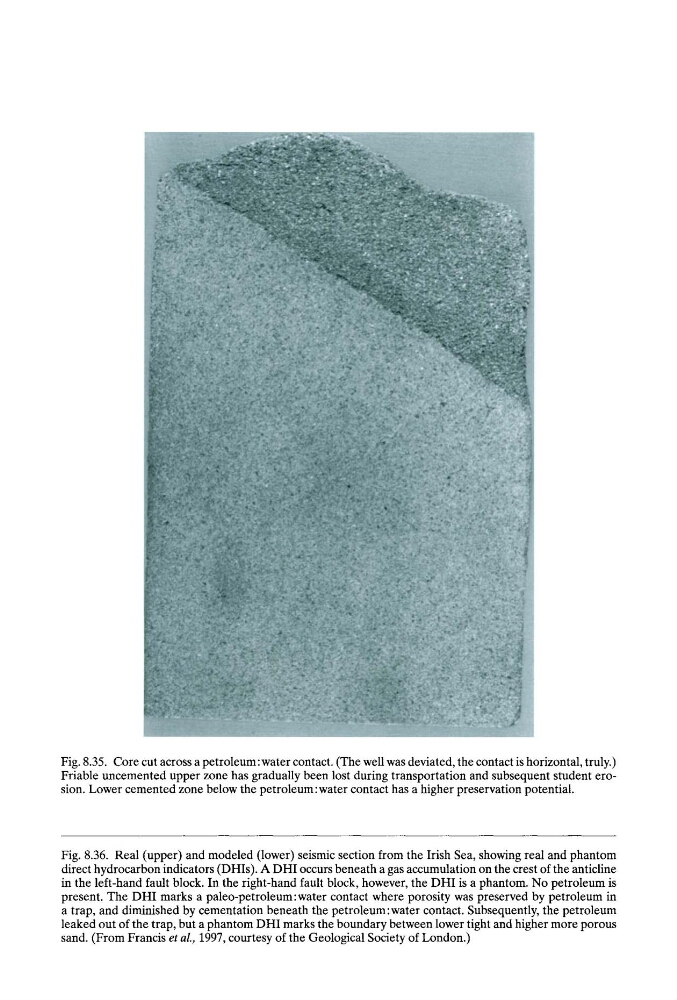
Fig. 8.35. Core cut across a petroleum:water contact. (The well was deviated, the contact is horizontal, truly.)
Friable uncemented upper zone has gradually been lost during transportation and subsequent student erosion. Lower cemented zone below the petroleum:water contact has a higher preservation potential.
Fig. 8.36. Real (upper) and modeled (lower) seismic section from the Irish Sea, showing real and phantom
direct hydrocarbon indicators (DHIs). A DHI occurs beneath a gas accumulation on the crest of the anticline
in the left-hand fault block. In the right-hand fault block, however, the DHI is a phantom. No petroleum is
present. The DHI marks a paleo-petroleum:water contact where porosity was preserved by petroleum in
a trap, and diminished by cementation beneath the petroleum:water contact. Subsequently, the petroleum
leaked out of the trap, but a phantom DHI marks the boundary between lower tight and higher more porous
sand. (From Francis et al., 1997, courtesy of the Geological Society of London.)
Friable uncemented upper zone has gradually been lost during transportation and subsequent student erosion. Lower cemented zone below the petroleum:water contact has a higher preservation potential.
Fig. 8.36. Real (upper) and modeled (lower) seismic section from the Irish Sea, showing real and phantom
direct hydrocarbon indicators (DHIs). A DHI occurs beneath a gas accumulation on the crest of the anticline
in the left-hand fault block. In the right-hand fault block, however, the DHI is a phantom. No petroleum is
present. The DHI marks a paleo-petroleum:water contact where porosity was preserved by petroleum in
a trap, and diminished by cementation beneath the petroleum:water contact. Subsequently, the petroleum
leaked out of the trap, but a phantom DHI marks the boundary between lower tight and higher more porous
sand. (From Francis et al., 1997, courtesy of the Geological Society of London.)