

358
8 ALLOCHTHONOUS SEDIMENTS
0
10
I
I
Porosity (%)
20
30
!
I
40
5O
I
E
'-3
t~
6L
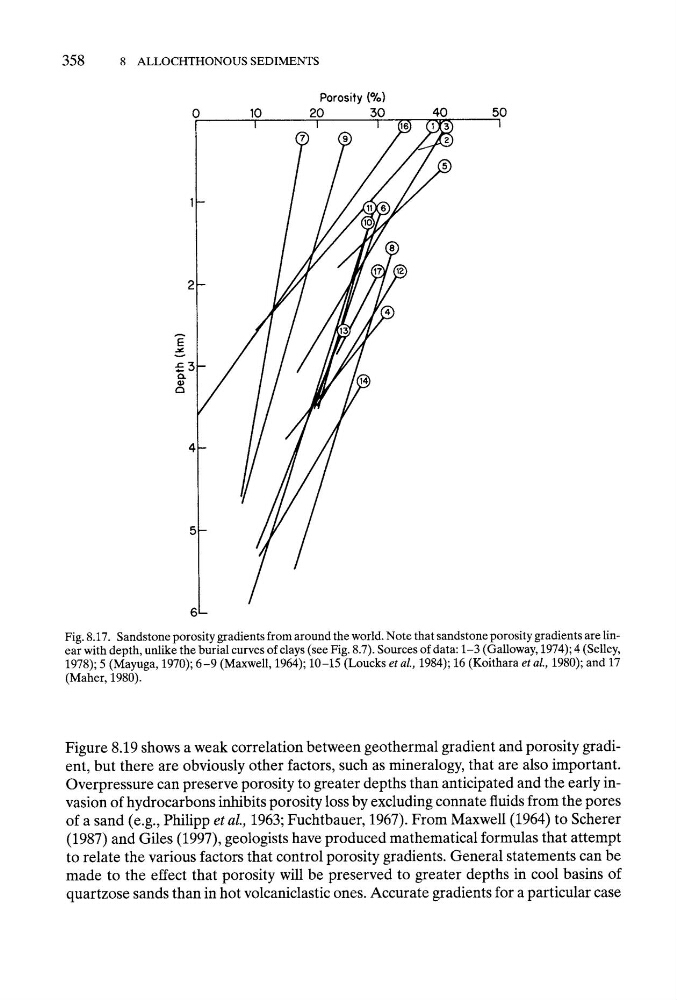
Fig. 8.17. Sandstone porosity gradients from around the world. Note that sandstone porosity gradients are linear with depth, unlike the burial curves of clays (see Fig. 8.7). Sources of data: 1-3 (Galloway, 1974); 4 (Selley,
1978); 5 (Mayuga, 1970); 6-9 (Maxwell, 1964); 10-15 (Loucks et al., 1984); 16 (Koithara et al., 1980); and 17
(Maher, 1980).
Figure 8.19 shows a weak correlation between geothermal gradient and porosity gradient, but there are obviously other factors, such as mineralogy, that are also important.
Overpressure can preserve porosity to greater depths than anticipated and the early invasion of hydrocarbons inhibits porosity loss by excluding connate fluids from the pores
of a sand (e.g., Philipp et aL, 1963; Fuchtbauer, 1967). From Maxwell (1964) to Scherer
(1987) and Giles (1997), geologists have produced mathematical formulas that attempt
to relate the various factors that control porosity gradients. General statements can be
made to the effect that porosity will be preserved to greater depths in cool basins of
quartzose sands than in hot volcaniclastic ones. Accurate gradients for a particular case
8 ALLOCHTHONOUS SEDIMENTS
0
10
I
I
Porosity (%)
20
30
!
I
40
5O
I
E
'-3
t~
6L
Fig. 8.17. Sandstone porosity gradients from around the world. Note that sandstone porosity gradients are linear with depth, unlike the burial curves of clays (see Fig. 8.7). Sources of data: 1-3 (Galloway, 1974); 4 (Selley,
1978); 5 (Mayuga, 1970); 6-9 (Maxwell, 1964); 10-15 (Loucks et al., 1984); 16 (Koithara et al., 1980); and 17
(Maher, 1980).
Figure 8.19 shows a weak correlation between geothermal gradient and porosity gradient, but there are obviously other factors, such as mineralogy, that are also important.
Overpressure can preserve porosity to greater depths than anticipated and the early invasion of hydrocarbons inhibits porosity loss by excluding connate fluids from the pores
of a sand (e.g., Philipp et aL, 1963; Fuchtbauer, 1967). From Maxwell (1964) to Scherer
(1987) and Giles (1997), geologists have produced mathematical formulas that attempt
to relate the various factors that control porosity gradients. General statements can be
made to the effect that porosity will be preserved to greater depths in cool basins of
quartzose sands than in hot volcaniclastic ones. Accurate gradients for a particular case