

332
8 ALLOCHTHONOUS SEDIMENTS
Groin size
Clay
T
Sand
1
t
Gravel
Composition
CLAY MINERALS
VOLCANIC
TERRIGENOUS
DETRITUS
DETRITUS
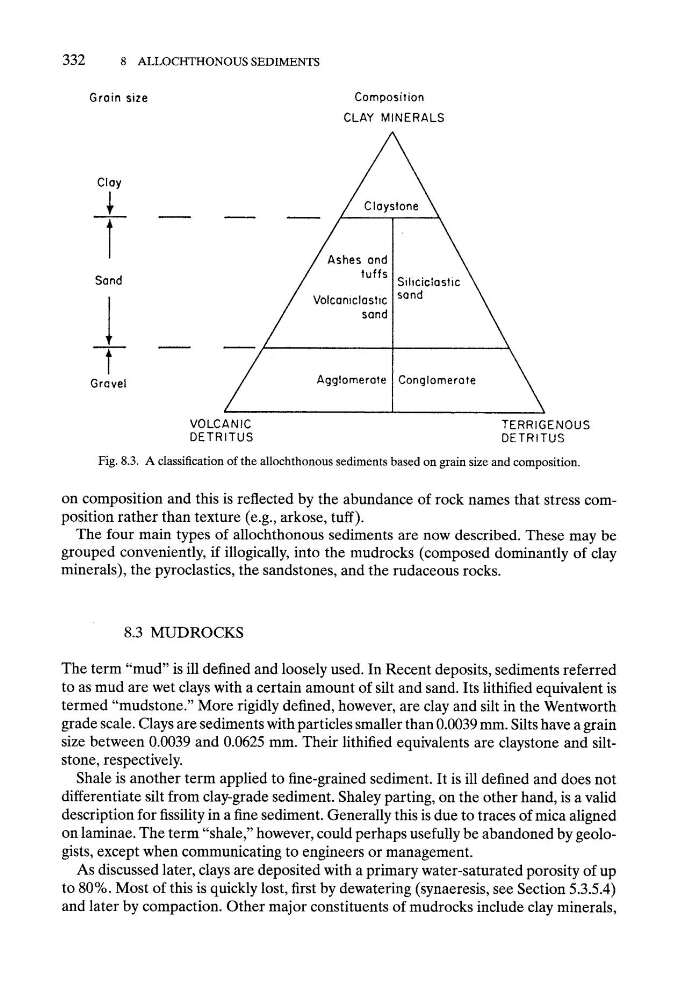
Fig. 8.3. A classification of the al]ochthonous sediments based on grain size and composition.
on composition and this is reflected by the abundance of rock names that stress composition rather than texture (e.g., arkose, tuff).
The four main types of allochthonous sediments are now described. These may be
grouped conveniently, if illogically, into the mudrocks (composed dominantly of clay
minerals), the pyroclastics, the sandstones, and the rudaceous rocks.
8.3 MUDROCKS
The term "mud" is ill defined and loosely used. In Recent deposits, sediments referred
to as mud are wet clays with a certain amount of silt and sand. Its lithified equivalent is
termed "mudstone." More rigidly defined, however, are clay and silt in the Wentworth
grade scale. Clays are sediments with particles smaller than 0.0039 mm. Silts have a grain
size between 0.0039 and 0.0625 mm. Their lithified equivalents are claystone and siltstone, respectively.
Shale is another term applied to fine-grained sediment. It is ill defined and does not
differentiate silt from clay-grade sediment. Shaley parting, on the other hand, is a valid
description for fissility in a fine sediment. Generally this is due to traces of mica aligned
on laminae. The term "shale," however, could perhaps usefully be abandoned by geologists, except when communicating to engineers or management.
As discussed later, clays are deposited with a primary water-saturated porosity of up
to 80%. Most of this is quickly lost, first by dewatering (synaeresis, see Section 5.3.5.4)
and later by compaction. Other major constituents of mudrocks include clay minerals,
8 ALLOCHTHONOUS SEDIMENTS
Groin size
Clay
T
Sand
1
t
Gravel
Composition
CLAY MINERALS
VOLCANIC
TERRIGENOUS
DETRITUS
DETRITUS
Fig. 8.3. A classification of the al]ochthonous sediments based on grain size and composition.
on composition and this is reflected by the abundance of rock names that stress composition rather than texture (e.g., arkose, tuff).
The four main types of allochthonous sediments are now described. These may be
grouped conveniently, if illogically, into the mudrocks (composed dominantly of clay
minerals), the pyroclastics, the sandstones, and the rudaceous rocks.
8.3 MUDROCKS
The term "mud" is ill defined and loosely used. In Recent deposits, sediments referred
to as mud are wet clays with a certain amount of silt and sand. Its lithified equivalent is
termed "mudstone." More rigidly defined, however, are clay and silt in the Wentworth
grade scale. Clays are sediments with particles smaller than 0.0039 mm. Silts have a grain
size between 0.0039 and 0.0625 mm. Their lithified equivalents are claystone and siltstone, respectively.
Shale is another term applied to fine-grained sediment. It is ill defined and does not
differentiate silt from clay-grade sediment. Shaley parting, on the other hand, is a valid
description for fissility in a fine sediment. Generally this is due to traces of mica aligned
on laminae. The term "shale," however, could perhaps usefully be abandoned by geologists, except when communicating to engineers or management.
As discussed later, clays are deposited with a primary water-saturated porosity of up
to 80%. Most of this is quickly lost, first by dewatering (synaeresis, see Section 5.3.5.4)
and later by compaction. Other major constituents of mudrocks include clay minerals,