

330
8 ALLOCHTHONOUS SEDIMENTS
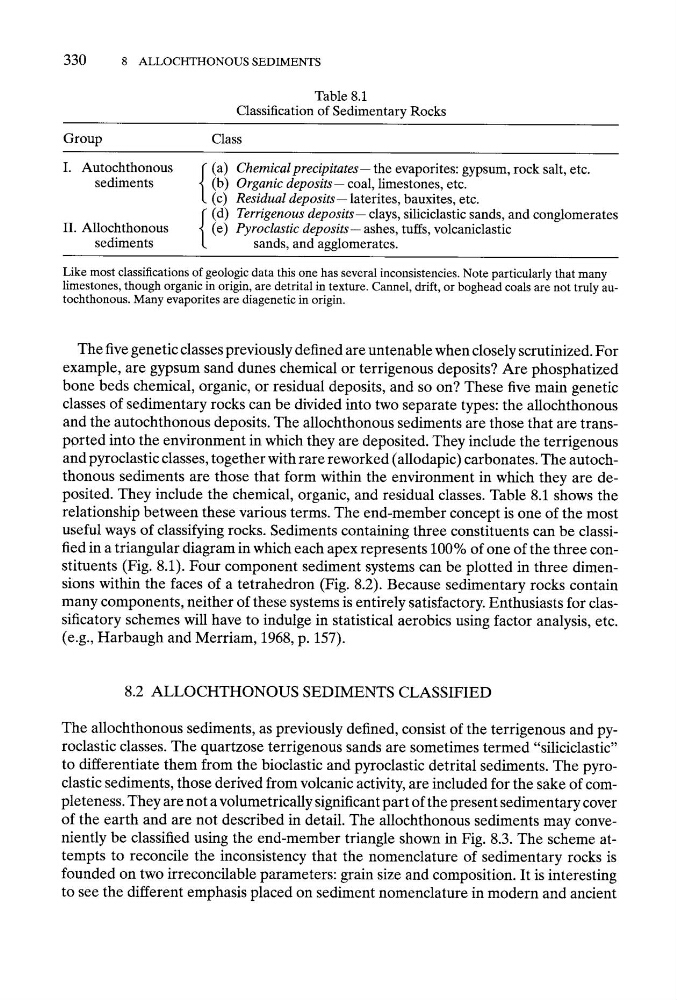
Table 8.1
Classification of Sedimentary Rocks
Group
Class
I. Autochthonous
sediments
II. Allochthonous
sediments
(a) Chemicalprecipitates-- the evaporites: gypsum, rock salt, etc.
(b) Organic deposits--coal, limestones, etc.
(c) Residual deposits--laterites, bauxites, etc.
(d) Terrigenous deposits-- clays, siliciclastic sands, and conglomerates
(e) Pyroclastic deposits-- ashes, tufts, volcaniclastic
sands, and agglomerates.
Like most classifications of geologic data this one has several inconsistencies. Note particularly that many
limestones, though organic in origin, are detrital in texture. Cannel, drift, or boghead coals are not truly autochthonous. Many evaporites are diagenetic in origin.
The five genetic classes previously defined are untenable when closely scrutinized. For
example, are gypsum sand dunes chemical or terrigenous deposits? Are phosphatized
bone beds chemical, organic, or residual deposits, and so on? These five main genetic
classes of sedimentary rocks can be divided into two separate types: the allochthonous
and the autochthonous deposits. The allochthonous sediments are those that are transported into the environment in which they are deposited. They include the terrigenous
and pyroclastic classes, together with rare reworked (allodapic) carbonates. The autochthonous sediments are those that form within the environment in which they are deposited. They include the chemical, organic, and residual classes. Table 8.1 shows the
relationship between these various terms. The end-member concept is one of the most
useful ways of classifying rocks. Sediments containing three constituents can be classified in a triangular diagram in which each apex represents 100% of one of the three constituents (Fig. 8.1). Four component sediment systems can be plotted in three dimensions within the faces of a tetrahedron (Fig. 8.2). Because sedimentary rocks contain
many components, neither of these systems is entirely satisfactory. Enthusiasts for classificatory schemes will have to indulge in statistical aerobics using factor analysis, etc.
(e.g., Harbaugh and Merriam, 1968, p. 157).
8.2 ALLOCHTHONOUS SEDIMENTS CLASSIFIED
The allochthonous sediments, as previously defined, consist of the terrigenous and pyroclastic classes. The quartzose terrigenous sands are sometimes termed "siliciclastic"
to differentiate them from the bioclastic and pyroclastic detrital sediments. The pyroclastic sediments, those derived from volcanic activity, are included for the sake of completeness. They are not a volumetrically significant part of the present sedimentary cover
of the earth and are not described in detail. The allochthonous sediments may conveniently be classified using the end-member triangle shown in Fig. 8.3. The scheme attempts to reconcile the inconsistency that the nomenclature of sedimentary rocks is
founded on two irreconcilable parameters: grain size and composition. It is interesting
to see the different emphasis placed on sediment nomenclature in modern and ancient
8 ALLOCHTHONOUS SEDIMENTS
Table 8.1
Classification of Sedimentary Rocks
Group
Class
I. Autochthonous
sediments
II. Allochthonous
sediments
(a) Chemicalprecipitates-- the evaporites: gypsum, rock salt, etc.
(b) Organic deposits--coal, limestones, etc.
(c) Residual deposits--laterites, bauxites, etc.
(d) Terrigenous deposits-- clays, siliciclastic sands, and conglomerates
(e) Pyroclastic deposits-- ashes, tufts, volcaniclastic
sands, and agglomerates.
Like most classifications of geologic data this one has several inconsistencies. Note particularly that many
limestones, though organic in origin, are detrital in texture. Cannel, drift, or boghead coals are not truly autochthonous. Many evaporites are diagenetic in origin.
The five genetic classes previously defined are untenable when closely scrutinized. For
example, are gypsum sand dunes chemical or terrigenous deposits? Are phosphatized
bone beds chemical, organic, or residual deposits, and so on? These five main genetic
classes of sedimentary rocks can be divided into two separate types: the allochthonous
and the autochthonous deposits. The allochthonous sediments are those that are transported into the environment in which they are deposited. They include the terrigenous
and pyroclastic classes, together with rare reworked (allodapic) carbonates. The autochthonous sediments are those that form within the environment in which they are deposited. They include the chemical, organic, and residual classes. Table 8.1 shows the
relationship between these various terms. The end-member concept is one of the most
useful ways of classifying rocks. Sediments containing three constituents can be classified in a triangular diagram in which each apex represents 100% of one of the three constituents (Fig. 8.1). Four component sediment systems can be plotted in three dimensions within the faces of a tetrahedron (Fig. 8.2). Because sedimentary rocks contain
many components, neither of these systems is entirely satisfactory. Enthusiasts for classificatory schemes will have to indulge in statistical aerobics using factor analysis, etc.
(e.g., Harbaugh and Merriam, 1968, p. 157).
8.2 ALLOCHTHONOUS SEDIMENTS CLASSIFIED
The allochthonous sediments, as previously defined, consist of the terrigenous and pyroclastic classes. The quartzose terrigenous sands are sometimes termed "siliciclastic"
to differentiate them from the bioclastic and pyroclastic detrital sediments. The pyroclastic sediments, those derived from volcanic activity, are included for the sake of completeness. They are not a volumetrically significant part of the present sedimentary cover
of the earth and are not described in detail. The allochthonous sediments may conveniently be classified using the end-member triangle shown in Fig. 8.3. The scheme attempts to reconcile the inconsistency that the nomenclature of sedimentary rocks is
founded on two irreconcilable parameters: grain size and composition. It is interesting
to see the different emphasis placed on sediment nomenclature in modern and ancient