

6.3 SEDIMENTARY MODELS
263
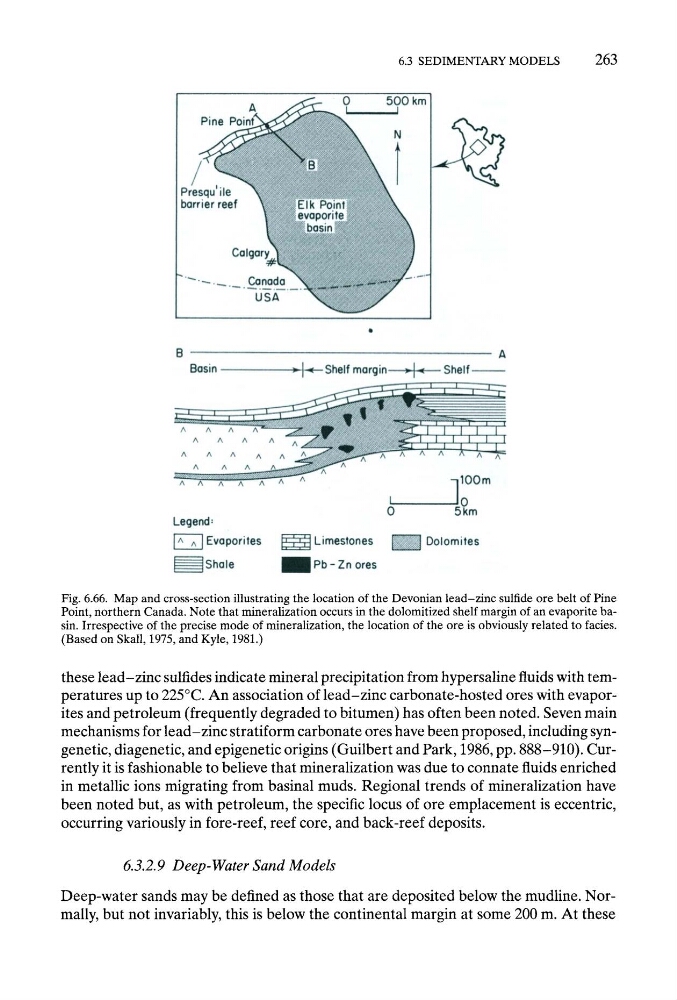
Fig. 6.66. Map and cross-section illustrating the location of the Devonian lead-zinc sulfide ore belt of Pine
Point, northern Canada. Note that mineralization occurs in the dolomitized shelf margin of an evaporite basin. Irrespective of the precise mode of mineralization, the location of the ore is obviously related to facies.
(Based on Skall, 1975, and Kyle, 1981.)
these lead-zinc sulfides indicate mineral precipitation from hypersaline fluids with temperatures up to 225~ An association of lead-zinc carbonate-hosted ores with evaporites and petroleum (frequently degraded to bitumen) has often been noted. Seven main
mechanisms for lead-zinc stratiform carbonate ores have been proposed, including syngenetic, diagenetic, and epigenetic origins (Guilbert and Park, 1986, pp. 888-910). Currently it is fashionable to believe that mineralization was due to connate fluids enriched
in metallic ions migrating from basinal muds. Regional trends of mineralization have
been noted but, as with petroleum, the specific locus of ore emplacement is eccentric,
occurring variously in fore-reef, reef core, and back-reef deposits.
6.3.2.9 Deep-Water Sand Models
Deep-water sands may be defined as those that are deposited below the mudline. Normally, but not invariably, this is below the continental margin at some 200 m. At these
263
Fig. 6.66. Map and cross-section illustrating the location of the Devonian lead-zinc sulfide ore belt of Pine
Point, northern Canada. Note that mineralization occurs in the dolomitized shelf margin of an evaporite basin. Irrespective of the precise mode of mineralization, the location of the ore is obviously related to facies.
(Based on Skall, 1975, and Kyle, 1981.)
these lead-zinc sulfides indicate mineral precipitation from hypersaline fluids with temperatures up to 225~ An association of lead-zinc carbonate-hosted ores with evaporites and petroleum (frequently degraded to bitumen) has often been noted. Seven main
mechanisms for lead-zinc stratiform carbonate ores have been proposed, including syngenetic, diagenetic, and epigenetic origins (Guilbert and Park, 1986, pp. 888-910). Currently it is fashionable to believe that mineralization was due to connate fluids enriched
in metallic ions migrating from basinal muds. Regional trends of mineralization have
been noted but, as with petroleum, the specific locus of ore emplacement is eccentric,
occurring variously in fore-reef, reef core, and back-reef deposits.
6.3.2.9 Deep-Water Sand Models
Deep-water sands may be defined as those that are deposited below the mudline. Normally, but not invariably, this is below the continental margin at some 200 m. At these