

6.3 SEDIMENTARY
MODELS
259
tinguish between stratigraphic reefs and ecologic reefs (Dunham, 1970). A stratigraphic
reef is a carbonate buildup that is inorganically (e.g., sparite) cemented. An ecologic reef
is one that is actually composed of frame-building skeletons bound by organic means,
such as encrusting algae. In the words of Dunham (1970, p. 1931):
The stratigraphic reef is an objective concept concerning three dimensional geometric masses.
The ecologic reef is a subjective concept concerning inferred interactions of organisms and topographic evolution. One involves geometry, the other topography.
In conclusion an organic reef sedimentary model is definable based on the study of modern tropical coral reefs. Application of this model to ancient sediments is difficult (Elloy,
1972). Lenticular carbonate masses are common, but it is hard to prove that these were
always wave-resistant topographic features composed of organic skeletons in growth
positions. This is especially hard because many buildups have lost their primary depositional features by obliterative diagenesis. There may be sufficient data, however, to
distinguish whether the buildup originated as a soft sediment bank of shells or ooliths,
or whether it was an ecologic or a stratigraphic reef. Though it may be impossible to be
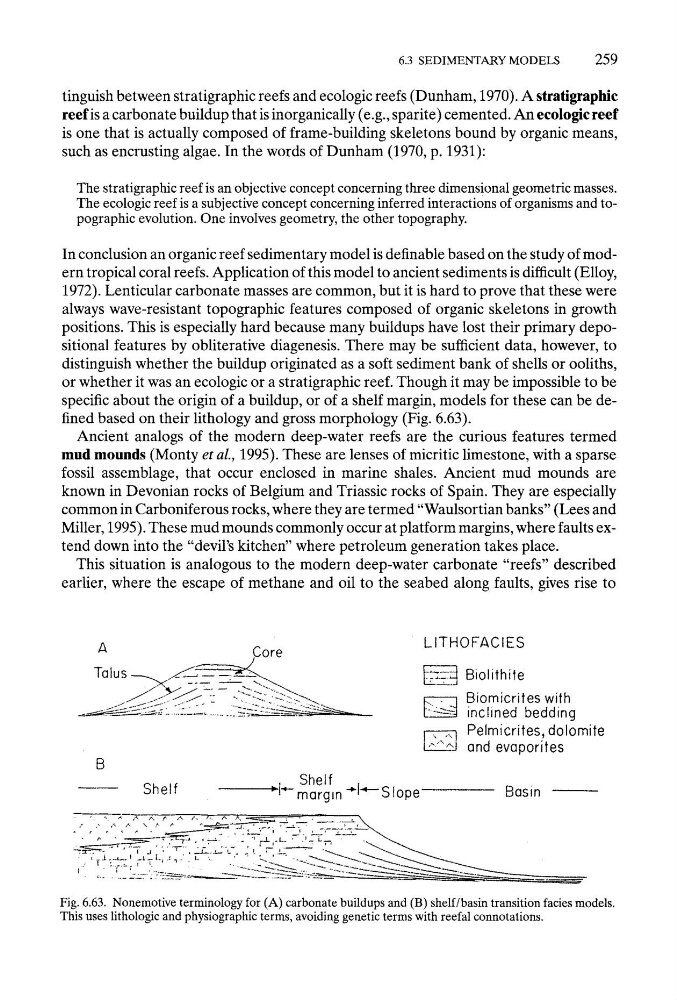
specific about the origin of a buildup, or of a shelf margin, models for these can be defined based on their lithology and gross morphology (Fig. 6.63).
Ancient analogs of the modern deep-water reefs are the curious features termed
mud mounds (Monty et al., 1995). These are lenses of micritic limestone, with a sparse
fossil assemblage, that occur enclosed in marine shales. Ancient mud mounds are
known in Devonian rocks of Belgium and Triassic rocks of Spain. They are especially
common in Carboniferous rocks, where they are termed "Waulsortian banks" (Lees and
Miller, 1995). These mud mounds commonly occur at platform margins, where faults extend down into the "devil's kitchen" where petroleum generation takes place.
This situation is analogous to the modern deep-water carbonate "reefs" described
earlier, where the escape of methane and oil to the seabed along faults, gives rise to
A
Core
Talus ~~~.
LITHOFACIES
Biolithite
L..::.L.L~. ~ Biomicriles with
inclined bedding
PelmicrJtes, dolomite
and evaporites
Shelf
Shelf
-- - ~l~margln-+'l"~Siope
Basin
9 ,.-+. ,, ,.-, ~ .,, /,. ,.., A. z ".,,, ~
'..--:
~-\
,, :. ,~, ,., ~, .,. ,,
,-_____~-- ~-z-~:--~. .... T_,--". -;
.~.. ,. \
,:
,.,,
- ~--r~__:._
'
-T _L
t
7"
~
L
9
o
"~'~.+ ~,..-r=-_
.... ,.__'. '. _'
..... -,
r _.," ",
7 r-,
...... ~
"r
..+
~
I
.I
'
~
, _.L.....,_-- I..
.
~
+
L_
"
'"~
.,.~
+ ' +-J., ...... ' --'7 t., .... ,- , + ' ...... ' "... :--.C ' ..... C.~--~. ~.L`_~--~_~'-~~
+
+., ..... , ..... _.u?.-+7...+~;~.+.+.
9 .... ..:.._Z~;L.--~.+-+:~-~--~:+.~,.
--_~-~.
+
-+" _
_
Fig. 6.63. Nonemotive terminology for (A) carbonate buildups and (B) shelf/basin transition facies models.
This uses lithologic and physiographic terms, avoiding genetic terms with reefal connotations.
MODELS
259
tinguish between stratigraphic reefs and ecologic reefs (Dunham, 1970). A stratigraphic
reef is a carbonate buildup that is inorganically (e.g., sparite) cemented. An ecologic reef
is one that is actually composed of frame-building skeletons bound by organic means,
such as encrusting algae. In the words of Dunham (1970, p. 1931):
The stratigraphic reef is an objective concept concerning three dimensional geometric masses.
The ecologic reef is a subjective concept concerning inferred interactions of organisms and topographic evolution. One involves geometry, the other topography.
In conclusion an organic reef sedimentary model is definable based on the study of modern tropical coral reefs. Application of this model to ancient sediments is difficult (Elloy,
1972). Lenticular carbonate masses are common, but it is hard to prove that these were
always wave-resistant topographic features composed of organic skeletons in growth
positions. This is especially hard because many buildups have lost their primary depositional features by obliterative diagenesis. There may be sufficient data, however, to
distinguish whether the buildup originated as a soft sediment bank of shells or ooliths,
or whether it was an ecologic or a stratigraphic reef. Though it may be impossible to be
specific about the origin of a buildup, or of a shelf margin, models for these can be defined based on their lithology and gross morphology (Fig. 6.63).
Ancient analogs of the modern deep-water reefs are the curious features termed
mud mounds (Monty et al., 1995). These are lenses of micritic limestone, with a sparse
fossil assemblage, that occur enclosed in marine shales. Ancient mud mounds are
known in Devonian rocks of Belgium and Triassic rocks of Spain. They are especially
common in Carboniferous rocks, where they are termed "Waulsortian banks" (Lees and
Miller, 1995). These mud mounds commonly occur at platform margins, where faults extend down into the "devil's kitchen" where petroleum generation takes place.
This situation is analogous to the modern deep-water carbonate "reefs" described
earlier, where the escape of methane and oil to the seabed along faults, gives rise to
A
Core
Talus ~~~.
LITHOFACIES
Biolithite
L..::.L.L~. ~ Biomicriles with
inclined bedding
PelmicrJtes, dolomite
and evaporites
Shelf
Shelf
-- - ~l~margln-+'l"~Siope
Basin
9 ,.-+. ,, ,.-, ~ .,, /,. ,.., A. z ".,,, ~
'..--:
~-\
,, :. ,~, ,., ~, .,. ,,
,-_____~-- ~-z-~:--~. .... T_,--". -;
.~.. ,. \
,:
,.,,
- ~--r~__:._
'
-T _L
t
7"
~
L
9
o
"~'~.+ ~,..-r=-_
.... ,.__'. '. _'
..... -,
r _.," ",
7 r-,
...... ~
"r
..+
~
I
.I
'
~
, _.L.....,_-- I..
.
~
+
L_
"
'"~
.,.~
+ ' +-J., ...... ' --'7 t., .... ,- , + ' ...... ' "... :--.C ' ..... C.~--~. ~.L`_~--~_~'-~~
+
+., ..... , ..... _.u?.-+7...+~;~.+.+.
9 .... ..:.._Z~;L.--~.+-+:~-~--~:+.~,.
--_~-~.
+
-+" _
_
Fig. 6.63. Nonemotive terminology for (A) carbonate buildups and (B) shelf/basin transition facies models.
This uses lithologic and physiographic terms, avoiding genetic terms with reefal connotations.