

246
6 DEPOSITIONAL SYSTEMS
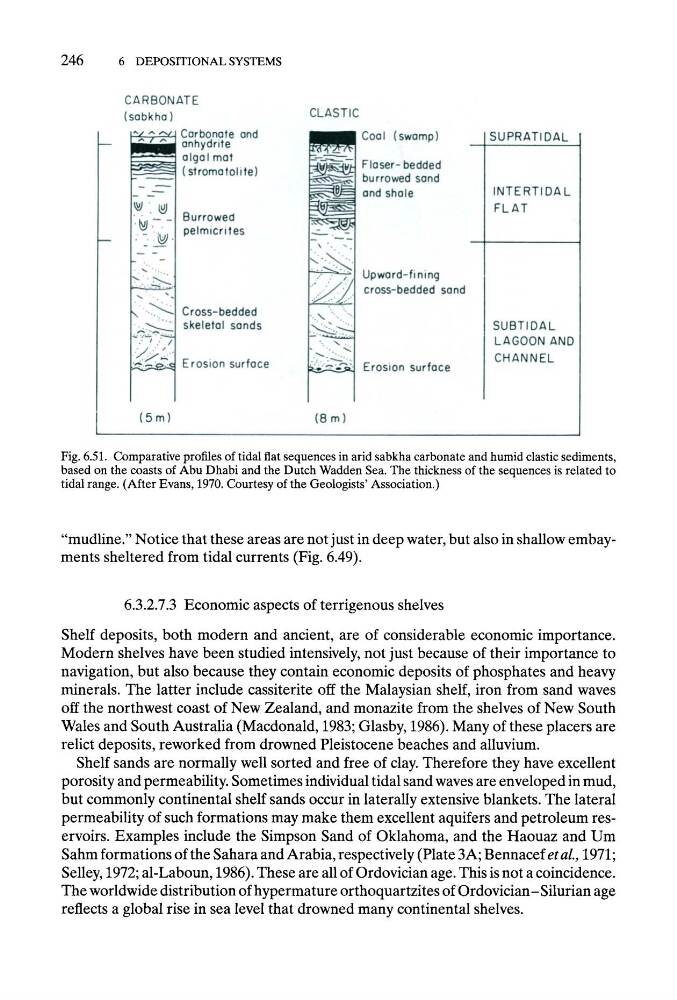
Fig. 6.51. Comparative profiles of tidal fiat sequences in arid sabkha carbonate and humid clastic sediments,
based on the coasts of Abu Dhabi and the Dutch Wadden Sea. The thickness of the sequences is related to
tidal range. (After Evans, 1970. Courtesy of the Geologists' Association.)
"mudline." Notice that these areas are not just in deep water, but also in shallow embayments sheltered from tidal currents (Fig. 6.49).
6.3.2.7.3 Economic aspects of terrigenous shelves
Shelf deposits, both modern and ancient, are of considerable economic importance.
Modern shelves have been studied intensively, not just because of their importance to
navigation, but also because they contain economic deposits of phosphates and heavy
minerals. The latter include cassiterite off the Malaysian shelf, iron from sand waves
off the northwest coast of New Zealand, and monazite from the shelves of New South
Wales and South Australia (Macdonald, 1983; Glasby, 1986). Many of these placers are
relict deposits, reworked from drowned Pleistocene beaches and alluvium.
Shelf sands are normally well sorted and free of clay. Therefore they have excellent
porosity and permeability. Sometimes individual tidal sand waves are enveloped in mud,
but commonly continental shelf sands occur in laterally extensive blankets. The lateral
permeability of such formations may make them excellent aquifers and petroleum reservoirs. Examples include the Simpson Sand of Oklahoma, and the Haouaz and Um
Sahm formations of the Sahara and Arabia, respectively (Plate 3A; Bennacef et aL, 1971;
Selley, 1972; al-Laboun, 1986). These are all of Ordovician age. This is not a coincidence.
The worldwide distribution of hypermature orthoquartzites of Ordovician- Silurian age
reflects a global rise in sea level that drowned many continental shelves.
6 DEPOSITIONAL SYSTEMS
Fig. 6.51. Comparative profiles of tidal fiat sequences in arid sabkha carbonate and humid clastic sediments,
based on the coasts of Abu Dhabi and the Dutch Wadden Sea. The thickness of the sequences is related to
tidal range. (After Evans, 1970. Courtesy of the Geologists' Association.)
"mudline." Notice that these areas are not just in deep water, but also in shallow embayments sheltered from tidal currents (Fig. 6.49).
6.3.2.7.3 Economic aspects of terrigenous shelves
Shelf deposits, both modern and ancient, are of considerable economic importance.
Modern shelves have been studied intensively, not just because of their importance to
navigation, but also because they contain economic deposits of phosphates and heavy
minerals. The latter include cassiterite off the Malaysian shelf, iron from sand waves
off the northwest coast of New Zealand, and monazite from the shelves of New South
Wales and South Australia (Macdonald, 1983; Glasby, 1986). Many of these placers are
relict deposits, reworked from drowned Pleistocene beaches and alluvium.
Shelf sands are normally well sorted and free of clay. Therefore they have excellent
porosity and permeability. Sometimes individual tidal sand waves are enveloped in mud,
but commonly continental shelf sands occur in laterally extensive blankets. The lateral
permeability of such formations may make them excellent aquifers and petroleum reservoirs. Examples include the Simpson Sand of Oklahoma, and the Haouaz and Um
Sahm formations of the Sahara and Arabia, respectively (Plate 3A; Bennacef et aL, 1971;
Selley, 1972; al-Laboun, 1986). These are all of Ordovician age. This is not a coincidence.
The worldwide distribution of hypermature orthoquartzites of Ordovician- Silurian age
reflects a global rise in sea level that drowned many continental shelves.