

6.3 SEDIMENTARY MODELS
237
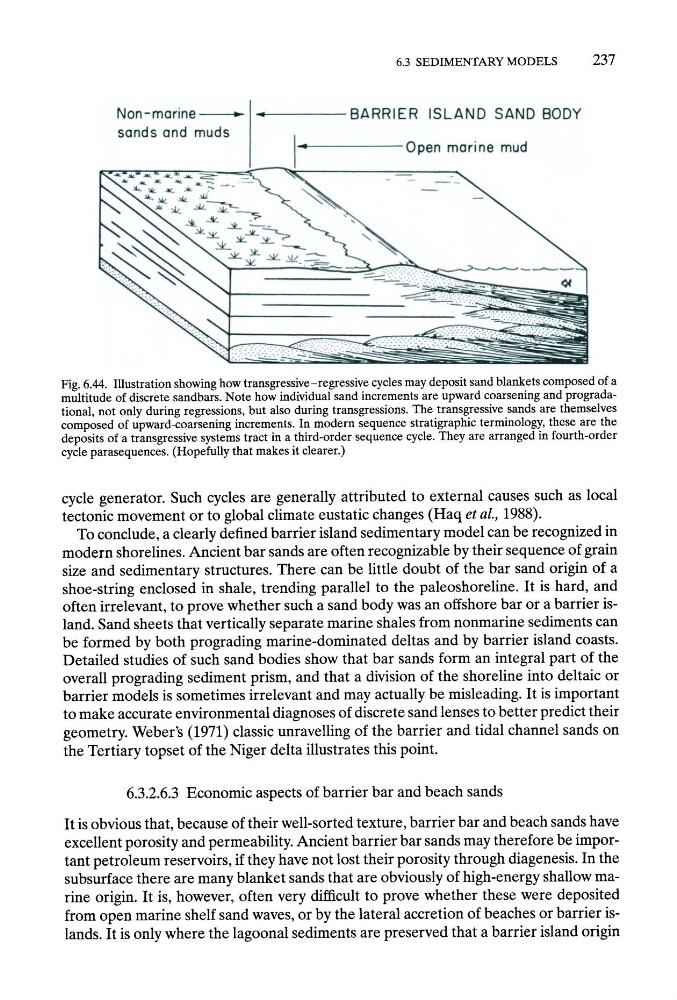
Fig. 6.44. Illustration showing how transgressive-regressive cycles may deposit sand blankets composed of a
multitude of discrete sandbars. Note how individual sand increments are upward coarsening and progradational, not only during regressions, but also during transgressions. The transgressive sands are themselves
composed of upward-coarsening increments. In modern sequence stratigraphic terminology, these are the
deposits of a transgressive systems tract in a third-order sequence cycle. They are arranged in fourth-order
cycle parasequences. (Hopefully that makes it clearer.)
cycle generator. Such cycles are generally attributed to external causes such as local
tectonic movement or to global climate eustatic changes (Haq et al., 1988).
To conclude, a clearly defined barrier island sedimentary model can be recognized in
modern shorelines. Ancient bar sands are often recognizable by their sequence of grain
size and sedimentary structures. There can be little doubt of the bar sand origin of a
shoe-string enclosed in shale, trending parallel to the paleoshoreline. It is hard, and
often irrelevant, to prove whether such a sand body was an offshore bar or a barrier island. Sand sheets that vertically separate marine shales from nonmarine sediments can
be formed by both prograding marine-dominated deltas and by barrier island coasts.
Detailed studies of such sand bodies show that bar sands form an integral part of the
overall prograding sediment prism, and that a division of the shoreline into deltaic or
barrier models is sometimes irrelevant and may actually be misleading. It is important
to make accurate environmental diagnoses of discrete sand lenses to better predict their
geometry. Weber's (1971) classic unravelling of the barrier and tidal channel sands on
the Tertiary topset of the Niger delta illustrates this point.
6.3.2.6.3 Economic aspects of barrier bar and beach sands
It is obvious that, because of their well-sorted texture, barrier bar and beach sands have
excellent porosity and permeability. Ancient barrier bar sands may therefore be important petroleum reservoirs, if they have not lost their porosity through diagenesis. In the
subsurface there are many blanket sands that are obviously of high-energy shallow marine origin. It is, however, often very difficult to prove whether these were deposited
from open marine shelf sand waves, or by the lateral accretion of beaches or barrier islands. It is only where the lagoonal sediments are preserved that a barrier island origin
237
Fig. 6.44. Illustration showing how transgressive-regressive cycles may deposit sand blankets composed of a
multitude of discrete sandbars. Note how individual sand increments are upward coarsening and progradational, not only during regressions, but also during transgressions. The transgressive sands are themselves
composed of upward-coarsening increments. In modern sequence stratigraphic terminology, these are the
deposits of a transgressive systems tract in a third-order sequence cycle. They are arranged in fourth-order
cycle parasequences. (Hopefully that makes it clearer.)
cycle generator. Such cycles are generally attributed to external causes such as local
tectonic movement or to global climate eustatic changes (Haq et al., 1988).
To conclude, a clearly defined barrier island sedimentary model can be recognized in
modern shorelines. Ancient bar sands are often recognizable by their sequence of grain
size and sedimentary structures. There can be little doubt of the bar sand origin of a
shoe-string enclosed in shale, trending parallel to the paleoshoreline. It is hard, and
often irrelevant, to prove whether such a sand body was an offshore bar or a barrier island. Sand sheets that vertically separate marine shales from nonmarine sediments can
be formed by both prograding marine-dominated deltas and by barrier island coasts.
Detailed studies of such sand bodies show that bar sands form an integral part of the
overall prograding sediment prism, and that a division of the shoreline into deltaic or
barrier models is sometimes irrelevant and may actually be misleading. It is important
to make accurate environmental diagnoses of discrete sand lenses to better predict their
geometry. Weber's (1971) classic unravelling of the barrier and tidal channel sands on
the Tertiary topset of the Niger delta illustrates this point.
6.3.2.6.3 Economic aspects of barrier bar and beach sands
It is obvious that, because of their well-sorted texture, barrier bar and beach sands have
excellent porosity and permeability. Ancient barrier bar sands may therefore be important petroleum reservoirs, if they have not lost their porosity through diagenesis. In the
subsurface there are many blanket sands that are obviously of high-energy shallow marine origin. It is, however, often very difficult to prove whether these were deposited
from open marine shelf sand waves, or by the lateral accretion of beaches or barrier islands. It is only where the lagoonal sediments are preserved that a barrier island origin