

234
6 DEPOSITIONAL SYSTEMS
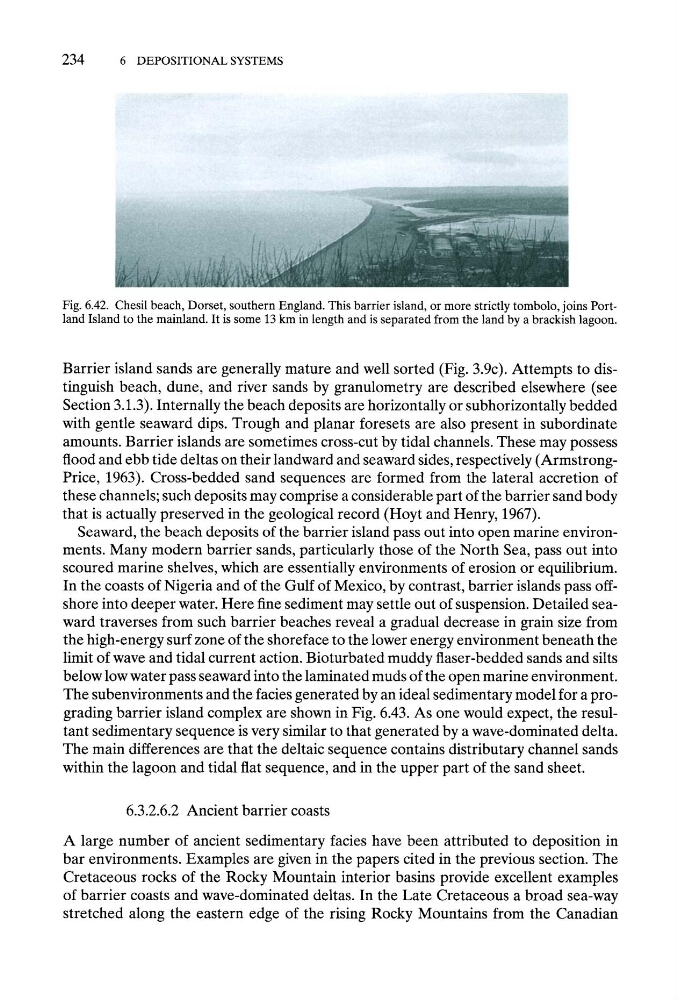
Fig. 6.42. Chesil beach, Dorset, southern England. This barrier island, or more strictly tombolo, joins Portland Island to the mainland. It is some 13 km in length and is separated from the land by a brackish lagoon.
Barrier island sands are generally mature and well sorted (Fig. 3.9c). Attempts to distinguish beach, dune, and river sands by granulometry are described elsewhere (see
Section 3.1.3). Internally the beach deposits are horizontally or subhorizontally bedded
with gentle seaward dips. Trough and planar foresets are also present in subordinate
amounts. Barrier islands are sometimes cross-cut by tidal channels. These may possess
flood and ebb tide deltas on their landward and seaward sides, respectively (ArmstrongPrice, 1963). Cross-bedded sand sequences are formed from the lateral accretion of
these channels; such deposits may comprise a considerable part of the barrier sand body
that is actually preserved in the geological record (Hoyt and Henry, 1967).
Seaward, the beach deposits of the barrier island pass out into open marine environments. Many modern barrier sands, particularly those of the North Sea, pass out into
scoured marine shelves, which are essentially environments of erosion or equilibrium.
In the coasts of Nigeria and of the Gulf of Mexico, by contrast, barrier islands pass offshore into deeper water. Here fine sediment may settle out of suspension. Detailed seaward traverses from such barrier beaches reveal a gradual decrease in grain size from
the high-energy surf zone of the shoreface to the lower energy environment beneath the
limit of wave and tidal current action. Bioturbated muddy flaser-bedded sands and silts
below low water pass seaward into the laminated muds of the open marine environment.
The subenvironments and the facies generated by an ideal sedimentary model for a prograding barrier island complex are shown in Fig. 6.43. As one would expect, the resultant sedimentary sequence is very similar to that generated by a wave-dominated delta.
The main differences are that the deltaic sequence contains distributary channel sands
within the lagoon and tidal flat sequence, and in the upper part of the sand sheet.
6.3.2.6.2 Ancient barrier coasts
A large number of ancient sedimentary facies have been attributed to deposition in
bar environments. Examples are given in the papers cited in the previous section. The
Cretaceous rocks of the Rocky Mountain interior basins provide excellent examples
of barrier coasts and wave-dominated deltas. In the Late Cretaceous a broad sea-way
stretched along the eastern edge of the rising Rocky Mountains from the Canadian
6 DEPOSITIONAL SYSTEMS
Fig. 6.42. Chesil beach, Dorset, southern England. This barrier island, or more strictly tombolo, joins Portland Island to the mainland. It is some 13 km in length and is separated from the land by a brackish lagoon.
Barrier island sands are generally mature and well sorted (Fig. 3.9c). Attempts to distinguish beach, dune, and river sands by granulometry are described elsewhere (see
Section 3.1.3). Internally the beach deposits are horizontally or subhorizontally bedded
with gentle seaward dips. Trough and planar foresets are also present in subordinate
amounts. Barrier islands are sometimes cross-cut by tidal channels. These may possess
flood and ebb tide deltas on their landward and seaward sides, respectively (ArmstrongPrice, 1963). Cross-bedded sand sequences are formed from the lateral accretion of
these channels; such deposits may comprise a considerable part of the barrier sand body
that is actually preserved in the geological record (Hoyt and Henry, 1967).
Seaward, the beach deposits of the barrier island pass out into open marine environments. Many modern barrier sands, particularly those of the North Sea, pass out into
scoured marine shelves, which are essentially environments of erosion or equilibrium.
In the coasts of Nigeria and of the Gulf of Mexico, by contrast, barrier islands pass offshore into deeper water. Here fine sediment may settle out of suspension. Detailed seaward traverses from such barrier beaches reveal a gradual decrease in grain size from
the high-energy surf zone of the shoreface to the lower energy environment beneath the
limit of wave and tidal current action. Bioturbated muddy flaser-bedded sands and silts
below low water pass seaward into the laminated muds of the open marine environment.
The subenvironments and the facies generated by an ideal sedimentary model for a prograding barrier island complex are shown in Fig. 6.43. As one would expect, the resultant sedimentary sequence is very similar to that generated by a wave-dominated delta.
The main differences are that the deltaic sequence contains distributary channel sands
within the lagoon and tidal flat sequence, and in the upper part of the sand sheet.
6.3.2.6.2 Ancient barrier coasts
A large number of ancient sedimentary facies have been attributed to deposition in
bar environments. Examples are given in the papers cited in the previous section. The
Cretaceous rocks of the Rocky Mountain interior basins provide excellent examples
of barrier coasts and wave-dominated deltas. In the Late Cretaceous a broad sea-way
stretched along the eastern edge of the rising Rocky Mountains from the Canadian