

230
6 DEPOSITIONAL SYSTEMS
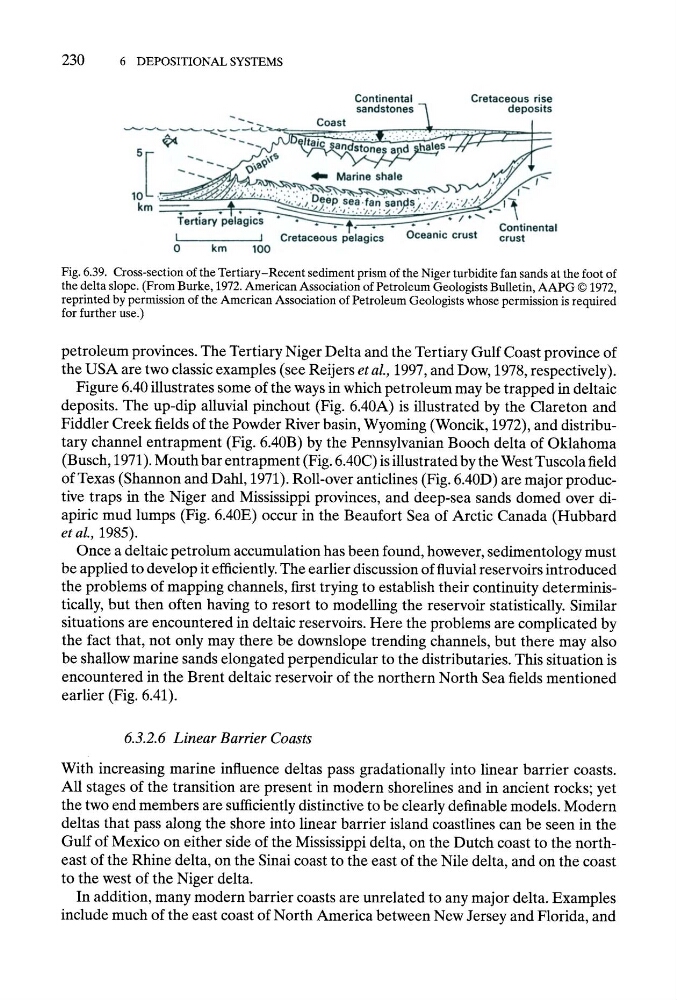
Fig. 6.39. Cross-section of the Tertiary-Recent sediment prism of the Niger turbidite fan sands at the foot of
the delta slope. (From Burke, 1972. American Association of Petroleum Geologists Bulletin, AAPG 9 1972,
reprinted by permission of the American Association of Petroleum Geologists whose permission is required
for further use.)
petroleum provinces. The Tertiary Niger Delta and the Tertiary Gulf Coast province of
the USA are two classic examples (see Reijers et al., 1997, and Dow, 1978, respectively).
Figure 6.40 illustrates some of the ways in which petroleum may be trapped in deltaic
deposits. The up-dip alluvial pinchout (Fig. 6.40A) is illustrated by the Clareton and
Fiddler Creek fields of the Powder River basin, Wyoming (Woncik, 1972), and distributary channel entrapment (Fig. 6.40B) by the Pennsylvanian Booch delta of Oklahoma
(Busch, 1971). Mouth bar entrapment (Fig. 6.40C) is illustrated by the West Tuscola field
of Texas (Shannon and Dahl, 1971). Roll-over anticlines (Fig. 6.40D) are major productive traps in the Niger and Mississippi provinces, and deep-sea sands domed over diapiric mud lumps (Fig. 6.40E) occur in the Beaufort Sea of Arctic Canada (Hubbard
et al., 1985).
Once a deltaic petrolum accumulation has been found, however, sedimentology must
be applied to develop it efficiently. The earlier discussion of fluvial reservoirs introduced
the problems of mapping channels, first trying to establish their continuity deterministically, but then often having to resort to modelling the reservoir statistically. Similar
situations are encountered in deltaic reservoirs. Here the problems are complicated by
the fact that, not only may there be downslope trending channels, but there may also
be shallow marine sands elongated perpendicular to the distributaries. This situation is
encountered in the Brent deltaic reservoir of the northern North Sea fields mentioned
earlier (Fig. 6.41).
6.3.2.6 Linear Barrier Coasts
With increasing marine influence deltas pass gradationally into linear barrier coasts.
All stages of the transition are present in modern shorelines and in ancient rocks; yet
the two end members are sufficiently distinctive to be clearly definable models. Modern
deltas that pass along the shore into linear barrier island coastlines can be seen in the
Gulf of Mexico on either side of the Mississippi delta, on the Dutch coast to the northeast of the Rhine delta, on the Sinai coast to the east of the Nile delta, and on the coast
to the west of the Niger delta.
In addition, many modern barrier coasts are unrelated to any major delta. Examples
include much of the east coast of North America between New Jersey and Florida, and
6 DEPOSITIONAL SYSTEMS
Fig. 6.39. Cross-section of the Tertiary-Recent sediment prism of the Niger turbidite fan sands at the foot of
the delta slope. (From Burke, 1972. American Association of Petroleum Geologists Bulletin, AAPG 9 1972,
reprinted by permission of the American Association of Petroleum Geologists whose permission is required
for further use.)
petroleum provinces. The Tertiary Niger Delta and the Tertiary Gulf Coast province of
the USA are two classic examples (see Reijers et al., 1997, and Dow, 1978, respectively).
Figure 6.40 illustrates some of the ways in which petroleum may be trapped in deltaic
deposits. The up-dip alluvial pinchout (Fig. 6.40A) is illustrated by the Clareton and
Fiddler Creek fields of the Powder River basin, Wyoming (Woncik, 1972), and distributary channel entrapment (Fig. 6.40B) by the Pennsylvanian Booch delta of Oklahoma
(Busch, 1971). Mouth bar entrapment (Fig. 6.40C) is illustrated by the West Tuscola field
of Texas (Shannon and Dahl, 1971). Roll-over anticlines (Fig. 6.40D) are major productive traps in the Niger and Mississippi provinces, and deep-sea sands domed over diapiric mud lumps (Fig. 6.40E) occur in the Beaufort Sea of Arctic Canada (Hubbard
et al., 1985).
Once a deltaic petrolum accumulation has been found, however, sedimentology must
be applied to develop it efficiently. The earlier discussion of fluvial reservoirs introduced
the problems of mapping channels, first trying to establish their continuity deterministically, but then often having to resort to modelling the reservoir statistically. Similar
situations are encountered in deltaic reservoirs. Here the problems are complicated by
the fact that, not only may there be downslope trending channels, but there may also
be shallow marine sands elongated perpendicular to the distributaries. This situation is
encountered in the Brent deltaic reservoir of the northern North Sea fields mentioned
earlier (Fig. 6.41).
6.3.2.6 Linear Barrier Coasts
With increasing marine influence deltas pass gradationally into linear barrier coasts.
All stages of the transition are present in modern shorelines and in ancient rocks; yet
the two end members are sufficiently distinctive to be clearly definable models. Modern
deltas that pass along the shore into linear barrier island coastlines can be seen in the
Gulf of Mexico on either side of the Mississippi delta, on the Dutch coast to the northeast of the Rhine delta, on the Sinai coast to the east of the Nile delta, and on the coast
to the west of the Niger delta.
In addition, many modern barrier coasts are unrelated to any major delta. Examples
include much of the east coast of North America between New Jersey and Florida, and