

216
6 DEPOSITIONAL SYSTEMS
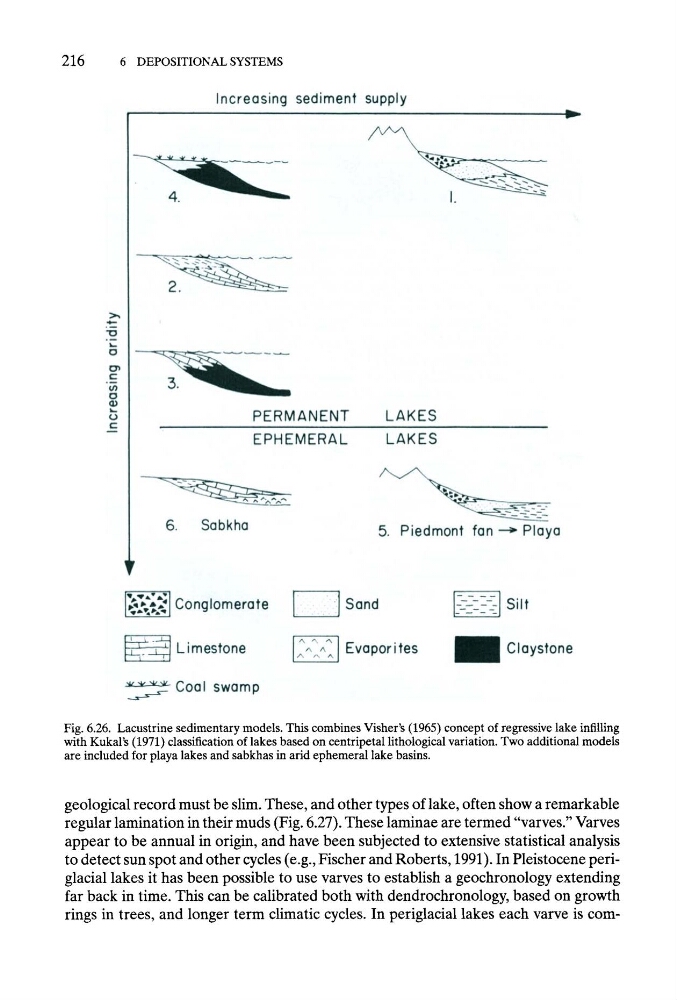
Fig. 6.26. Lacustrine sedimentary models. This combines Visher's (1965) concept of regressive lake infiUing
with Kukal's (1971) classification of lakes based on centripetal lithological variation. Two additional models
are included for playa lakes and sabkhas in arid ephemeral lake basins.
geological record must be slim. These, and other types of lake, often show a remarkable
regular lamination in their muds (Fig. 6.27). These laminae are termed "varves." Varves
appear to be annual in origin, and have been subjected to extensive statistical analysis
to detect sun spot and other cycles (e.g., Fischer and Roberts, 1991). In Pleistocene periglacial lakes it has been possible to use varves to establish a geochronology extending
far back in time. This can be calibrated both with dendrochronology, based on growth
rings in trees, and longer term climatic cycles. In periglacial lakes each varve is com-
6 DEPOSITIONAL SYSTEMS
Fig. 6.26. Lacustrine sedimentary models. This combines Visher's (1965) concept of regressive lake infiUing
with Kukal's (1971) classification of lakes based on centripetal lithological variation. Two additional models
are included for playa lakes and sabkhas in arid ephemeral lake basins.
geological record must be slim. These, and other types of lake, often show a remarkable
regular lamination in their muds (Fig. 6.27). These laminae are termed "varves." Varves
appear to be annual in origin, and have been subjected to extensive statistical analysis
to detect sun spot and other cycles (e.g., Fischer and Roberts, 1991). In Pleistocene periglacial lakes it has been possible to use varves to establish a geochronology extending
far back in time. This can be calibrated both with dendrochronology, based on growth
rings in trees, and longer term climatic cycles. In periglacial lakes each varve is com-