

196
6 DEPOSITIONAL SYSTEMS
modern, have been given by Doeglas (1962), Rust (1972), Williams (1971), and Best
and Bristow (1993). Miall (1977), Rust (1978), and Cant (1982) have proposed several
depositional models for braided channel systems. Miall (1977) defined four types of
braided alluvial deposit, named after the recent Scott, Donjek, and Platte rivers and Bijou Creek. The Scott River type is composed almost entirely of flood gravels, with minor
cross-bedded sand bars. The Donjek type consists of upward fining channel lag gravels and braid bar sands. The Platte River type is predominantly sandy. It contains thin
channel lag gravels but is mainly composed of cross-bedded sands deposited from migrating longitudinal and linguoid bars. Finally, the Bijou Creek type is the finest grained
of all. There are no gravels, apart from rare intraformational clay pebble conglomerates. Cross-bedded braid bar sands predominate, with minor abandoned channel muds.
Examples of alluvium that was deposited from braided channel systems are found
worldwide in rocks of diverse ages from the Pre-Cambrian to the recent. One noted instance occurs in the great Cambro-Ordovician sand blanket that stretches from the
Atlantic Ocean, across the Sahara and Arabia as far as the Arabian Gulf (Bennacef
et al., 1971; Selley, 1972, 1996; al-Laboun, 1986). These sands were derived from the PreCambrian shields, transported northward across vast braided outwash plains, some as
periglacial outwash, to interfinger with shallow marine shelf sands. With excellent porosity and permeability, and great lateral continuity, these formations are important
aquifers and petroleum reservoirs in Algeria, Libya, and Arabia.
6.3.2.2.3 Alluvium of meandering rivers
With increasing distance from source, the gradient of river profiles lessens, grain size
decreases, and channels diminish in number on the floodplain and increase in sinuosity.
Thus braided alluvial plains can change downstream into broad floodplains traversed
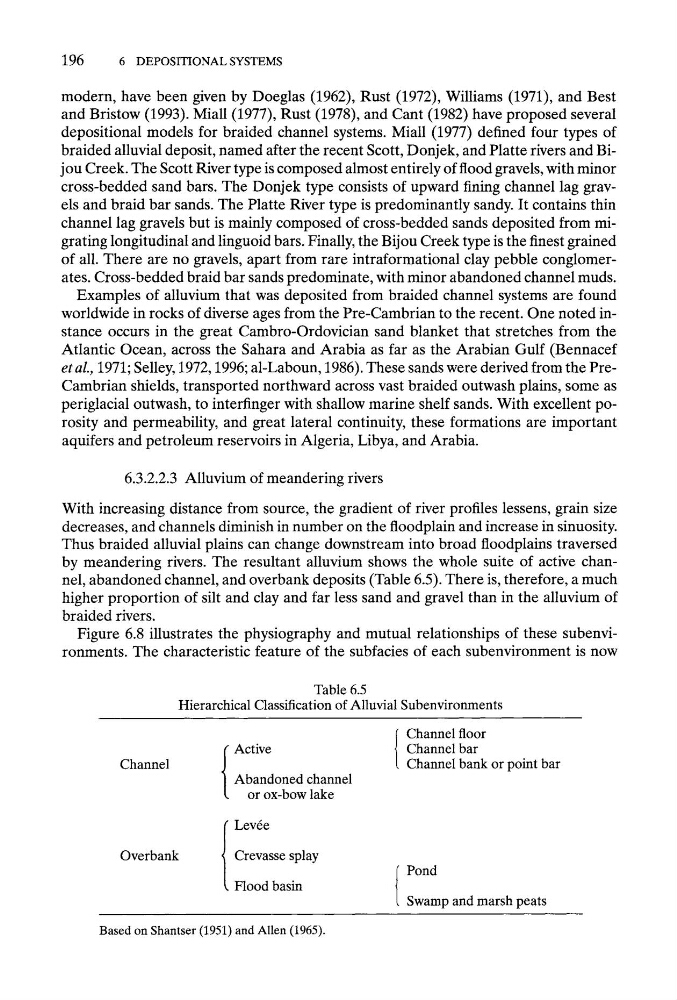
by meandering rivers. The resultant alluvium shows the whole suite of active channel, abandoned channel, and overbank deposits (Table 6.5). There is, therefore, a much
higher proportion of silt and clay and far less sand and gravel than in the alluvium of
braided rivers.
Figure 6.8 illustrates the physiography and mutual relationships of these subenvironments. The characteristic feature of the subfacies of each subenvironment is now
Table 6.5
Hierarchical Classification of Alluvial Subenvironments
Channel
Overbank
Active
Abandoned channel
or ox-bow lake
Lev6e
Crevasse splay
Flood basin
Channel floor
Channel bar
Channel bank or point bar
Pond
Swamp and marsh peats
Based on Shantser (1951) and Allen (1965).
6 DEPOSITIONAL SYSTEMS
modern, have been given by Doeglas (1962), Rust (1972), Williams (1971), and Best
and Bristow (1993). Miall (1977), Rust (1978), and Cant (1982) have proposed several
depositional models for braided channel systems. Miall (1977) defined four types of
braided alluvial deposit, named after the recent Scott, Donjek, and Platte rivers and Bijou Creek. The Scott River type is composed almost entirely of flood gravels, with minor
cross-bedded sand bars. The Donjek type consists of upward fining channel lag gravels and braid bar sands. The Platte River type is predominantly sandy. It contains thin
channel lag gravels but is mainly composed of cross-bedded sands deposited from migrating longitudinal and linguoid bars. Finally, the Bijou Creek type is the finest grained
of all. There are no gravels, apart from rare intraformational clay pebble conglomerates. Cross-bedded braid bar sands predominate, with minor abandoned channel muds.
Examples of alluvium that was deposited from braided channel systems are found
worldwide in rocks of diverse ages from the Pre-Cambrian to the recent. One noted instance occurs in the great Cambro-Ordovician sand blanket that stretches from the
Atlantic Ocean, across the Sahara and Arabia as far as the Arabian Gulf (Bennacef
et al., 1971; Selley, 1972, 1996; al-Laboun, 1986). These sands were derived from the PreCambrian shields, transported northward across vast braided outwash plains, some as
periglacial outwash, to interfinger with shallow marine shelf sands. With excellent porosity and permeability, and great lateral continuity, these formations are important
aquifers and petroleum reservoirs in Algeria, Libya, and Arabia.
6.3.2.2.3 Alluvium of meandering rivers
With increasing distance from source, the gradient of river profiles lessens, grain size
decreases, and channels diminish in number on the floodplain and increase in sinuosity.
Thus braided alluvial plains can change downstream into broad floodplains traversed
by meandering rivers. The resultant alluvium shows the whole suite of active channel, abandoned channel, and overbank deposits (Table 6.5). There is, therefore, a much
higher proportion of silt and clay and far less sand and gravel than in the alluvium of
braided rivers.
Figure 6.8 illustrates the physiography and mutual relationships of these subenvironments. The characteristic feature of the subfacies of each subenvironment is now
Table 6.5
Hierarchical Classification of Alluvial Subenvironments
Channel
Overbank
Active
Abandoned channel
or ox-bow lake
Lev6e
Crevasse splay
Flood basin
Channel floor
Channel bar
Channel bank or point bar
Pond
Swamp and marsh peats
Based on Shantser (1951) and Allen (1965).