

6.3 SEDIMENTARY MODELS
189
SHELF
I I
I
~ -~
BASIN
~..:: ::, 9 : .
.
t
.....~%~:~:2/'
...... ~~'-c-~
Cret
a
"
~~'" .... "" : ..... ' '...
Cretaceous'
..'. ..... "" "'...o, " ~d,~ ~: o ~/, ~1
~' ~z~. ~!
s andsJ~
s .... !imeston e facies ~,~'1' .....
-"::" :,-: )~.,~k.
Conglomerate
facies (submarine
channel
environments)
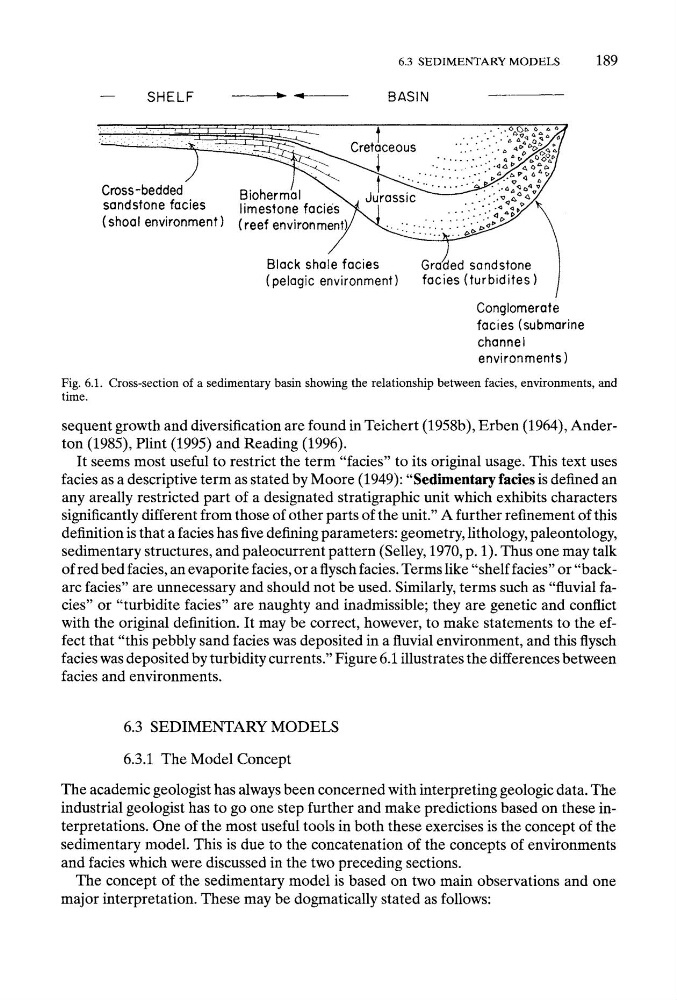
Fig. 6.1. Cross-section of a sedimentary basin showing the relationship between facies, environments, and
time.
sequent growth and diversification are found in Teichert (1958b), Erben (1964), Anderton (1985), Plint (1995) and Reading (1996).
It seems most useful to restrict the term "facies" to its original usage. This text uses
facies as a descriptive term as stated by Moore (1949): "Sedimentary facies is defined an
any areally restricted part of a designated stratigraphic unit which exhibits characters
significantly different from those of other parts of the unit." A further refinement of this
definition is that a facies has five defining parameters: geometry, lithology, paleontology,
sedimentary structures, and paleocurrent pattern (Selley, 1970, p. 1). Thus one may talk
of red bed facies, an evaporite facies, or a flysch facies. Terms like "shelf facies" or "backarc facies" are unnecessary and should not be used. Similarly, terms such as "fluvial facies" or "turbidite facies" are naughty and inadmissible; they are genetic and conflict
with the original definition. It may be correct, however, to make statements to the effect that "this pebbly sand facies was deposited in a fluvial environment, and this flysch
facies was deposited by turbidity currents." Figure 6.1 illustrates the differences between
facies and environments.
6.3 SEDIMENTARY MODELS
6.3.1 The Model Concept
The academic geologist has always been concerned with interpreting geologic data. The
industrial geologist has to go one step further and make predictions based on these interpretations. One of the most useful tools in both these exercises is the concept of the
sedimentary model. This is due to the concatenation of the concepts of environments
and facies which were discussed in the two preceding sections.
The concept of the sedimentary model is based on two main observations and one
major interpretation. These may be dogmatically stated as follows:
189
SHELF
I I
I
~ -~
BASIN
~..:: ::, 9 : .
.
t
.....~%~:~:2/'
...... ~~'-c-~
Cret
a
"
~~'" .... "" : ..... ' '...
Cretaceous'
..'. ..... "" "'...o, " ~d,~ ~: o ~/, ~1
~' ~z~. ~!
s andsJ~
s .... !imeston e facies ~,~'1' .....
-"::" :,-: )~.,~k.
Conglomerate
facies (submarine
channel
environments)
Fig. 6.1. Cross-section of a sedimentary basin showing the relationship between facies, environments, and
time.
sequent growth and diversification are found in Teichert (1958b), Erben (1964), Anderton (1985), Plint (1995) and Reading (1996).
It seems most useful to restrict the term "facies" to its original usage. This text uses
facies as a descriptive term as stated by Moore (1949): "Sedimentary facies is defined an
any areally restricted part of a designated stratigraphic unit which exhibits characters
significantly different from those of other parts of the unit." A further refinement of this
definition is that a facies has five defining parameters: geometry, lithology, paleontology,
sedimentary structures, and paleocurrent pattern (Selley, 1970, p. 1). Thus one may talk
of red bed facies, an evaporite facies, or a flysch facies. Terms like "shelf facies" or "backarc facies" are unnecessary and should not be used. Similarly, terms such as "fluvial facies" or "turbidite facies" are naughty and inadmissible; they are genetic and conflict
with the original definition. It may be correct, however, to make statements to the effect that "this pebbly sand facies was deposited in a fluvial environment, and this flysch
facies was deposited by turbidity currents." Figure 6.1 illustrates the differences between
facies and environments.
6.3 SEDIMENTARY MODELS
6.3.1 The Model Concept
The academic geologist has always been concerned with interpreting geologic data. The
industrial geologist has to go one step further and make predictions based on these interpretations. One of the most useful tools in both these exercises is the concept of the
sedimentary model. This is due to the concatenation of the concepts of environments
and facies which were discussed in the two preceding sections.
The concept of the sedimentary model is based on two main observations and one
major interpretation. These may be dogmatically stated as follows: