

186
6 DEPOSITIONAL SYSTEMS
Table 6.3
Continued
Continental slope
Deep sea
Reef
Deep-sea fan
Abyssal plain
Marine areas marginal to
glaciers
Linear
Patch
Fringing
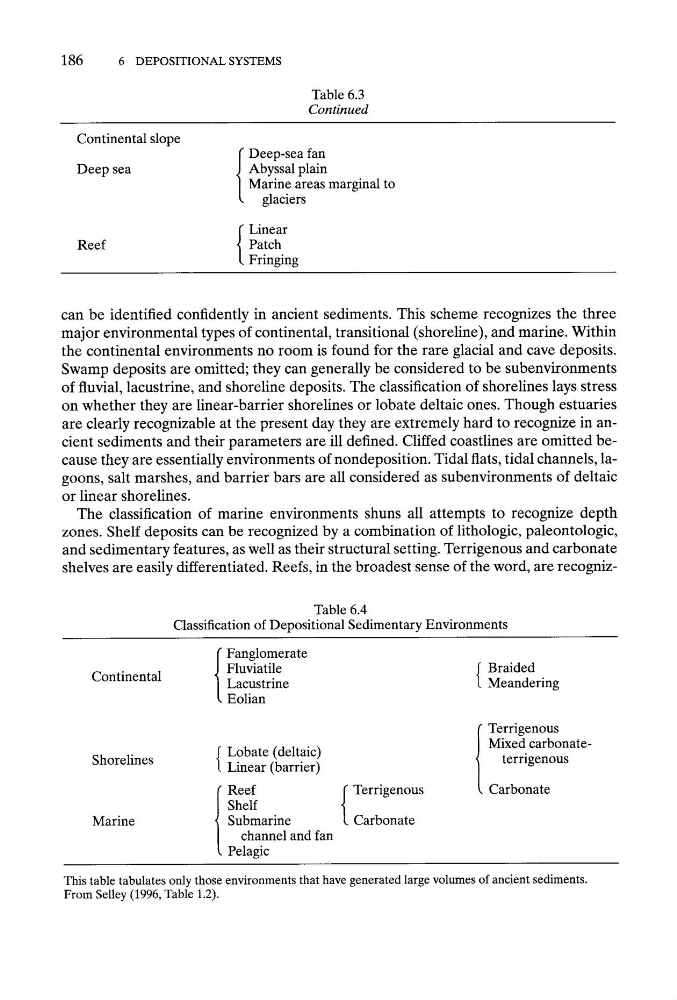
can be identified confidently in ancient sediments. This scheme recognizes the three
major environmental types of continental, transitional (shoreline), and marine. Within
the continental environments no room is found for the rare glacial and cave deposits.
Swamp deposits are omitted; they can generally be considered to be subenvironments
of fluvial, lacustrine, and shoreline deposits. The classification of shorelines lays stress
on whether they are linear-barrier shorelines or lobate deltaic ones. Though estuaries
are clearly recognizable at the present day they are extremely hard to recognize in ancient sediments and their parameters are ill defined. Cliffed coastlines are omitted because they are essentially environments of nondeposition. Tidal fiats, tidal channels, lagoons, salt marshes, and barrier bars are all considered as subenvironments of deltaic
or linear shorelines.
The classification of marine environments shuns all attempts to recognize depth
zones. Shelf deposits can be recognized by a combination of lithologic, paleontologic,
and sedimentary features, as well as their structural setting. Terrigenous and carbonate
shelves are easily differentiated. Reefs, in the broadest sense of the word, are recognizTable 6.4
Classification of Depositional Sedimentary Environments
Continental
Shorelines
Marine
Fanglomerate
Fluviatile
Lacustrine
Eolian
Lobate (deltaic)
Linear (barrier)
Reef
Shelf
Submarine
channel and fan
Pelagic
Terrigenous
Carbonate
Braided
Meandering
Terrigenous
Mixed carbonateterrigenous
Carbonate
This table tabulates only those environments that have generated large volumes of ancient sediments.
From Selley (1996, Table 1.2).
6 DEPOSITIONAL SYSTEMS
Table 6.3
Continued
Continental slope
Deep sea
Reef
Deep-sea fan
Abyssal plain
Marine areas marginal to
glaciers
Linear
Patch
Fringing
can be identified confidently in ancient sediments. This scheme recognizes the three
major environmental types of continental, transitional (shoreline), and marine. Within
the continental environments no room is found for the rare glacial and cave deposits.
Swamp deposits are omitted; they can generally be considered to be subenvironments
of fluvial, lacustrine, and shoreline deposits. The classification of shorelines lays stress
on whether they are linear-barrier shorelines or lobate deltaic ones. Though estuaries
are clearly recognizable at the present day they are extremely hard to recognize in ancient sediments and their parameters are ill defined. Cliffed coastlines are omitted because they are essentially environments of nondeposition. Tidal fiats, tidal channels, lagoons, salt marshes, and barrier bars are all considered as subenvironments of deltaic
or linear shorelines.
The classification of marine environments shuns all attempts to recognize depth
zones. Shelf deposits can be recognized by a combination of lithologic, paleontologic,
and sedimentary features, as well as their structural setting. Terrigenous and carbonate
shelves are easily differentiated. Reefs, in the broadest sense of the word, are recognizTable 6.4
Classification of Depositional Sedimentary Environments
Continental
Shorelines
Marine
Fanglomerate
Fluviatile
Lacustrine
Eolian
Lobate (deltaic)
Linear (barrier)
Reef
Shelf
Submarine
channel and fan
Pelagic
Terrigenous
Carbonate
Braided
Meandering
Terrigenous
Mixed carbonateterrigenous
Carbonate
This table tabulates only those environments that have generated large volumes of ancient sediments.
From Selley (1996, Table 1.2).