

6.1 SEDIMENTARY ENVIRONMENTS
183
bauxite horizons are the products of certain specific climatic conditions in conjunction
with suitable rock substrates (see Section 2.3.3). They may be regarded as the products
of sedimentary environments of equilibrium.
Environments of equilibrium can also be recognized beneath the sea. Extensive areas, both of the continental shelves and of the abyssal plains, are subjected to currents
that are powerful enough to remove any sediment which may have settled by suspension, yet are too weak to erode the substrate. These scoured surfaces are susceptible to
chemical reactions with seawater leading to the formation of manganese crusts and to
phosphatization and other diagenetic changes (Cronan, 1980). In the geological column
submarine sedimentary environments of equilibrium are represented by hardgrounds
(see Section 9.2.5.3). These are mineralized surfaces, generally within limestones, often
intensely bored and overlain by a thin conglomerate composed of clasts of the substrate.
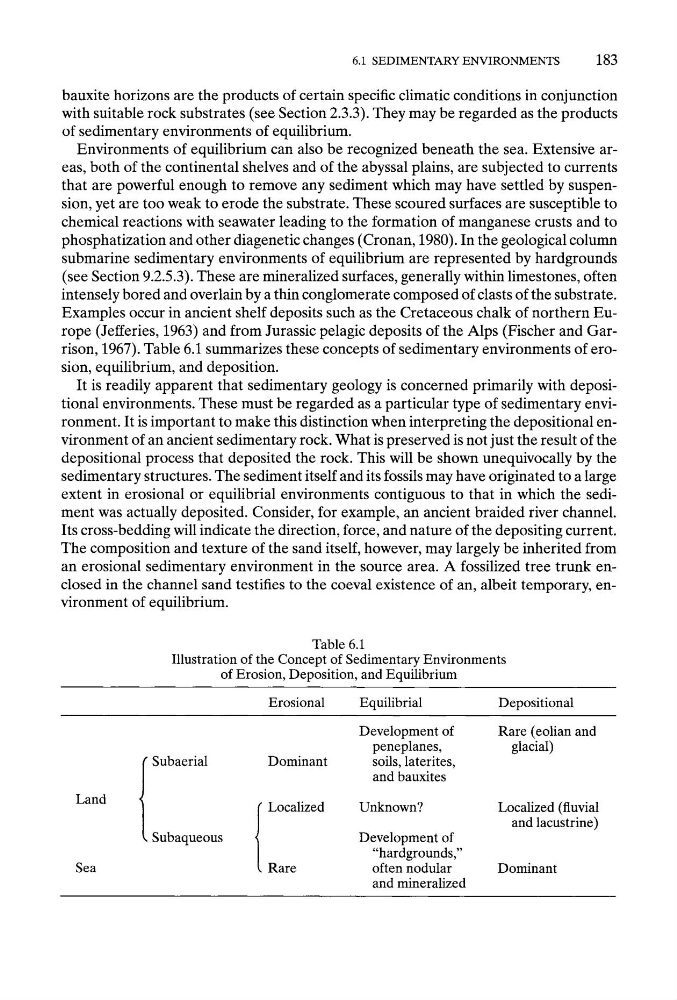
Examples occur in ancient shelf deposits such as the Cretaceous chalk of northern Europe (Jefferies, 1963) and from Jurassic pelagic deposits of the Alps (Fischer and Garrison, 1967). Table 6.1 summarizes these concepts of sedimentary environments of erosion, equilibrium, and deposition.
It is readily apparent that sedimentary geology is concerned primarily with depositional environments. These must be regarded as a particular type of sedimentary environment. It is important to make this distinction when interpreting the depositional environment of an ancient sedimentary rock. What is preserved is not just the result of the
depositional process that deposited the rock. This will be shown unequivocally by the
sedimentary structures. The sediment itself and its fossils may have originated to a large
extent in erosional or equilibrial environments contiguous to that in which the sediment was actually deposited. Consider, for example, an ancient braided river channel.
Its cross-bedding will indicate the direction, force, and nature of the depositing current.
The composition and texture of the sand itself, however, may largely be inherited from
an erosional sedimentary environment in the source area. A fossilized tree trunk enclosed in the channel sand testifies to the coeval existence of an, albeit temporary, environment of equilibrium.
Table 6.1
Illustration of the Concept of Sedimentary Environments
of Erosion, Deposition, and Equilibrium
Erosional
Equilibrial
Depositional
Land
Sea
Subaerial
Subaqueous
Dominant
Localized
Rare
Development of
peneplanes,
soils, laterites,
and bauxites
Unknown?
Development of
"hardgrounds,"
often nodular
and mineralized
Rare (eolian and
glacial)
Localized (fluvial
and lacustrine)
Dominant
183
bauxite horizons are the products of certain specific climatic conditions in conjunction
with suitable rock substrates (see Section 2.3.3). They may be regarded as the products
of sedimentary environments of equilibrium.
Environments of equilibrium can also be recognized beneath the sea. Extensive areas, both of the continental shelves and of the abyssal plains, are subjected to currents
that are powerful enough to remove any sediment which may have settled by suspension, yet are too weak to erode the substrate. These scoured surfaces are susceptible to
chemical reactions with seawater leading to the formation of manganese crusts and to
phosphatization and other diagenetic changes (Cronan, 1980). In the geological column
submarine sedimentary environments of equilibrium are represented by hardgrounds
(see Section 9.2.5.3). These are mineralized surfaces, generally within limestones, often
intensely bored and overlain by a thin conglomerate composed of clasts of the substrate.
Examples occur in ancient shelf deposits such as the Cretaceous chalk of northern Europe (Jefferies, 1963) and from Jurassic pelagic deposits of the Alps (Fischer and Garrison, 1967). Table 6.1 summarizes these concepts of sedimentary environments of erosion, equilibrium, and deposition.
It is readily apparent that sedimentary geology is concerned primarily with depositional environments. These must be regarded as a particular type of sedimentary environment. It is important to make this distinction when interpreting the depositional environment of an ancient sedimentary rock. What is preserved is not just the result of the
depositional process that deposited the rock. This will be shown unequivocally by the
sedimentary structures. The sediment itself and its fossils may have originated to a large
extent in erosional or equilibrial environments contiguous to that in which the sediment was actually deposited. Consider, for example, an ancient braided river channel.
Its cross-bedding will indicate the direction, force, and nature of the depositing current.
The composition and texture of the sand itself, however, may largely be inherited from
an erosional sedimentary environment in the source area. A fossilized tree trunk enclosed in the channel sand testifies to the coeval existence of an, albeit temporary, environment of equilibrium.
Table 6.1
Illustration of the Concept of Sedimentary Environments
of Erosion, Deposition, and Equilibrium
Erosional
Equilibrial
Depositional
Land
Sea
Subaerial
Subaqueous
Dominant
Localized
Rare
Development of
peneplanes,
soils, laterites,
and bauxites
Unknown?
Development of
"hardgrounds,"
often nodular
and mineralized
Rare (eolian and
glacial)
Localized (fluvial
and lacustrine)
Dominant