

166
5 SEDIMENTARY STRUCTURES
Somewhat larger than Monroes are sand volcanoes. These are more than 1 m in diameter. They may overlie slumped beds, such as those illustrated (Fig. 5.32) earlier from
the Carboniferous slumps of County Clare, Ireland (Gill and Kuenen, 1958; Gill, 1979).
A feeder pipe extends down from the center of the volcanic cone into a deeper sand
bed. Sometimes the feeder pipe exits at ground level in the form of a depressed pock
mark. The feeder, and its concomitant surface expression, is termed a sand blow. They
have been described from recent sediments from around the world since the eighteenth
century (De la Beche, 1851). Sand blows are generally reported in sediments that have
recently been subjected to seismic activity (e.g., McCalpin, 1996; Obermeir, 1996). Sand
blows on the Mississippi River floodplain, however, are due to flood activity, devoid of
recent earthquakes (Li et al., 1996).
At a larger scale still are modern sedimentary volcanoes discovered in deep marine
settings, for example, mud volcanoes up to 1.5 km in diameter occur in 1800 m of water in the Mediterranean Sea between Greece and Libya. Here many volcanoes have
been located above overpressured mud diapirs along a compressive fold belt (Cita et al.,
1995). The Gulf of Mexico is a petroleum province where volcanoes ejecting sediments,
and assorted gases and liquids, often petroliferous, are ubiquitous. One particularly
noteworthy vent occurs 115 km southeast of the Mississippi River delta in over 2100 m
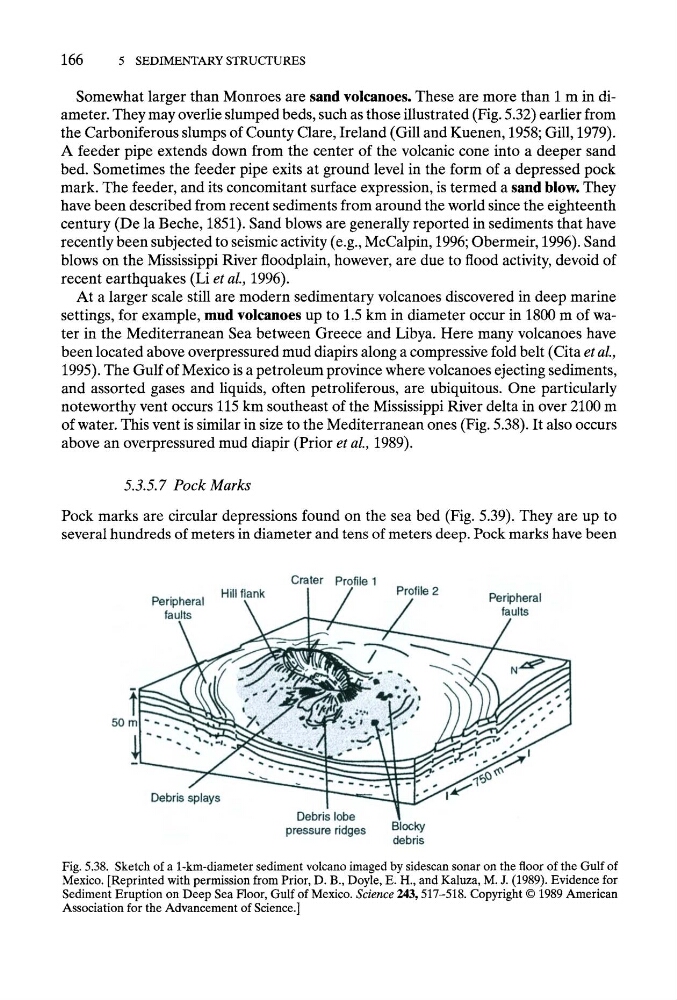
of water. This vent is similar in size to the Mediterranean ones (Fig. 5.38). It also occurs
above an overpressured mud diapir (Prior et al., 1989).
5.3.5. 7 Pock Marks
Pock marks are circular depressions found on the sea bed (Fig. 5.39). They are up to
several hundreds of meters in diameter and tens of meters deep. Pock marks have been
Fig. 5.38. Sketch of a 1-km-diameter sediment volcano imaged by sidescan sonar on the floor of the Gulf of
Mexico. [Reprinted with permission from Prior, D. B., Doyle, E. H., and Kaluza, M. J. (1989). Evidence for
Sediment Eruption on Deep Sea Floor, Gulf of Mexico. Science 243, 517-518. Copyright 9 1989 American
Association for the Advancement of Science.]
5 SEDIMENTARY STRUCTURES
Somewhat larger than Monroes are sand volcanoes. These are more than 1 m in diameter. They may overlie slumped beds, such as those illustrated (Fig. 5.32) earlier from
the Carboniferous slumps of County Clare, Ireland (Gill and Kuenen, 1958; Gill, 1979).
A feeder pipe extends down from the center of the volcanic cone into a deeper sand
bed. Sometimes the feeder pipe exits at ground level in the form of a depressed pock
mark. The feeder, and its concomitant surface expression, is termed a sand blow. They
have been described from recent sediments from around the world since the eighteenth
century (De la Beche, 1851). Sand blows are generally reported in sediments that have
recently been subjected to seismic activity (e.g., McCalpin, 1996; Obermeir, 1996). Sand
blows on the Mississippi River floodplain, however, are due to flood activity, devoid of
recent earthquakes (Li et al., 1996).
At a larger scale still are modern sedimentary volcanoes discovered in deep marine
settings, for example, mud volcanoes up to 1.5 km in diameter occur in 1800 m of water in the Mediterranean Sea between Greece and Libya. Here many volcanoes have
been located above overpressured mud diapirs along a compressive fold belt (Cita et al.,
1995). The Gulf of Mexico is a petroleum province where volcanoes ejecting sediments,
and assorted gases and liquids, often petroliferous, are ubiquitous. One particularly
noteworthy vent occurs 115 km southeast of the Mississippi River delta in over 2100 m
of water. This vent is similar in size to the Mediterranean ones (Fig. 5.38). It also occurs
above an overpressured mud diapir (Prior et al., 1989).
5.3.5. 7 Pock Marks
Pock marks are circular depressions found on the sea bed (Fig. 5.39). They are up to
several hundreds of meters in diameter and tens of meters deep. Pock marks have been
Fig. 5.38. Sketch of a 1-km-diameter sediment volcano imaged by sidescan sonar on the floor of the Gulf of
Mexico. [Reprinted with permission from Prior, D. B., Doyle, E. H., and Kaluza, M. J. (1989). Evidence for
Sediment Eruption on Deep Sea Floor, Gulf of Mexico. Science 243, 517-518. Copyright 9 1989 American
Association for the Advancement of Science.]