

164
5 SEDIMENTARY STRUCTURES
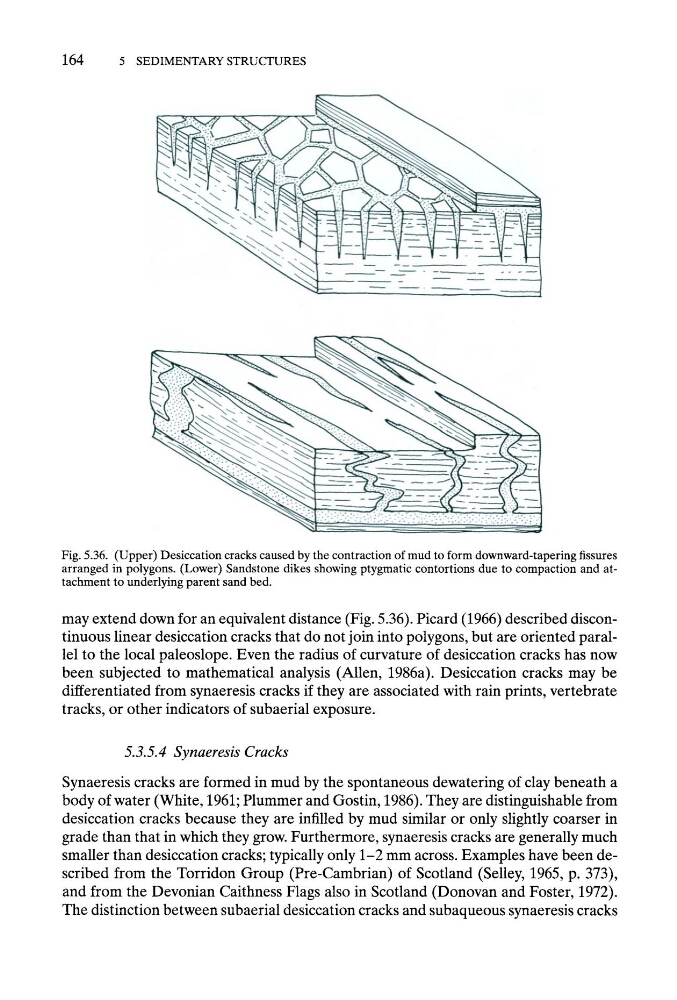
Fig. 5.36. (Upper) Desiccation cracks caused by the contraction of mud to form downward-tapering fissures
arranged in polygons. (Lower) Sandstone dikes showing ptygmatic contortions due to compaction and attachment to underlying parent sand bed.
may extend down for an equivalent distance (Fig. 5.36). Picard (1966) described discontinuous linear desiccation cracks that do not join into polygons, but are oriented parallel to the local paleoslope. Even the radius of curvature of desiccation cracks has now
been subjected to mathematical analysis (Allen, 1986a). Desiccation cracks may be
differentiated from synaeresis cracks if they are associated with rain prints, vertebrate
tracks, or other indicators of subaerial exposure.
5.3.5.4 Synaeresis Cracks
Synaeresis cracks are formed in mud by the spontaneous dewatering of clay beneath a
body of water (White, 1961; Plummer and Gostin, 1986). They are distinguishable from
desiccation cracks because they are infilled by mud similar or only slightly coarser in
grade than that in which they grow. Furthermore, synaeresis cracks are generally much
smaller than desiccation cracks; typically only 1-2 mm across. Examples have been described from the Torridon Group (Pre-Cambrian) of Scotland (Selley, 1965, p. 373),
and from the Devonian Caithness Flags also in Scotland (Donovan and Foster, 1972).
The distinction between subaerial desiccation cracks and subaqueous synaeresis cracks
5 SEDIMENTARY STRUCTURES
Fig. 5.36. (Upper) Desiccation cracks caused by the contraction of mud to form downward-tapering fissures
arranged in polygons. (Lower) Sandstone dikes showing ptygmatic contortions due to compaction and attachment to underlying parent sand bed.
may extend down for an equivalent distance (Fig. 5.36). Picard (1966) described discontinuous linear desiccation cracks that do not join into polygons, but are oriented parallel to the local paleoslope. Even the radius of curvature of desiccation cracks has now
been subjected to mathematical analysis (Allen, 1986a). Desiccation cracks may be
differentiated from synaeresis cracks if they are associated with rain prints, vertebrate
tracks, or other indicators of subaerial exposure.
5.3.5.4 Synaeresis Cracks
Synaeresis cracks are formed in mud by the spontaneous dewatering of clay beneath a
body of water (White, 1961; Plummer and Gostin, 1986). They are distinguishable from
desiccation cracks because they are infilled by mud similar or only slightly coarser in
grade than that in which they grow. Furthermore, synaeresis cracks are generally much
smaller than desiccation cracks; typically only 1-2 mm across. Examples have been described from the Torridon Group (Pre-Cambrian) of Scotland (Selley, 1965, p. 373),
and from the Devonian Caithness Flags also in Scotland (Donovan and Foster, 1972).
The distinction between subaerial desiccation cracks and subaqueous synaeresis cracks