

148
5 SEDIMENTARY STRUCTURES
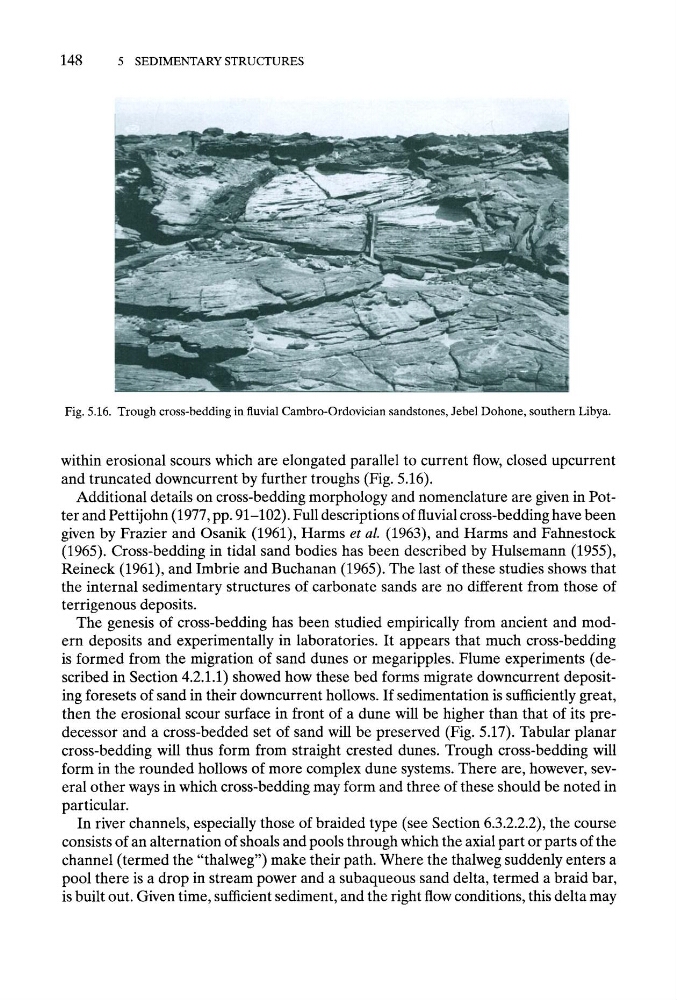
Fig. 5.16. Trough cross-bedding in fluvial Cambro-Ordovician sandstones, Jebel Dohone, southern Libya.
within erosional scours which are elongated parallel to current flow, closed upcurrent
and truncated downcurrent by further troughs (Fig. 5.16).
Additional details on cross-bedding morphology and nomenclature are given in Potter and Pettijohn (1977, pp. 91-102). Full descriptions of fluvial cross-bedding have been
given by Frazier and Osanik (1961), Harms et al. (1963), and Harms and Fahnestock
(1965). Cross-bedding in tidal sand bodies has been described by Hulsemann (1955),
Reineck (1961), and Imbrie and Buchanan (1965). The last of these studies shows that
the internal sedimentary structures of carbonate sands are no different from those of
terrigenous deposits.
The genesis of cross-bedding has been studied empirically from ancient and modern deposits and experimentally in laboratories. It appears that much cross-bedding
is formed from the migration of sand dunes or megaripples. Flume experiments (described in Section 4.2.1.1) showed how these bed forms migrate downcurrent depositing foresets of sand in their downcurrent hollows. If sedimentation is sufficiently great,
then the erosional scour surface in front of a dune will be higher than that of its predecessor and a cross-bedded set of sand will be preserved (Fig. 5.17). Tabular planar
cross-bedding will thus form from straight crested dunes. Trough cross-bedding will
form in the rounded hollows of more complex dune systems. There are, however, several other ways in which cross-bedding may form and three of these should be noted in
particular.
In river channels, especially those of braided type (see Section 6.3.2.2.2), the course
consists of an alternation of shoals and pools through which the axial part or parts of the
channel (termed the "thalweg") make their path. Where the thalweg suddenly enters a
pool there is a drop in stream power and a subaqueous sand delta, termed a braid bar,
is built out. Given time, sufficient sediment, and the right flow conditions, this delta may
5 SEDIMENTARY STRUCTURES
Fig. 5.16. Trough cross-bedding in fluvial Cambro-Ordovician sandstones, Jebel Dohone, southern Libya.
within erosional scours which are elongated parallel to current flow, closed upcurrent
and truncated downcurrent by further troughs (Fig. 5.16).
Additional details on cross-bedding morphology and nomenclature are given in Potter and Pettijohn (1977, pp. 91-102). Full descriptions of fluvial cross-bedding have been
given by Frazier and Osanik (1961), Harms et al. (1963), and Harms and Fahnestock
(1965). Cross-bedding in tidal sand bodies has been described by Hulsemann (1955),
Reineck (1961), and Imbrie and Buchanan (1965). The last of these studies shows that
the internal sedimentary structures of carbonate sands are no different from those of
terrigenous deposits.
The genesis of cross-bedding has been studied empirically from ancient and modern deposits and experimentally in laboratories. It appears that much cross-bedding
is formed from the migration of sand dunes or megaripples. Flume experiments (described in Section 4.2.1.1) showed how these bed forms migrate downcurrent depositing foresets of sand in their downcurrent hollows. If sedimentation is sufficiently great,
then the erosional scour surface in front of a dune will be higher than that of its predecessor and a cross-bedded set of sand will be preserved (Fig. 5.17). Tabular planar
cross-bedding will thus form from straight crested dunes. Trough cross-bedding will
form in the rounded hollows of more complex dune systems. There are, however, several other ways in which cross-bedding may form and three of these should be noted in
particular.
In river channels, especially those of braided type (see Section 6.3.2.2.2), the course
consists of an alternation of shoals and pools through which the axial part or parts of the
channel (termed the "thalweg") make their path. Where the thalweg suddenly enters a
pool there is a drop in stream power and a subaqueous sand delta, termed a braid bar,
is built out. Given time, sufficient sediment, and the right flow conditions, this delta may