

5.3 PRIMARY INORGANIC SEDIMENTARY STRUCTURES
145
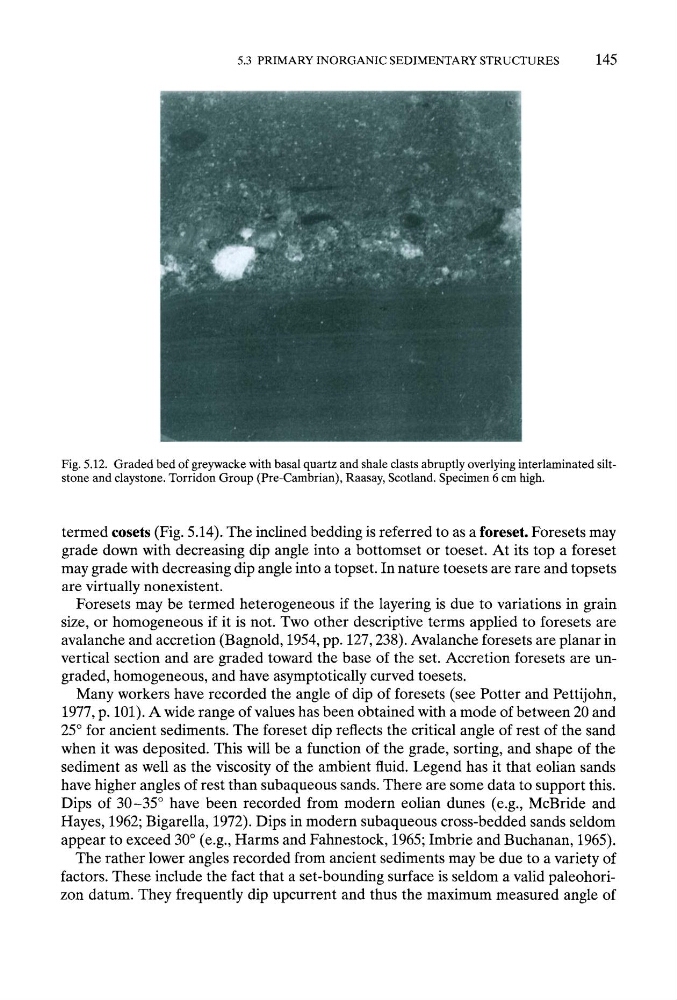
Fig. 5.12. Graded bed of greywacke with basal quartz and shale clasts abruptly overlying interlaminated siltstone and claystone. Torridon Group (Pre-Cambrian), Raasay, Scotland. Specimen 6 cm high.
termed cosets (Fig. 5.14). The inclined bedding is referred to as a foreset. Foresets may
grade down with decreasing dip angle into a bottomset or toeset. At its top a foreset
may grade with decreasing dip angle into a topset. In nature toesets are rare and topsets
are virtually nonexistent.
Foresets may be termed heterogeneous if the layering is due to variations in grain
size, or homogeneous if it is not. Two other descriptive terms applied to foresets are
avalanche and accretion (Bagnold, 1954, pp. 127, 238). Avalanche foresets are planar in
vertical section and are graded toward the base of the set. Accretion foresets are ungraded, homogeneous, and have asymptotically curved toesets.
Many workers have recorded the angle of dip of foresets (see Potter and Pettijohn,
1977, p. 101). A wide range of values has been obtained with a mode of between 20 and
25 ~ for ancient sediments. The foreset dip reflects the critical angle of rest of the sand
when it was deposited. This will be a function of the grade, sorting, and shape of the
sediment as well as the viscosity of the ambient fluid. Legend has it that eolian sands
have higher angles of rest than subaqueous sands. There are some data to support this.
Dips of 30-35 ~ have been recorded from modern eolian dunes (e.g., McBride and
Hayes, 1962; Bigarella, 1972). Dips in modern subaqueous cross-bedded sands seldom
appear to exceed 30 ~ (e.g., Harms and Fahnestock, 1965; Imbrie and Buchanan, 1965).
The rather lower angles recorded from ancient sediments may be due to a variety of
factors. These include the fact that a set-bounding surface is seldom a valid paleohorizon datum. They frequently dip upcurrent and thus the maximum measured angle of
145
Fig. 5.12. Graded bed of greywacke with basal quartz and shale clasts abruptly overlying interlaminated siltstone and claystone. Torridon Group (Pre-Cambrian), Raasay, Scotland. Specimen 6 cm high.
termed cosets (Fig. 5.14). The inclined bedding is referred to as a foreset. Foresets may
grade down with decreasing dip angle into a bottomset or toeset. At its top a foreset
may grade with decreasing dip angle into a topset. In nature toesets are rare and topsets
are virtually nonexistent.
Foresets may be termed heterogeneous if the layering is due to variations in grain
size, or homogeneous if it is not. Two other descriptive terms applied to foresets are
avalanche and accretion (Bagnold, 1954, pp. 127, 238). Avalanche foresets are planar in
vertical section and are graded toward the base of the set. Accretion foresets are ungraded, homogeneous, and have asymptotically curved toesets.
Many workers have recorded the angle of dip of foresets (see Potter and Pettijohn,
1977, p. 101). A wide range of values has been obtained with a mode of between 20 and
25 ~ for ancient sediments. The foreset dip reflects the critical angle of rest of the sand
when it was deposited. This will be a function of the grade, sorting, and shape of the
sediment as well as the viscosity of the ambient fluid. Legend has it that eolian sands
have higher angles of rest than subaqueous sands. There are some data to support this.
Dips of 30-35 ~ have been recorded from modern eolian dunes (e.g., McBride and
Hayes, 1962; Bigarella, 1972). Dips in modern subaqueous cross-bedded sands seldom
appear to exceed 30 ~ (e.g., Harms and Fahnestock, 1965; Imbrie and Buchanan, 1965).
The rather lower angles recorded from ancient sediments may be due to a variety of
factors. These include the fact that a set-bounding surface is seldom a valid paleohorizon datum. They frequently dip upcurrent and thus the maximum measured angle of