

112
4 TRANSPORTATION AND SEDIMENTATION
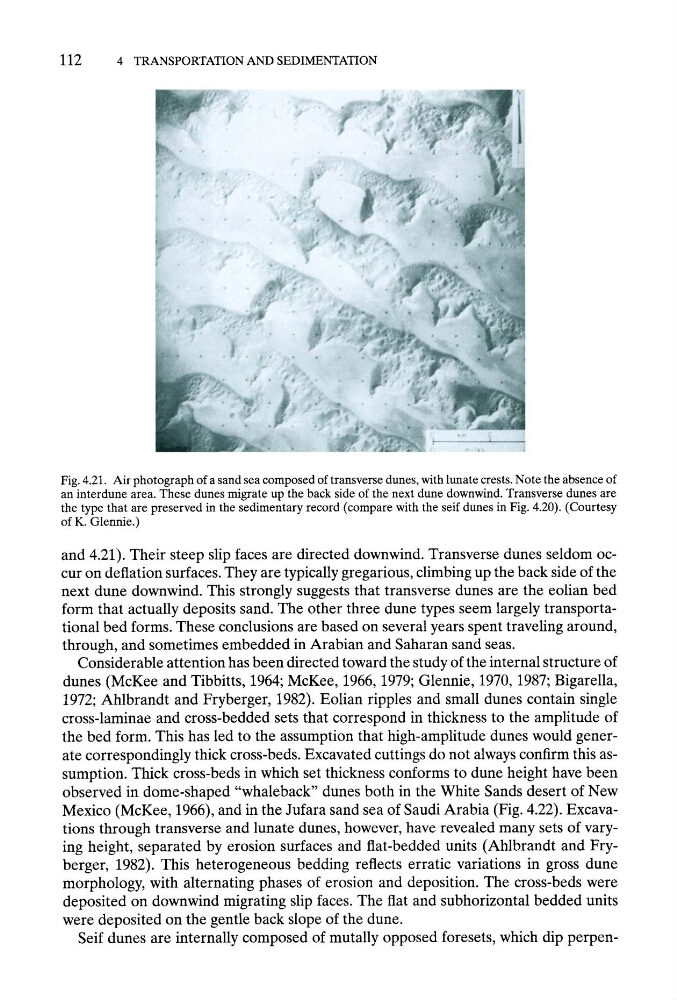
Fig. 4.21. Air photograph of a sand sea composed of transverse dunes, with lunate crests. Note the absence of
an interdune area. These dunes migrate up the back side of the next dune downwind. Transverse dunes are
the type that are preserved in the sedimentary record (compare with the seif dunes in Fig. 4.20). (Courtesy
of K. Glennie.)
and 4.21). Their steep slip faces are directed downwind. Transverse dunes seldom occur on deflation surfaces. They are typically gregarious, climbing up the back side of the
next dune downwind. This strongly suggests that transverse dunes are the eolian bed
form that actually deposits sand. The other three dune types seem largely transportational bed forms. These conclusions are based on several years spent traveling around,
through, and sometimes embedded in Arabian and Saharan sand seas.
Considerable attention has been directed toward the study of the internal structure of
dunes (McKee and Tibbitts, 1964; McKee, 1966, 1979; Glennie, 1970, 1987; Bigarella,
1972; Ahlbrandt and Fryberger, 1982). Eolian ripples and small dunes contain single
cross-laminae and cross-bedded sets that correspond in thickness to the amplitude of
the bed form. This has led to the assumption that high-amplitude dunes would generate correspondingly thick cross-beds. Excavated cuttings do not always confirm this assumption. Thick cross-beds in which set thickness conforms to dune height have been
observed in dome-shaped "whaleback" dunes both in the White Sands desert of New
Mexico (McKee, 1966), and in the Jufara sand sea of Saudi Arabia (Fig. 4.22). Excavations through transverse and lunate dunes, however, have revealed many sets of varying height, separated by erosion surfaces and flat-bedded units (Ahlbrandt and Fryberger, 1982). This heterogeneous bedding reflects erratic variations in gross dune
morphology, with alternating phases of erosion and deposition. The cross-beds were
deposited on downwind migrating slip faces. The flat and subhorizontal bedded units
were deposited on the gentle back slope of the dune.
Seif dunes are internally composed of mutally opposed foresets, which dip perpen-
4 TRANSPORTATION AND SEDIMENTATION
Fig. 4.21. Air photograph of a sand sea composed of transverse dunes, with lunate crests. Note the absence of
an interdune area. These dunes migrate up the back side of the next dune downwind. Transverse dunes are
the type that are preserved in the sedimentary record (compare with the seif dunes in Fig. 4.20). (Courtesy
of K. Glennie.)
and 4.21). Their steep slip faces are directed downwind. Transverse dunes seldom occur on deflation surfaces. They are typically gregarious, climbing up the back side of the
next dune downwind. This strongly suggests that transverse dunes are the eolian bed
form that actually deposits sand. The other three dune types seem largely transportational bed forms. These conclusions are based on several years spent traveling around,
through, and sometimes embedded in Arabian and Saharan sand seas.
Considerable attention has been directed toward the study of the internal structure of
dunes (McKee and Tibbitts, 1964; McKee, 1966, 1979; Glennie, 1970, 1987; Bigarella,
1972; Ahlbrandt and Fryberger, 1982). Eolian ripples and small dunes contain single
cross-laminae and cross-bedded sets that correspond in thickness to the amplitude of
the bed form. This has led to the assumption that high-amplitude dunes would generate correspondingly thick cross-beds. Excavated cuttings do not always confirm this assumption. Thick cross-beds in which set thickness conforms to dune height have been
observed in dome-shaped "whaleback" dunes both in the White Sands desert of New
Mexico (McKee, 1966), and in the Jufara sand sea of Saudi Arabia (Fig. 4.22). Excavations through transverse and lunate dunes, however, have revealed many sets of varying height, separated by erosion surfaces and flat-bedded units (Ahlbrandt and Fryberger, 1982). This heterogeneous bedding reflects erratic variations in gross dune
morphology, with alternating phases of erosion and deposition. The cross-beds were
deposited on downwind migrating slip faces. The flat and subhorizontal bedded units
were deposited on the gentle back slope of the dune.
Seif dunes are internally composed of mutally opposed foresets, which dip perpen-