

110
4 TRANSPORTATION AND SEDIMENTATION
WIND DIRECTION
I
A
....
...-...
..-.. 9
9 ..-: ........ 9
'...
...
Lunate dune
.,..~'
:...
':!;::
or barchan
__~_.~_C-,~
~
-=f,-.:. 9
-.--.
.4!
~::...
WIND DIRECTION
D. Transverse dune
B. Stellate dune
C. Seif or longitudinal dune
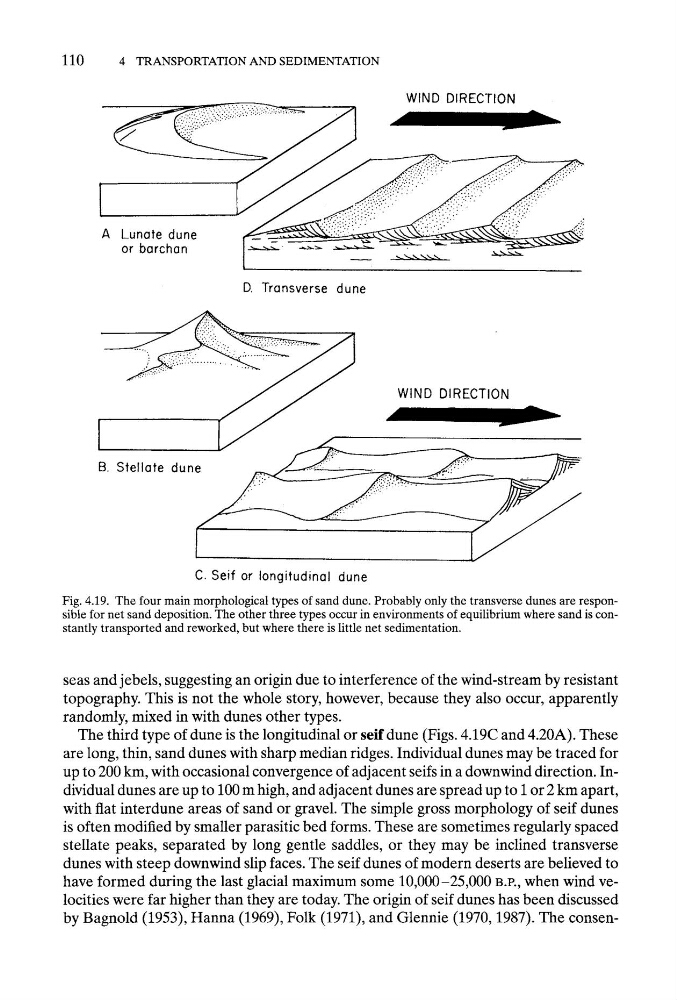
Fig. 4.19. The four main morphological types of sand dune. Probably only the transverse dunes are responsible for net sand deposition. The other three types occur in environments of equilibrium where sand is constantly transported and reworked, but where there is little net sedimentation.
seas and jebels, suggesting an origin due to interference of the wind-stream by resistant
topography. This is not the whole story, however, because they also occur, apparently
randomly, mixed in with dunes other types.
The third type of dune is the longitudinal or self dune (Figs. 4.19C and 4.20A). These
are long, thin, sand dunes with sharp median ridges. Individual dunes may be traced for
up to 200 km, with occasional convergence of adjacent seifs in a downwind direction. Individual dunes are up to 100 m high, and adjacent dunes are spread up to 1 or 2 km apart,
with flat interdune areas of sand or gravel. The simple gross morphology of seif dunes
is often modified by smaller parasitic bed forms. These are sometimes regularly spaced
stellate peaks, separated by long gentle saddles, or they may be inclined transverse
dunes with steep downwind slip faces. The seif dunes of modern deserts are believed to
have formed during the last glacial maximum some 10,000-25,000 B.P., when wind velocities were far higher than they are today. The origin of seif dunes has been discussed
by Bagnold (1953), Hanna (1969), Folk (1971), and Glennie (1970, 1987). The consen-
4 TRANSPORTATION AND SEDIMENTATION
WIND DIRECTION
I
A
....
...-...
..-.. 9
9 ..-: ........ 9
'...
...
Lunate dune
.,..~'
:...
':!;::
or barchan
__~_.~_C-,~
~
-=f,-.:. 9
-.--.
.4!
~::...
WIND DIRECTION
D. Transverse dune
B. Stellate dune
C. Seif or longitudinal dune
Fig. 4.19. The four main morphological types of sand dune. Probably only the transverse dunes are responsible for net sand deposition. The other three types occur in environments of equilibrium where sand is constantly transported and reworked, but where there is little net sedimentation.
seas and jebels, suggesting an origin due to interference of the wind-stream by resistant
topography. This is not the whole story, however, because they also occur, apparently
randomly, mixed in with dunes other types.
The third type of dune is the longitudinal or self dune (Figs. 4.19C and 4.20A). These
are long, thin, sand dunes with sharp median ridges. Individual dunes may be traced for
up to 200 km, with occasional convergence of adjacent seifs in a downwind direction. Individual dunes are up to 100 m high, and adjacent dunes are spread up to 1 or 2 km apart,
with flat interdune areas of sand or gravel. The simple gross morphology of seif dunes
is often modified by smaller parasitic bed forms. These are sometimes regularly spaced
stellate peaks, separated by long gentle saddles, or they may be inclined transverse
dunes with steep downwind slip faces. The seif dunes of modern deserts are believed to
have formed during the last glacial maximum some 10,000-25,000 B.P., when wind velocities were far higher than they are today. The origin of seif dunes has been discussed
by Bagnold (1953), Hanna (1969), Folk (1971), and Glennie (1970, 1987). The consen-