

4.2 AQUEOUS PROCESSES
107
SOURCE
Proximal
Grain size and bed thickness decrease'
Distal
v
INTERNAL
I
STRUCTURESI
1 ..... ~JE
f
ID
B
_~J
.f
BOTTOM
Flute
Groove
Tool
STRUCTURES Channels
~
~
.....
marks
marks
marks
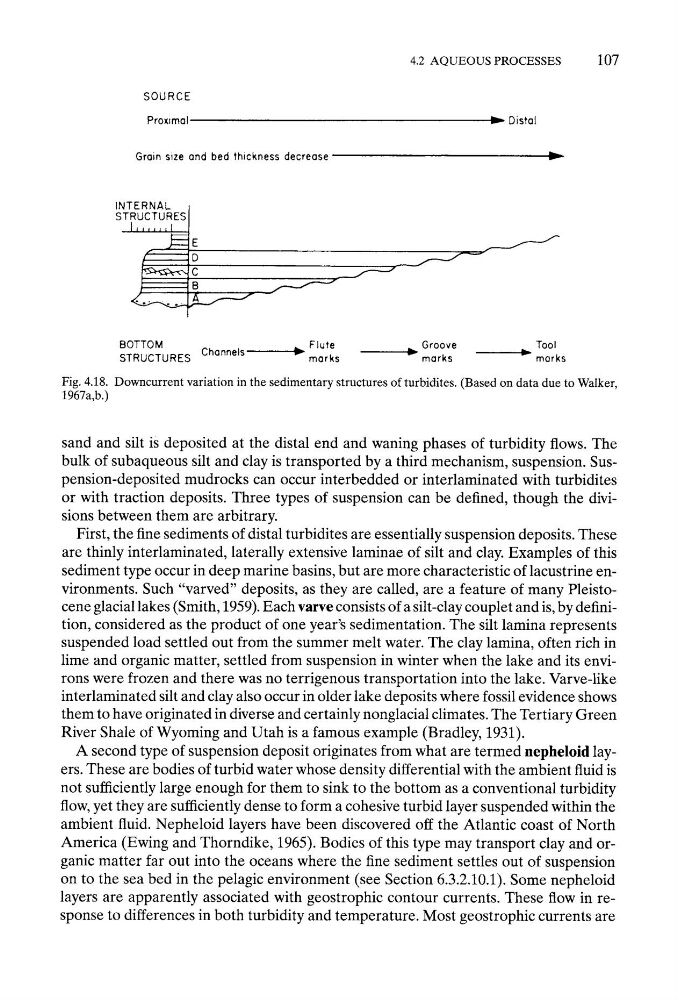
Fig. 4.18. Downcurrent variation in the sedimentary structures of turbidites. (Based on data due to Walker,
1967a,b.)
sand and silt is deposited at the distal end and waning phases of turbidity flows. The
bulk of subaqueous silt and clay is transported by a third mechanism, suspension. Suspension-deposited mudrocks can occur interbedded or interlaminated with turbidites
or with traction deposits. Three types of suspension can be defined, though the divisions between them are arbitrary.
First, the fine sediments of distal turbidites are essentially suspension deposits. These
are thinly interlaminated, laterally extensive laminae of silt and clay. Examples of this
sediment type occur in deep marine basins, but are more characteristic of lacustrine environments. Such "varved" deposits, as they are called, are a feature of many Pleistocene glacial lakes (Smith, 1959). Each varve consists of a silt-clay couplet and is, by definition, considered as the product of one year's sedimentation. The silt lamina represents
suspended load settled out from the summer melt water. The clay lamina, often rich in
lime and organic matter, settled from suspension in winter when the lake and its environs were frozen and there was no terrigenous transportation into the lake. Varve-like
interlaminated silt and clay also occur in older lake deposits where fossil evidence shows
them to have originated in diverse and certainly nonglacial climates. The Tertiary Green
River Shale of Wyoming and Utah is a famous example (Bradley, 1931).
A second type of suspension deposit originates from what are termed nepheloid layers. These are bodies of turbid water whose density differential with the ambient fluid is
not sufficiently large enough for them to sink to the bottom as a conventional turbidity
flow, yet they are sufficiently dense to form a cohesive turbid layer suspended within the
ambient fluid. Nepheloid layers have been discovered off the Atlantic coast of North
America (Ewing and Thorndike, 1965). Bodies of this type may transport clay and organic matter far out into the oceans where the fine sediment settles out of suspension
on to the sea bed in the pelagic environment (see Section 6.3.2.10.1). Some nepheloid
layers are apparently associated with geostrophic contour currents. These flow in response to differences in both turbidity and temperature. Most geostrophic currents are
107
SOURCE
Proximal
Grain size and bed thickness decrease'
Distal
v
INTERNAL
I
STRUCTURESI
1 ..... ~JE
f
ID
B
_~J
.f
BOTTOM
Flute
Groove
Tool
STRUCTURES Channels
~
~
.....
marks
marks
marks
Fig. 4.18. Downcurrent variation in the sedimentary structures of turbidites. (Based on data due to Walker,
1967a,b.)
sand and silt is deposited at the distal end and waning phases of turbidity flows. The
bulk of subaqueous silt and clay is transported by a third mechanism, suspension. Suspension-deposited mudrocks can occur interbedded or interlaminated with turbidites
or with traction deposits. Three types of suspension can be defined, though the divisions between them are arbitrary.
First, the fine sediments of distal turbidites are essentially suspension deposits. These
are thinly interlaminated, laterally extensive laminae of silt and clay. Examples of this
sediment type occur in deep marine basins, but are more characteristic of lacustrine environments. Such "varved" deposits, as they are called, are a feature of many Pleistocene glacial lakes (Smith, 1959). Each varve consists of a silt-clay couplet and is, by definition, considered as the product of one year's sedimentation. The silt lamina represents
suspended load settled out from the summer melt water. The clay lamina, often rich in
lime and organic matter, settled from suspension in winter when the lake and its environs were frozen and there was no terrigenous transportation into the lake. Varve-like
interlaminated silt and clay also occur in older lake deposits where fossil evidence shows
them to have originated in diverse and certainly nonglacial climates. The Tertiary Green
River Shale of Wyoming and Utah is a famous example (Bradley, 1931).
A second type of suspension deposit originates from what are termed nepheloid layers. These are bodies of turbid water whose density differential with the ambient fluid is
not sufficiently large enough for them to sink to the bottom as a conventional turbidity
flow, yet they are sufficiently dense to form a cohesive turbid layer suspended within the
ambient fluid. Nepheloid layers have been discovered off the Atlantic coast of North
America (Ewing and Thorndike, 1965). Bodies of this type may transport clay and organic matter far out into the oceans where the fine sediment settles out of suspension
on to the sea bed in the pelagic environment (see Section 6.3.2.10.1). Some nepheloid
layers are apparently associated with geostrophic contour currents. These flow in response to differences in both turbidity and temperature. Most geostrophic currents are