

4.2 AQUEOUS PROCESSES
101
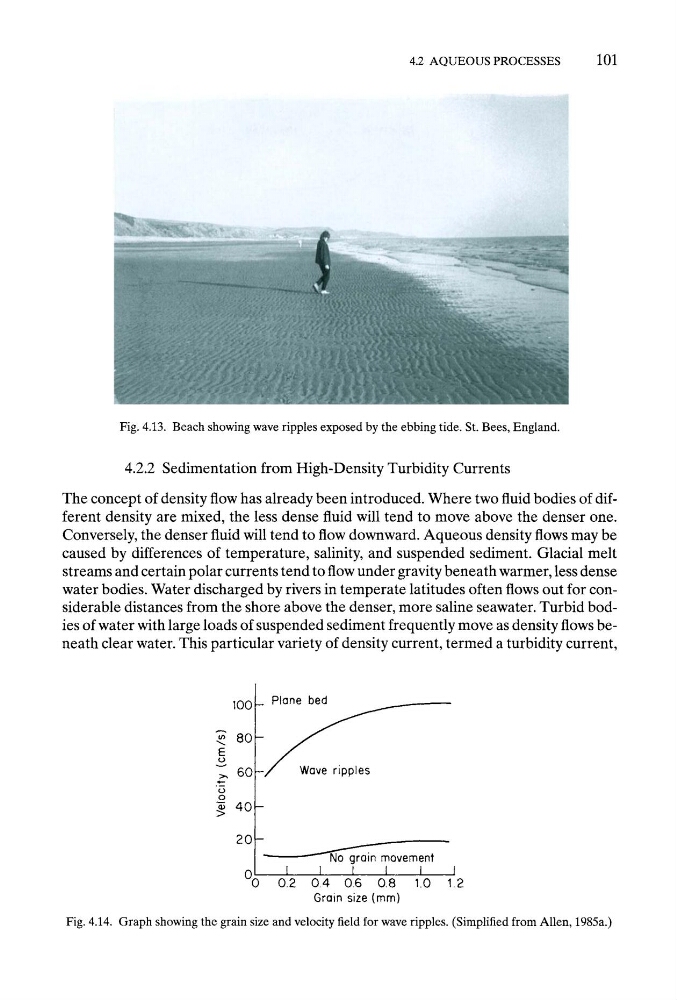
Fig. 4.13. Beach showing wave ripples exposed by the ebbing tide. St. Bees, England.
4.2.2 Sedimentation from High-Density Turbidity Currents
The concept of density flow has already been introduced. Where two fluid bodies of different density are mixed, the less dense fluid will tend to move above the denser one.
Conversely, the denser fluid will tend to flow downward. Aqueous density flows may be
caused by differences of temperature, salinity, and suspended sediment. Glacial melt
streams and certain polar currents tend to flow under gravity beneath warmer, less dense
water bodies. Water discharged by rivers in temperate latitudes often flows out for considerable distances from the shore above the denser, more saline seawater. Turbid bodies of water with large loads of suspended sediment frequently move as density flows beneath clear water. This particular variety of density current, termed a turbidity current,
/
100~ Plane bed
/
E
~ 40
~
20
No groin movement
0 /
1
I
1
!
I
J
0
0.2 0.4 0.6 0.8
1.0 1.2
Grain size (mm)
Fig. 4.14. Graph showing the grain size and velocity field for wave ripples. (Simplified from Allen, 1985a.)
101
Fig. 4.13. Beach showing wave ripples exposed by the ebbing tide. St. Bees, England.
4.2.2 Sedimentation from High-Density Turbidity Currents
The concept of density flow has already been introduced. Where two fluid bodies of different density are mixed, the less dense fluid will tend to move above the denser one.
Conversely, the denser fluid will tend to flow downward. Aqueous density flows may be
caused by differences of temperature, salinity, and suspended sediment. Glacial melt
streams and certain polar currents tend to flow under gravity beneath warmer, less dense
water bodies. Water discharged by rivers in temperate latitudes often flows out for considerable distances from the shore above the denser, more saline seawater. Turbid bodies of water with large loads of suspended sediment frequently move as density flows beneath clear water. This particular variety of density current, termed a turbidity current,
/
100~ Plane bed
/
E
~ 40
~
20
No groin movement
0 /
1
I
1
!
I
J
0
0.2 0.4 0.6 0.8
1.0 1.2
Grain size (mm)
Fig. 4.14. Graph showing the grain size and velocity field for wave ripples. (Simplified from Allen, 1985a.)