

4.2 AQUEOUS PROCESSES
99
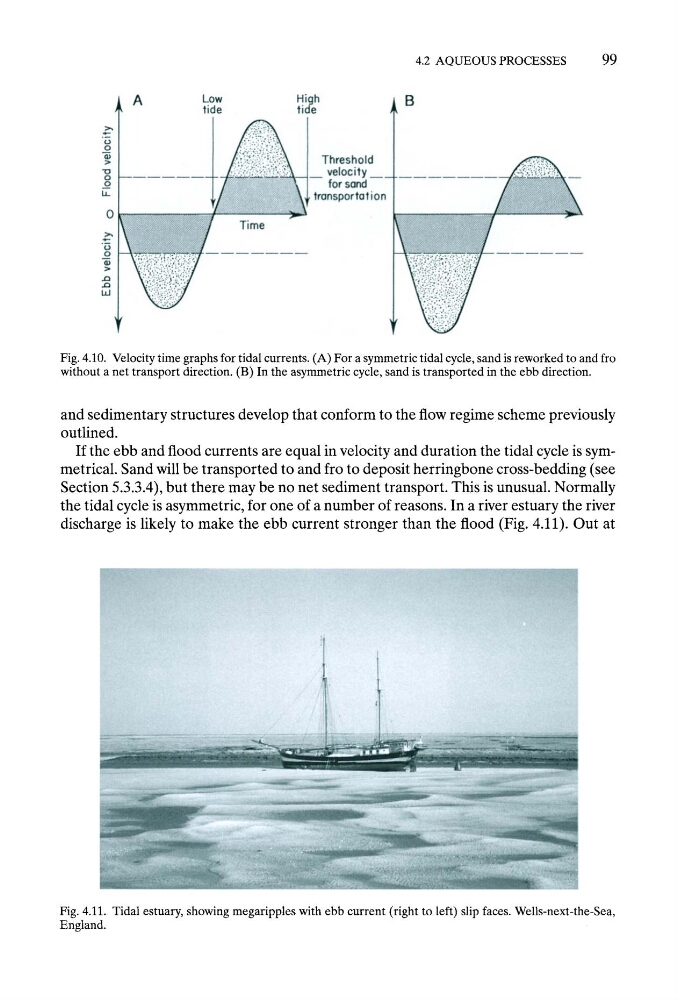
Fig. 4.10. Velocity time graphs for tidal currents. (A) For a symmetric tidal cycle, sand is reworked to and fro
without a net transport direction. (B) In the asymmetric cycle, sand is transported in the ebb direction.
and sedimentary structures develop that conform to the flow regimescheme previously
outlined.
If the ebb and flood currents are equal in velocity and duration the tidal cycle is symmetrical. Sand will be transported to and fro to deposit herringbone cross-bedding (see
Section 5.3.3.4), but there may be no net sediment transport. This is unusual. Normally
the tidal cycle is asymmetric, for one of a number of reasons. In a river estuary the river
discharge is likely to make the ebb current stronger than the flood (Fig. 4.11). Out at
Fig. 4.11. Tidal estuary, showing megaripples with ebb current (right to left) slip faces. Wells-next-the-Sea,
England.
99
Fig. 4.10. Velocity time graphs for tidal currents. (A) For a symmetric tidal cycle, sand is reworked to and fro
without a net transport direction. (B) In the asymmetric cycle, sand is transported in the ebb direction.
and sedimentary structures develop that conform to the flow regimescheme previously
outlined.
If the ebb and flood currents are equal in velocity and duration the tidal cycle is symmetrical. Sand will be transported to and fro to deposit herringbone cross-bedding (see
Section 5.3.3.4), but there may be no net sediment transport. This is unusual. Normally
the tidal cycle is asymmetric, for one of a number of reasons. In a river estuary the river
discharge is likely to make the ebb current stronger than the flood (Fig. 4.11). Out at
Fig. 4.11. Tidal estuary, showing megaripples with ebb current (right to left) slip faces. Wells-next-the-Sea,
England.