

90
4 TRANSPORTATION AND SEDIMENTATION
simplest a small particle will settle faster than a larger one of equal density. Conversely,
of two particles of equal diameter but different densities, the denser one will settle first.
Stokes' law is only valid, however, for a single sphere. In the real world, settling velocity also varies according to grain shape and to grain concentration, since sedimentation rate will be affected by adjacent particles colliding. Few sediment grains are perfect spheres. Quartz and feldspar particles are normally ovoid, micas are plate-like, and
skeletal fragments highly irregular. The idea of sedimentation-equivalent particles has
thus been developed to take into account grain shape. Hydraulically equivalent particles settle at the same velocity in water. Aerodynamically equivalent particles settle at
the same velocity in air (Friedman, 1961; Hand, 1967). Detrital minerals have a wide
range of densities. Terrigenous sands are largely made up of quartz with a density of
2.65 g/cm 3. But they may also contain feldspars, ranging between 2.55 and 2.76 g/cm 3,
and micas, ranging from 2.83 (muscovite) to 3.12 g/cm 3 (biotite). Most sands also contain varying amounts of heavy minerals, arbitrarily defined as those with a density
greater than 3.0 g/cm 3. These include many economically important minerals such as
gold, with a density of 19 g/cm 3. When segregated these valuable heavy minerals are
the placer ores. Thus much work has been done to try to understand the processes that
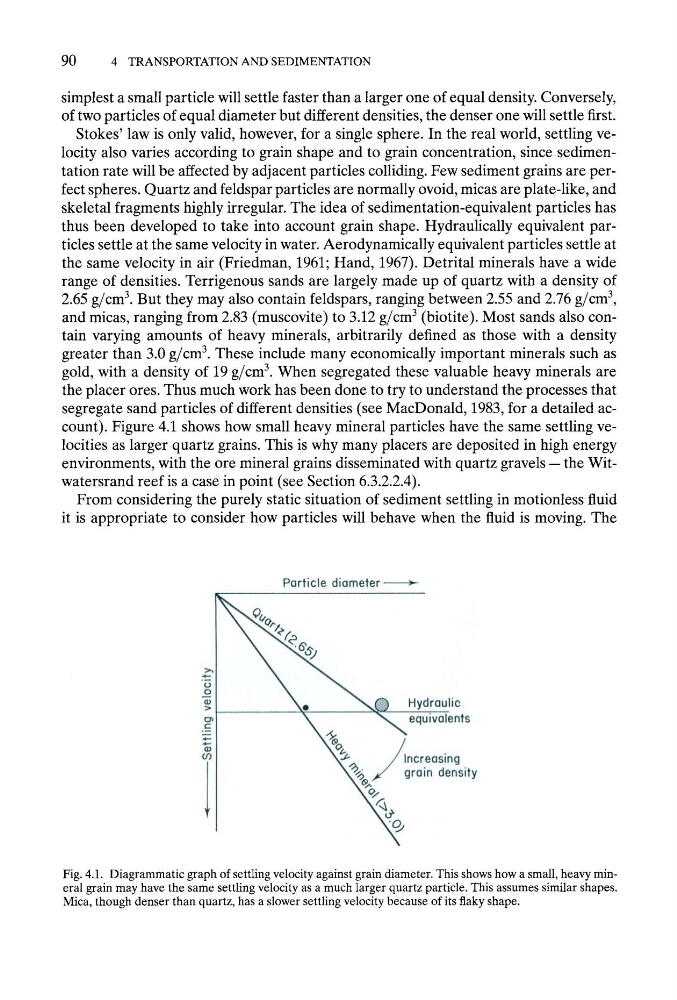
segregate sand particles of different densities (see MacDonald, 1983, for a detailed account). Figure 4.1 shows how small heavy mineral particles have the same settling velocities as larger quartz grains. This is why many placers are deposited in high energy
environments, with the ore mineral grains disseminated with quartz gravels- the Witwatersrand reef is a case in point (see Section 6.3.2.2.4).
From considering the purely static situation of sediment settling in motionless fluid
it is appropriate to consider how particles will behave when the fluid is moving. The
Fig. 4.1. Diagrammatic graph of settling velocity against grain diameter. This shows how a small, heavy mineral grain may have the same settling velocity as a much larger quartz particle. This assumes similar shapes.
Mica, though denser than quartz, has a slower settling velocity because of its flaky shape.
4 TRANSPORTATION AND SEDIMENTATION
simplest a small particle will settle faster than a larger one of equal density. Conversely,
of two particles of equal diameter but different densities, the denser one will settle first.
Stokes' law is only valid, however, for a single sphere. In the real world, settling velocity also varies according to grain shape and to grain concentration, since sedimentation rate will be affected by adjacent particles colliding. Few sediment grains are perfect spheres. Quartz and feldspar particles are normally ovoid, micas are plate-like, and
skeletal fragments highly irregular. The idea of sedimentation-equivalent particles has
thus been developed to take into account grain shape. Hydraulically equivalent particles settle at the same velocity in water. Aerodynamically equivalent particles settle at
the same velocity in air (Friedman, 1961; Hand, 1967). Detrital minerals have a wide
range of densities. Terrigenous sands are largely made up of quartz with a density of
2.65 g/cm 3. But they may also contain feldspars, ranging between 2.55 and 2.76 g/cm 3,
and micas, ranging from 2.83 (muscovite) to 3.12 g/cm 3 (biotite). Most sands also contain varying amounts of heavy minerals, arbitrarily defined as those with a density
greater than 3.0 g/cm 3. These include many economically important minerals such as
gold, with a density of 19 g/cm 3. When segregated these valuable heavy minerals are
the placer ores. Thus much work has been done to try to understand the processes that
segregate sand particles of different densities (see MacDonald, 1983, for a detailed account). Figure 4.1 shows how small heavy mineral particles have the same settling velocities as larger quartz grains. This is why many placers are deposited in high energy
environments, with the ore mineral grains disseminated with quartz gravels- the Witwatersrand reef is a case in point (see Section 6.3.2.2.4).
From considering the purely static situation of sediment settling in motionless fluid
it is appropriate to consider how particles will behave when the fluid is moving. The
Fig. 4.1. Diagrammatic graph of settling velocity against grain diameter. This shows how a small, heavy mineral grain may have the same settling velocity as a much larger quartz particle. This assumes similar shapes.
Mica, though denser than quartz, has a slower settling velocity because of its flaky shape.