

42
Chapter 3: Fronts and Pycnoclines: Ecological Discontinuities
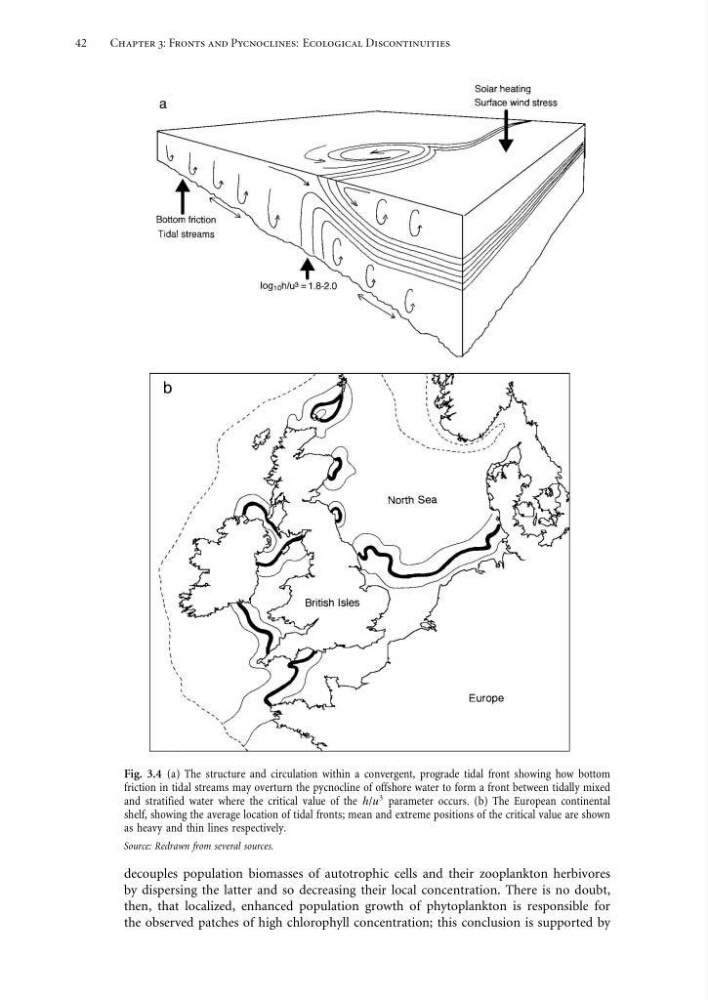
Fig. 3.4 (a) The structure and circulation within a convergent, prograde tidal front showing how bottom
friction in tidal streams may overturn the pycnocline of offshore water to form a front between tidally mixed
and stratified water where the critical value of the h/u
3 parameter occurs. (b) The European continental
shelf, showing the average location of tidal fronts; mean and extreme positions of the critical value are shown
as heavy and thin lines respectively.
Source: Redrawn from several sources.
decouples population biomasses of autotrophic cells and their zooplankton herbivores
by dispersing the latter and so decreasing their local concentration. There is no doubt,
then, that localized, enhanced population growth of phytoplankton is responsible for
the observed patches of high chlorophyll concentration; this conclusion is supported by
Chapter 3: Fronts and Pycnoclines: Ecological Discontinuities
Fig. 3.4 (a) The structure and circulation within a convergent, prograde tidal front showing how bottom
friction in tidal streams may overturn the pycnocline of offshore water to form a front between tidally mixed
and stratified water where the critical value of the h/u
3 parameter occurs. (b) The European continental
shelf, showing the average location of tidal fronts; mean and extreme positions of the critical value are shown
as heavy and thin lines respectively.
Source: Redrawn from several sources.
decouples population biomasses of autotrophic cells and their zooplankton herbivores
by dispersing the latter and so decreasing their local concentration. There is no doubt,
then, that localized, enhanced population growth of phytoplankton is responsible for
the observed patches of high chlorophyll concentration; this conclusion is supported by