

40
Chapter 3: Fronts and Pycnoclines: Ecological Discontinuities
stream and the existence of long standing waves is now confirmed by observation of
sun-glint pattern at the sea surface.
The enriched phytoplankton biomass that occurs in these frontal zones may arise
also from other mechanisms; Horne and Petrie (1986) described “shear-flow” dispersion
by which nutrient-rich subsurface water passes into shallower areas with the incoming
tide, to retreat a half-tidal cycle later with a diminished nutrient content. Whatever
physical mechanisms may dominate at each location, rates of cross-frontal transfer may
be quite high and apparently sufficient to maintain the observed enhanced phytoplankton
biomass. It should also be noted that where the shelf is sufficiently wide, a shelf edge
front may also occur seaward of coastal upwelling cells, in which case it will appear in
the chlorophyll field as a secondary, outer zone of biological enhancement.
Shelf-break fronts occur almost everywhere but, in some special circumstances, they
risk being confused with major oceanic fronts that lie parallel to the coast but further
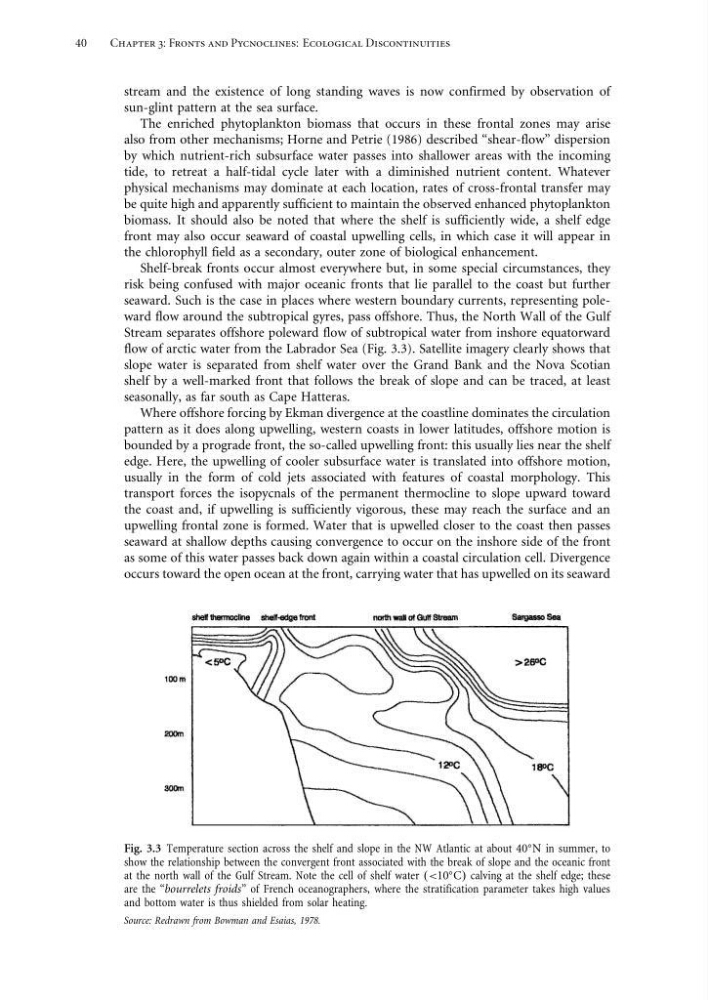
seaward. Such is the case in places where western boundary currents, representing poleward flow around the subtropical gyres, pass offshore. Thus, the North Wall of the Gulf
Stream separates offshore poleward flow of subtropical water from inshore equatorward
flow of arctic water from the Labrador Sea (Fig. 3.3). Satellite imagery clearly shows that
slope water is separated from shelf water over the Grand Bank and the Nova Scotian
shelf by a well-marked front that follows the break of slope and can be traced, at least
seasonally, as far south as Cape Hatteras.
Where offshore forcing by Ekman divergence at the coastline dominates the circulation
pattern as it does along upwelling, western coasts in lower latitudes, offshore motion is
bounded by a prograde front, the so-called upwelling front: this usually lies near the shelf
edge. Here, the upwelling of cooler subsurface water is translated into offshore motion,
usually in the form of cold jets associated with features of coastal morphology. This
transport forces the isopycnals of the permanent thermocline to slope upward toward
the coast and, if upwelling is sufficiently vigorous, these may reach the surface and an
upwelling frontal zone is formed. Water that is upwelled closer to the coast then passes
seaward at shallow depths causing convergence to occur on the inshore side of the front
as some of this water passes back down again within a coastal circulation cell. Divergence
occurs toward the open ocean at the front, carrying water that has upwelled on its seaward
Fig. 3.3 Temperature section across the shelf and slope in the NW Atlantic at about 40
N in summer, to
show the relationship between the convergent front associated with the break of slope and the oceanic front
at the north wall of the Gulf Stream. Note the cell of shelf water <10
C calving at the shelf edge; these
are the “bourrelets froids” of French oceanographers, where the stratification parameter takes high values
and bottom water is thus shielded from solar heating.
Source: Redrawn from Bowman and Esaias, 1978.
Chapter 3: Fronts and Pycnoclines: Ecological Discontinuities
stream and the existence of long standing waves is now confirmed by observation of
sun-glint pattern at the sea surface.
The enriched phytoplankton biomass that occurs in these frontal zones may arise
also from other mechanisms; Horne and Petrie (1986) described “shear-flow” dispersion
by which nutrient-rich subsurface water passes into shallower areas with the incoming
tide, to retreat a half-tidal cycle later with a diminished nutrient content. Whatever
physical mechanisms may dominate at each location, rates of cross-frontal transfer may
be quite high and apparently sufficient to maintain the observed enhanced phytoplankton
biomass. It should also be noted that where the shelf is sufficiently wide, a shelf edge
front may also occur seaward of coastal upwelling cells, in which case it will appear in
the chlorophyll field as a secondary, outer zone of biological enhancement.
Shelf-break fronts occur almost everywhere but, in some special circumstances, they
risk being confused with major oceanic fronts that lie parallel to the coast but further
seaward. Such is the case in places where western boundary currents, representing poleward flow around the subtropical gyres, pass offshore. Thus, the North Wall of the Gulf
Stream separates offshore poleward flow of subtropical water from inshore equatorward
flow of arctic water from the Labrador Sea (Fig. 3.3). Satellite imagery clearly shows that
slope water is separated from shelf water over the Grand Bank and the Nova Scotian
shelf by a well-marked front that follows the break of slope and can be traced, at least
seasonally, as far south as Cape Hatteras.
Where offshore forcing by Ekman divergence at the coastline dominates the circulation
pattern as it does along upwelling, western coasts in lower latitudes, offshore motion is
bounded by a prograde front, the so-called upwelling front: this usually lies near the shelf
edge. Here, the upwelling of cooler subsurface water is translated into offshore motion,
usually in the form of cold jets associated with features of coastal morphology. This
transport forces the isopycnals of the permanent thermocline to slope upward toward
the coast and, if upwelling is sufficiently vigorous, these may reach the surface and an
upwelling frontal zone is formed. Water that is upwelled closer to the coast then passes
seaward at shallow depths causing convergence to occur on the inshore side of the front
as some of this water passes back down again within a coastal circulation cell. Divergence
occurs toward the open ocean at the front, carrying water that has upwelled on its seaward
Fig. 3.3 Temperature section across the shelf and slope in the NW Atlantic at about 40
N in summer, to
show the relationship between the convergent front associated with the break of slope and the oceanic front
at the north wall of the Gulf Stream. Note the cell of shelf water <10
C calving at the shelf edge; these
are the “bourrelets froids” of French oceanographers, where the stratification parameter takes high values
and bottom water is thus shielded from solar heating.
Source: Redrawn from Bowman and Esaias, 1978.