

Fronts and Frontal Systems
37
eddies, stronger than background; at the local scale they include fronts that may be so
sharply defined at the ocean surface as to surprise oceanographers who come across them
at sea. For those who like their geography to be tidy, the TOPEX-POSEIDON images
must have been a difficult awakening to the real world. The images also explain why I
have suggested that some oceanic frontal regions should be regarded not as boundaries
between biogeographic regions, but as regions having unique characteristics.
The group of fronts associated with the equatorial currents differs strongly from other
frontal systems. The system of parallel Equatorial fronts is most clearly developed in
the eastern tropical Pacific Ocean, which will act as an exemplary case from which to
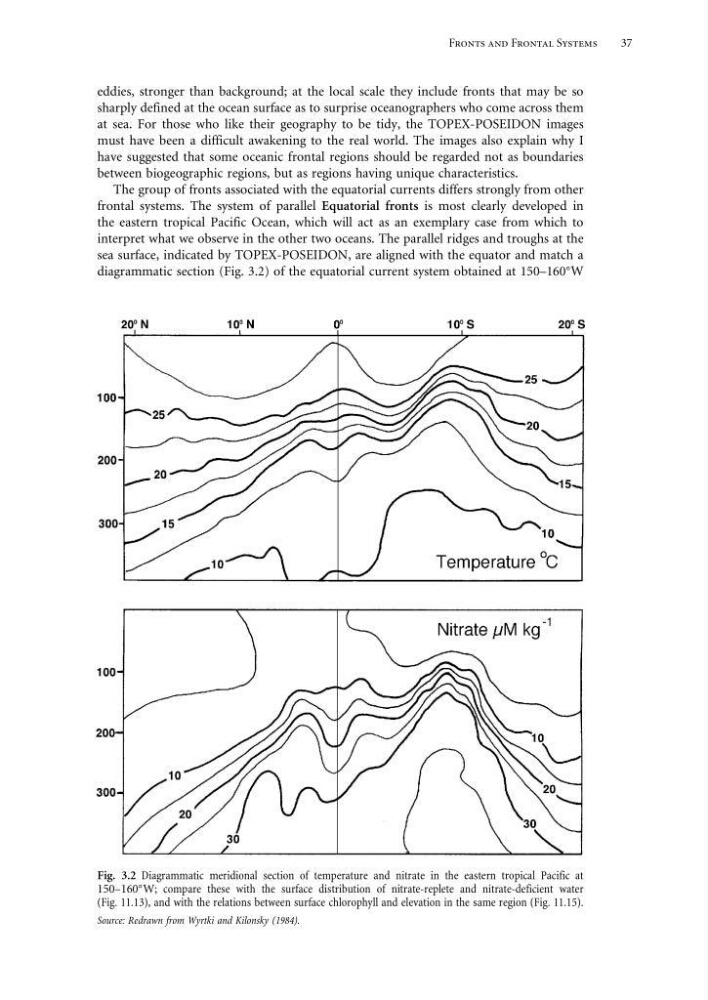
interpret what we observe in the other two oceans. The parallel ridges and troughs at the
sea surface, indicated by TOPEX-POSEIDON, are aligned with the equator and match a
diagrammatic section (Fig. 3.2) of the equatorial current system obtained at 150–160
W
Fig. 3.2 Diagrammatic meridional section of temperature and nitrate in the eastern tropical Pacific at
150–160
W; compare these with the surface distribution of nitrate-replete and nitrate-deficient water
(Fig. 11.13), and with the relations between surface chlorophyll and elevation in the same region (Fig. 11.15).
Source: Redrawn from Wyrtki and Kilonsky (1984).
37
eddies, stronger than background; at the local scale they include fronts that may be so
sharply defined at the ocean surface as to surprise oceanographers who come across them
at sea. For those who like their geography to be tidy, the TOPEX-POSEIDON images
must have been a difficult awakening to the real world. The images also explain why I
have suggested that some oceanic frontal regions should be regarded not as boundaries
between biogeographic regions, but as regions having unique characteristics.
The group of fronts associated with the equatorial currents differs strongly from other
frontal systems. The system of parallel Equatorial fronts is most clearly developed in
the eastern tropical Pacific Ocean, which will act as an exemplary case from which to
interpret what we observe in the other two oceans. The parallel ridges and troughs at the
sea surface, indicated by TOPEX-POSEIDON, are aligned with the equator and match a
diagrammatic section (Fig. 3.2) of the equatorial current system obtained at 150–160
W
Fig. 3.2 Diagrammatic meridional section of temperature and nitrate in the eastern tropical Pacific at
150–160
W; compare these with the surface distribution of nitrate-replete and nitrate-deficient water
(Fig. 11.13), and with the relations between surface chlorophyll and elevation in the same region (Fig. 11.15).
Source: Redrawn from Wyrtki and Kilonsky (1984).