

474
Chapter 12: The Southern Ocean
(Ommatophoca), Weddell (Leptonychotes), fur (Arctocephalus), and leopard (Hydrurga)
seals dominate, whereas elephant seals (Mirounga) occur mostly on the island groups
in the Southern Ocean. Greatest numbers of all species occur in the pack-ice zone: fur
and elephant seals breed on the ice, the others ashore. Their exact distributions at sea
when not breeding are not well known. Krill dominate the diet of crabeaters and are
important to fur seals. Diet otherwise largely comprises other seals and birds (leopard
seal), cephalopods (all), and fish (all). Elephant seals eat fish and cephalopods almost
exclusively.
It is in these seas that the large rorquals, the blue, fin, and Minke whales (Balaenoptera
spp.) and the humpbacks (Megaptera novazealandiae) refuel themselves during austral
summer, largely on krill. During austral winter, they pass north into tropical or subtropical
breeding areas where very little feeding occurs. Fin, Minke, and humpback whales have
deeply grooved throats that are prominent in photographs of whales on the slipways of
the old whaling stations. These grooves enable the throat to open like a bag to enclose
a very large volume of water engulfed by the mouth; this water is subsequently ejected,
jetlike, by pressure from throat and tongue. Krill are strained from the ejected water as it
passes through the filtering apparatus formed by the lateral baleen plates. The right whale
(Balaenoptera musculus) has baleen plates that are rather finer, so instead of ingesting
a large volume of water, subsequently to filter it, theses whales swim slowly forward
with widely open mouth, filtering krill from the water as they go after the manner of a
plankton net (Brown and Lockyer, 1984).
0.0
0.4
0.8
1.2
1.6
2.0
0.0
0.4
0.7
1.0
1.4
1.8
SeaWiFS (APLR): September 1997 - January 2002
Surface Chl (mg m
-3
)
Pt (gC m
-2
d
-1
)
Pt d
-1
Chl m
-3
1998
1999
2000
2001
0
20
40
60
80
100
0
5
10
15
20
Climatology (years)
Depth (m)
Production at DCM (%)
Zm (sigma)
Zeu
Pt (at DCM)
ice cover
ice cover
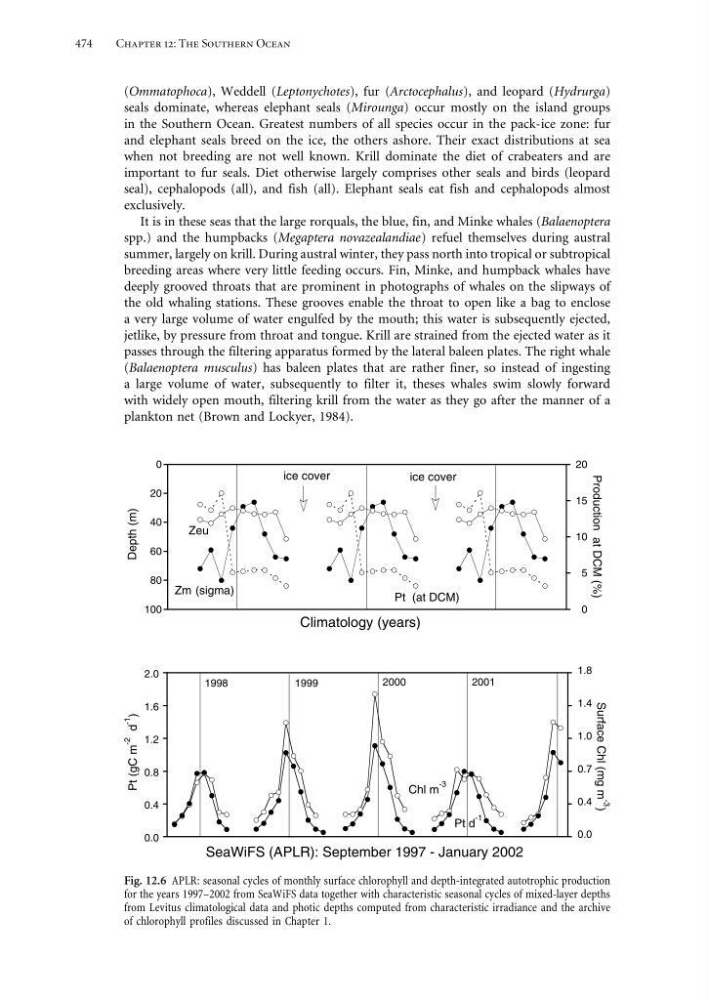
Fig. 12.6 APLR: seasonal cycles of monthly surface chlorophyll and depth-integrated autotrophic production
for the years 1997–2002 from SeaWiFS data together with characteristic seasonal cycles of mixed-layer depths
from Levitus climatological data and photic depths computed from characteristic irradiance and the archive
of chlorophyll profiles discussed in Chapter 1.
Chapter 12: The Southern Ocean
(Ommatophoca), Weddell (Leptonychotes), fur (Arctocephalus), and leopard (Hydrurga)
seals dominate, whereas elephant seals (Mirounga) occur mostly on the island groups
in the Southern Ocean. Greatest numbers of all species occur in the pack-ice zone: fur
and elephant seals breed on the ice, the others ashore. Their exact distributions at sea
when not breeding are not well known. Krill dominate the diet of crabeaters and are
important to fur seals. Diet otherwise largely comprises other seals and birds (leopard
seal), cephalopods (all), and fish (all). Elephant seals eat fish and cephalopods almost
exclusively.
It is in these seas that the large rorquals, the blue, fin, and Minke whales (Balaenoptera
spp.) and the humpbacks (Megaptera novazealandiae) refuel themselves during austral
summer, largely on krill. During austral winter, they pass north into tropical or subtropical
breeding areas where very little feeding occurs. Fin, Minke, and humpback whales have
deeply grooved throats that are prominent in photographs of whales on the slipways of
the old whaling stations. These grooves enable the throat to open like a bag to enclose
a very large volume of water engulfed by the mouth; this water is subsequently ejected,
jetlike, by pressure from throat and tongue. Krill are strained from the ejected water as it
passes through the filtering apparatus formed by the lateral baleen plates. The right whale
(Balaenoptera musculus) has baleen plates that are rather finer, so instead of ingesting
a large volume of water, subsequently to filter it, theses whales swim slowly forward
with widely open mouth, filtering krill from the water as they go after the manner of a
plankton net (Brown and Lockyer, 1984).
0.0
0.4
0.8
1.2
1.6
2.0
0.0
0.4
0.7
1.0
1.4
1.8
SeaWiFS (APLR): September 1997 - January 2002
Surface Chl (mg m
-3
)
Pt (gC m
-2
d
-1
)
Pt d
-1
Chl m
-3
1998
1999
2000
2001
0
20
40
60
80
100
0
5
10
15
20
Climatology (years)
Depth (m)
Production at DCM (%)
Zm (sigma)
Zeu
Pt (at DCM)
ice cover
ice cover
Fig. 12.6 APLR: seasonal cycles of monthly surface chlorophyll and depth-integrated autotrophic production
for the years 1997–2002 from SeaWiFS data together with characteristic seasonal cycles of mixed-layer depths
from Levitus climatological data and photic depths computed from characteristic irradiance and the archive
of chlorophyll profiles discussed in Chapter 1.