

444
Chapter 12: The Southern Ocean
and almost continuous circumpolar features around the Southern Ocean. At sea, these
may be relatively easily identified by the crowding of isotherms or isohalines that slope
upward toward the surface of the Southern Ocean. The surface water masses of the ACC,
and their ecological characteristics, are thus partitioned into zonal bands. Only far to the
south of the most poleward of these fronts is there contrary, westward transport in the
East Wind Drift, close to the Antarctic continent. I refrain from quoting characteristic
latitudes for each feature, because of the extent to which coastline and deep bottom
topography deform the annular flow; thus, the characteristic latitude of each feature
differs by at least 10
of latitude as it passes around the ocean.
From the earliest days of Antarctic oceanography, this frontal pattern has suggested a
partition into zones for which, unfortunately, there is much duplication of terminology.
To make the reading of this chapter simpler, it may be helpful to summarize how these
fronts, and the annular zones between, are arranged. What follows depends heavily on
the fresh interpretation and revised terminology of Orsi et al. (1995), although the names
used in this chapter for each individual feature are a compromise and do not conform
precisely to those of Orsi et al. The sequence of fronts and zones across the Southern
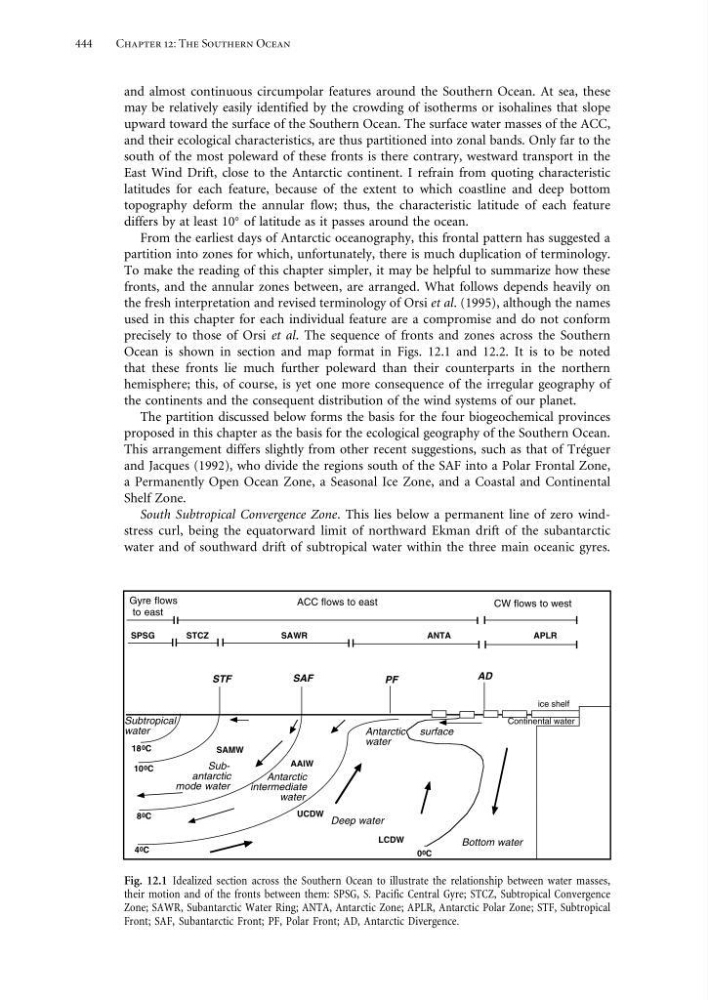
Ocean is shown in section and map format in Figs. 12.1 and 12.2. It is to be noted
that these fronts lie much further poleward than their counterparts in the northern
hemisphere; this, of course, is yet one more consequence of the irregular geography of
the continents and the consequent distribution of the wind systems of our planet.
The partition discussed below forms the basis for the four biogeochemical provinces
proposed in this chapter as the basis for the ecological geography of the Southern Ocean.
This arrangement differs slightly from other recent suggestions, such as that of Tréguer
and Jacques (1992), who divide the regions south of the SAF into a Polar Frontal Zone,
a Permanently Open Ocean Zone, a Seasonal Ice Zone, and a Coastal and Continental
Shelf Zone.
South Subtropical Convergence Zone. This lies below a permanent line of zero windstress curl, being the equatorward limit of northward Ekman drift of the subantarctic
water and of southward drift of subtropical water within the three main oceanic gyres.
STF
SAF
PF
AD
APLR
STCZ
SAWR
ANTA
ACC flows to east
CW flows to west
Gyre flows
to east
18 0 C
10 0 C
8 0 C
4 0 C
0 0 C
Subantarctic
mode water
Subtropical
water
Bottom water
Antarctic
intermediate
water
SAMW
Deep water
LCDW
UCDW
SPSG
ice shelf
AAIW
Antarctic surface
water
Continental water
Fig. 12.1 Idealized section across the Southern Ocean to illustrate the relationship between water masses,
their motion and of the fronts between them: SPSG, S. Pacific Central Gyre; STCZ, Subtropical Convergence
Zone; SAWR, Subantarctic Water Ring; ANTA, Antarctic Zone; APLR, Antarctic Polar Zone; STF, Subtropical
Front; SAF, Subantarctic Front; PF, Polar Front; AD, Antarctic Divergence.
Chapter 12: The Southern Ocean
and almost continuous circumpolar features around the Southern Ocean. At sea, these
may be relatively easily identified by the crowding of isotherms or isohalines that slope
upward toward the surface of the Southern Ocean. The surface water masses of the ACC,
and their ecological characteristics, are thus partitioned into zonal bands. Only far to the
south of the most poleward of these fronts is there contrary, westward transport in the
East Wind Drift, close to the Antarctic continent. I refrain from quoting characteristic
latitudes for each feature, because of the extent to which coastline and deep bottom
topography deform the annular flow; thus, the characteristic latitude of each feature
differs by at least 10
of latitude as it passes around the ocean.
From the earliest days of Antarctic oceanography, this frontal pattern has suggested a
partition into zones for which, unfortunately, there is much duplication of terminology.
To make the reading of this chapter simpler, it may be helpful to summarize how these
fronts, and the annular zones between, are arranged. What follows depends heavily on
the fresh interpretation and revised terminology of Orsi et al. (1995), although the names
used in this chapter for each individual feature are a compromise and do not conform
precisely to those of Orsi et al. The sequence of fronts and zones across the Southern
Ocean is shown in section and map format in Figs. 12.1 and 12.2. It is to be noted
that these fronts lie much further poleward than their counterparts in the northern
hemisphere; this, of course, is yet one more consequence of the irregular geography of
the continents and the consequent distribution of the wind systems of our planet.
The partition discussed below forms the basis for the four biogeochemical provinces
proposed in this chapter as the basis for the ecological geography of the Southern Ocean.
This arrangement differs slightly from other recent suggestions, such as that of Tréguer
and Jacques (1992), who divide the regions south of the SAF into a Polar Frontal Zone,
a Permanently Open Ocean Zone, a Seasonal Ice Zone, and a Coastal and Continental
Shelf Zone.
South Subtropical Convergence Zone. This lies below a permanent line of zero windstress curl, being the equatorward limit of northward Ekman drift of the subantarctic
water and of southward drift of subtropical water within the three main oceanic gyres.
STF
SAF
PF
AD
APLR
STCZ
SAWR
ANTA
ACC flows to east
CW flows to west
Gyre flows
to east
18 0 C
10 0 C
8 0 C
4 0 C
0 0 C
Subantarctic
mode water
Subtropical
water
Bottom water
Antarctic
intermediate
water
SAMW
Deep water
LCDW
UCDW
SPSG
ice shelf
AAIW
Antarctic surface
water
Continental water
Fig. 12.1 Idealized section across the Southern Ocean to illustrate the relationship between water masses,
their motion and of the fronts between them: SPSG, S. Pacific Central Gyre; STCZ, Subtropical Convergence
Zone; SAWR, Subantarctic Water Ring; ANTA, Antarctic Zone; APLR, Antarctic Polar Zone; STF, Subtropical
Front; SAF, Subantarctic Front; PF, Polar Front; AD, Antarctic Divergence.