

422
Chapter 11: The Pacific Ocean
significantly between surveys performed after 1967 even as the total landings progressively
increased from 1970 (127 × 10
3 t y
−1 ) to 1991 (254 × 10
3 t y
−1 ). The 1967 surveys of the
eastern Yellow Sea identified 134 species of 68 families of fish, but in 1980 only 51 species
of 38 families figured in the listings (Zhang and Kim, 1999, and associated papers).
Catch-per-unit-effort has progressively declined, and relative abundance shifted so that
only 8 of the 20 most abundant species in 1980 had been among the top 20 in 1967.
A now-classical effect of industrial exploitation of fish stocks is very extreme here: the
population of chub mackerel, having a longevity of >10 years in the pristine state, are
today represented by a stock that is highly dependent on 1- and 2-year old spawners.
It may be confidently predicted that this stock will disappear after its next recruitment
failure.
Synopsis
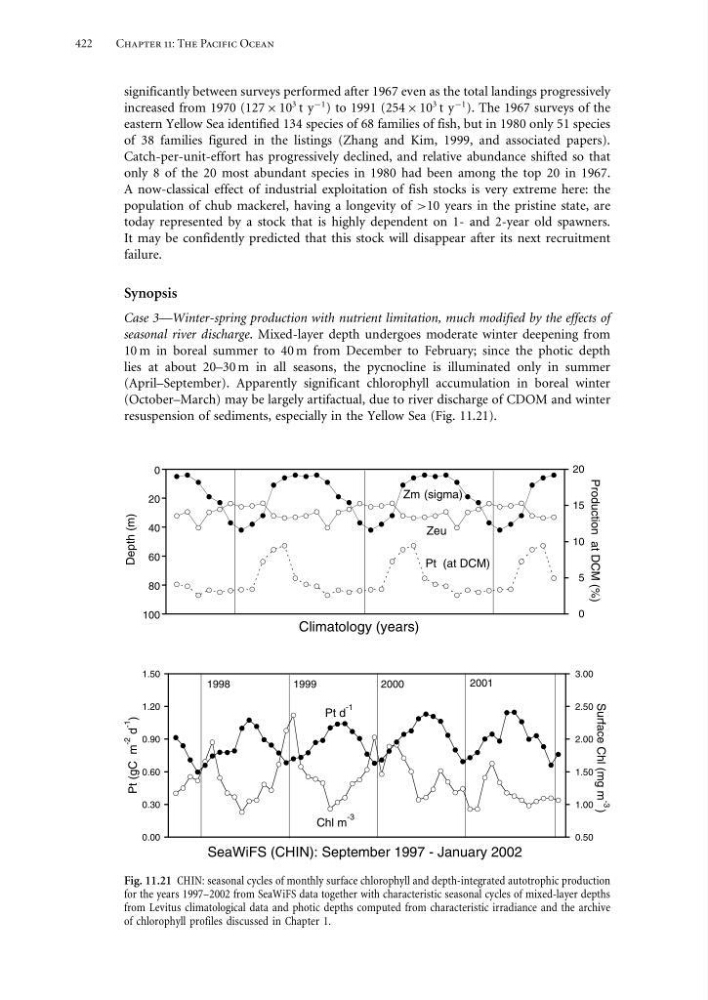
Case 3—Winter-spring production with nutrient limitation, much modified by the effects of
seasonal river discharge. Mixed-layer depth undergoes moderate winter deepening from
10 m in boreal summer to 40 m from December to February; since the photic depth
lies at about 20–30 m in all seasons, the pycnocline is illuminated only in summer
(April–September). Apparently significant chlorophyll accumulation in boreal winter
(October–March) may be largely artifactual, due to river discharge of CDOM and winter
resuspension of sediments, especially in the Yellow Sea (Fig. 11.21).
0
20
40
60
80
100
0
5
10
15
20
Climatology (years)
Depth (m)
Production at DCM (%)
Zm (sigma)
Zeu
Pt (at DCM)
0.00
0.30
0.60
0.90
1.20
1.50
0.50
1.00
1.50
2.00
2.50
3.00
SeaWiFS (CHIN): September 1997 - January 2002
Surface Chl (mg m -3
)
Pt d
-1
Chl m
-3
1999
1998
2000
2001
Pt (gC m
-2
d
-1
)
Fig. 11.21 CHIN: seasonal cycles of monthly surface chlorophyll and depth-integrated autotrophic production
for the years 1997–2002 from SeaWiFS data together with characteristic seasonal cycles of mixed-layer depths
from Levitus climatological data and photic depths computed from characteristic irradiance and the archive
of chlorophyll profiles discussed in Chapter 1.
Chapter 11: The Pacific Ocean
significantly between surveys performed after 1967 even as the total landings progressively
increased from 1970 (127 × 10
3 t y
−1 ) to 1991 (254 × 10
3 t y
−1 ). The 1967 surveys of the
eastern Yellow Sea identified 134 species of 68 families of fish, but in 1980 only 51 species
of 38 families figured in the listings (Zhang and Kim, 1999, and associated papers).
Catch-per-unit-effort has progressively declined, and relative abundance shifted so that
only 8 of the 20 most abundant species in 1980 had been among the top 20 in 1967.
A now-classical effect of industrial exploitation of fish stocks is very extreme here: the
population of chub mackerel, having a longevity of >10 years in the pristine state, are
today represented by a stock that is highly dependent on 1- and 2-year old spawners.
It may be confidently predicted that this stock will disappear after its next recruitment
failure.
Synopsis
Case 3—Winter-spring production with nutrient limitation, much modified by the effects of
seasonal river discharge. Mixed-layer depth undergoes moderate winter deepening from
10 m in boreal summer to 40 m from December to February; since the photic depth
lies at about 20–30 m in all seasons, the pycnocline is illuminated only in summer
(April–September). Apparently significant chlorophyll accumulation in boreal winter
(October–March) may be largely artifactual, due to river discharge of CDOM and winter
resuspension of sediments, especially in the Yellow Sea (Fig. 11.21).
0
20
40
60
80
100
0
5
10
15
20
Climatology (years)
Depth (m)
Production at DCM (%)
Zm (sigma)
Zeu
Pt (at DCM)
0.00
0.30
0.60
0.90
1.20
1.50
0.50
1.00
1.50
2.00
2.50
3.00
SeaWiFS (CHIN): September 1997 - January 2002
Surface Chl (mg m -3
)
Pt d
-1
Chl m
-3
1999
1998
2000
2001
Pt (gC m
-2
d
-1
)
Fig. 11.21 CHIN: seasonal cycles of monthly surface chlorophyll and depth-integrated autotrophic production
for the years 1997–2002 from SeaWiFS data together with characteristic seasonal cycles of mixed-layer depths
from Levitus climatological data and photic depths computed from characteristic irradiance and the archive
of chlorophyll profiles discussed in Chapter 1.