

26
Chapter 2: Biogeographic Partition of the Ocean
were annular around the Southern Ocean, and displaced in the North Atlantic because
of the open connection to the Arctic Ocean in its northeastern quadrant.
There was also agreement, I believe, that these zones were defined by the distributions
of widely different groups of organisms, from algae to fish, but especially by their more
abundant and widely distributed taxa. Rarer species, of course, confuse the general pattern
and perhaps for no better reason than poor representation in the data, so that a survey
by routine tow-net hauls across a grid may render their distribution incorrectly: the
proliferation of smaller biogeographic regions by some authors may be an artifact of
this problem. Beklemishev’s 1969 text on oceanic biogeography is one such, dividing
the surface of the ocean into 21 zonal regions, subdivided into very many more—often
overlapping—subregions.
Apart from the Russian biogeographic work reviewed by Beklemishev, the other major
sets of observations from which useful patterns emerge are those accumulated by the
biogeography group at Scripps in California, covering the whole Pacific Ocean. By 1978,
led by Joe Reid, this group was able to review ocean circulation and marine life comprehensively, extending their Pacific experience to the global ocean: the resultant maps
of euphauiid distributions by Brinton (1962) or of chaetognaths by Alvarino (1965) are
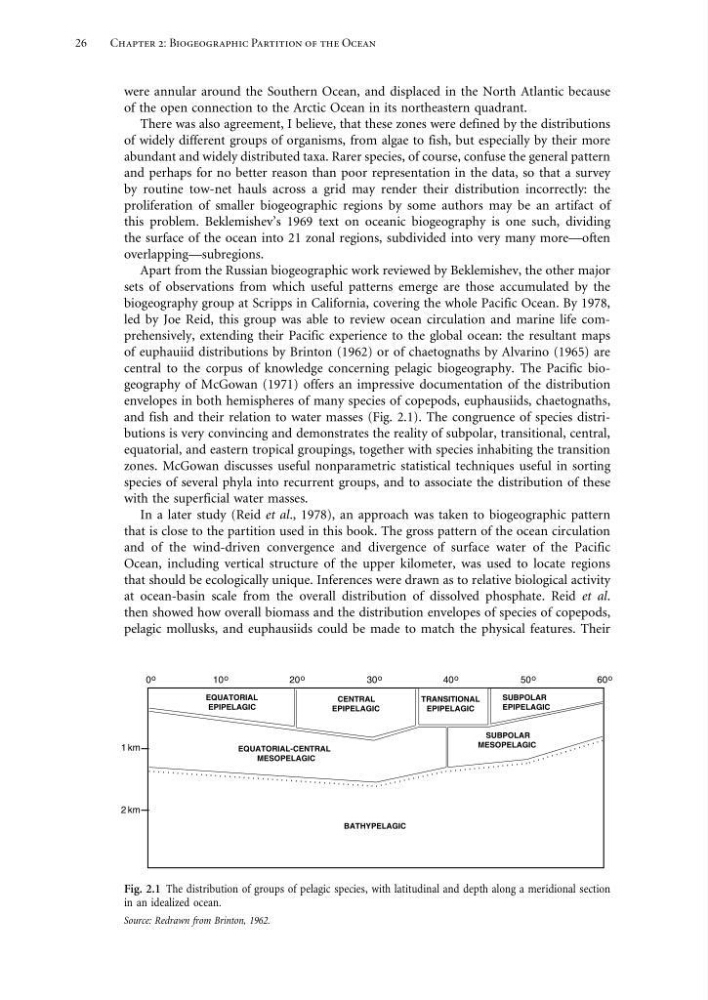
central to the corpus of knowledge concerning pelagic biogeography. The Pacific biogeography of McGowan (1971) offers an impressive documentation of the distribution
envelopes in both hemispheres of many species of copepods, euphausiids, chaetognaths,
and fish and their relation to water masses (Fig. 2.1). The congruence of species distributions is very convincing and demonstrates the reality of subpolar, transitional, central,
equatorial, and eastern tropical groupings, together with species inhabiting the transition
zones. McGowan discusses useful nonparametric statistical techniques useful in sorting
species of several phyla into recurrent groups, and to associate the distribution of these
with the superficial water masses.
In a later study (Reid et al., 1978), an approach was taken to biogeographic pattern
that is close to the partition used in this book. The gross pattern of the ocean circulation
and of the wind-driven convergence and divergence of surface water of the Pacific
Ocean, including vertical structure of the upper kilometer, was used to locate regions
that should be ecologically unique. Inferences were drawn as to relative biological activity
at ocean-basin scale from the overall distribution of dissolved phosphate. Reid et al.
then showed how overall biomass and the distribution envelopes of species of copepods,
pelagic mollusks, and euphausiids could be made to match the physical features. Their
1 km
2 km
0 o
10 o
20 o
30 o
40 o
50 o
60 o
BATHYPELAGIC
TRANSITIONAL
EPIPELAGIC
SUBPOLAR
EPIPELAGIC
CENTRAL
EPIPELAGIC
EQUATORIAL
EPIPELAGIC
EQUATORIAL-CENTRAL
MESOPELAGIC
SUBPOLAR
MESOPELAGIC
Fig. 2.1 The distribution of groups of pelagic species, with latitudinal and depth along a meridional section
in an idealized ocean.
Source: Redrawn from Brinton, 1962.
Chapter 2: Biogeographic Partition of the Ocean
were annular around the Southern Ocean, and displaced in the North Atlantic because
of the open connection to the Arctic Ocean in its northeastern quadrant.
There was also agreement, I believe, that these zones were defined by the distributions
of widely different groups of organisms, from algae to fish, but especially by their more
abundant and widely distributed taxa. Rarer species, of course, confuse the general pattern
and perhaps for no better reason than poor representation in the data, so that a survey
by routine tow-net hauls across a grid may render their distribution incorrectly: the
proliferation of smaller biogeographic regions by some authors may be an artifact of
this problem. Beklemishev’s 1969 text on oceanic biogeography is one such, dividing
the surface of the ocean into 21 zonal regions, subdivided into very many more—often
overlapping—subregions.
Apart from the Russian biogeographic work reviewed by Beklemishev, the other major
sets of observations from which useful patterns emerge are those accumulated by the
biogeography group at Scripps in California, covering the whole Pacific Ocean. By 1978,
led by Joe Reid, this group was able to review ocean circulation and marine life comprehensively, extending their Pacific experience to the global ocean: the resultant maps
of euphauiid distributions by Brinton (1962) or of chaetognaths by Alvarino (1965) are
central to the corpus of knowledge concerning pelagic biogeography. The Pacific biogeography of McGowan (1971) offers an impressive documentation of the distribution
envelopes in both hemispheres of many species of copepods, euphausiids, chaetognaths,
and fish and their relation to water masses (Fig. 2.1). The congruence of species distributions is very convincing and demonstrates the reality of subpolar, transitional, central,
equatorial, and eastern tropical groupings, together with species inhabiting the transition
zones. McGowan discusses useful nonparametric statistical techniques useful in sorting
species of several phyla into recurrent groups, and to associate the distribution of these
with the superficial water masses.
In a later study (Reid et al., 1978), an approach was taken to biogeographic pattern
that is close to the partition used in this book. The gross pattern of the ocean circulation
and of the wind-driven convergence and divergence of surface water of the Pacific
Ocean, including vertical structure of the upper kilometer, was used to locate regions
that should be ecologically unique. Inferences were drawn as to relative biological activity
at ocean-basin scale from the overall distribution of dissolved phosphate. Reid et al.
then showed how overall biomass and the distribution envelopes of species of copepods,
pelagic mollusks, and euphausiids could be made to match the physical features. Their
1 km
2 km
0 o
10 o
20 o
30 o
40 o
50 o
60 o
BATHYPELAGIC
TRANSITIONAL
EPIPELAGIC
SUBPOLAR
EPIPELAGIC
CENTRAL
EPIPELAGIC
EQUATORIAL
EPIPELAGIC
EQUATORIAL-CENTRAL
MESOPELAGIC
SUBPOLAR
MESOPELAGIC
Fig. 2.1 The distribution of groups of pelagic species, with latitudinal and depth along a meridional section
in an idealized ocean.
Source: Redrawn from Brinton, 1962.