

364
Chapter 11: The Pacific Ocean
EASTROPAC II Aug.-Sept/ 1966
EASTROPAC II Aug.-Sept/ 1966
Nitrate at 10 m
(µg NO 3 l
–1 )
Primary production
(mgC m –2 d –1 )
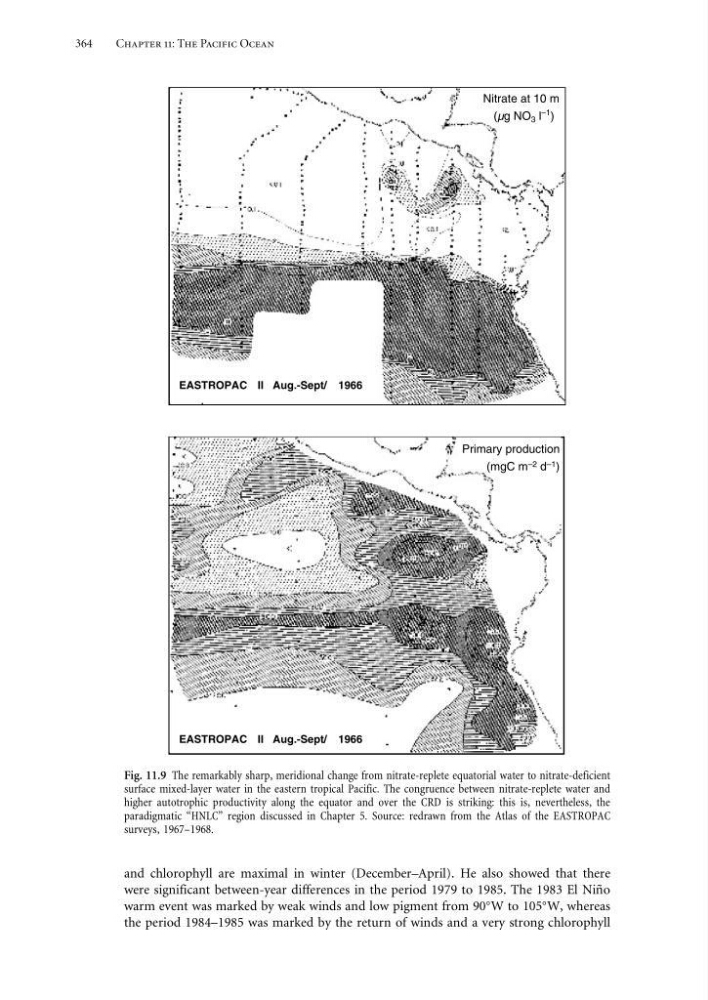
Fig. 11.9 The remarkably sharp, meridional change from nitrate-replete equatorial water to nitrate-deficient
surface mixed-layer water in the eastern tropical Pacific. The congruence between nitrate-replete water and
higher autotrophic productivity along the equator and over the CRD is striking: this is, nevertheless, the
paradigmatic “HNLC” region discussed in Chapter 5. Source: redrawn from the Atlas of the EASTROPAC
surveys, 1967–1968.
and chlorophyll are maximal in winter (December–April). He also showed that there
were significant between-year differences in the period 1979 to 1985. The 1983 El Niño
warm event was marked by weak winds and low pigment from 90
W to 105
W, whereas
the period 1984–1985 was marked by the return of winds and a very strong chlorophyll
Chapter 11: The Pacific Ocean
EASTROPAC II Aug.-Sept/ 1966
EASTROPAC II Aug.-Sept/ 1966
Nitrate at 10 m
(µg NO 3 l
–1 )
Primary production
(mgC m –2 d –1 )
Fig. 11.9 The remarkably sharp, meridional change from nitrate-replete equatorial water to nitrate-deficient
surface mixed-layer water in the eastern tropical Pacific. The congruence between nitrate-replete water and
higher autotrophic productivity along the equator and over the CRD is striking: this is, nevertheless, the
paradigmatic “HNLC” region discussed in Chapter 5. Source: redrawn from the Atlas of the EASTROPAC
surveys, 1967–1968.
and chlorophyll are maximal in winter (December–April). He also showed that there
were significant between-year differences in the period 1979 to 1985. The 1983 El Niño
warm event was marked by weak winds and low pigment from 90
W to 105
W, whereas
the period 1984–1985 was marked by the return of winds and a very strong chlorophyll