

Pacific Trade Winds Biome
361
account of McGowan and Walker (1979) for an analysis of the taxonomic diversity of the
105 species of copepods that they observed in the central North Pacific, of which 89 taxa
were recognized at CLIMAX-ALOHA. It is very difficult to obtain satisfactory analysis
of this community, taxon by taxon, because each has a characteristic distribution that
may not be resolved by standard sampling methods. For example, the most abundant
copepod at CLIMAX is Haloptilus longicornis, a nonmigrant, distributed from the surface
down to 400 m, and so not fully enumerated in standard, shallower plankton tows.
The envelopes of the distribution of 10 “central water mass” species plotted by
McGowan (1971) provide an interesting point regarding the definition of this province:
in the east of the ocean, and as far west as about 170
E, they match remarkably well
the limits of this province as defined here. To the west of this longitude, the envelopes
widen and eventually encompass the whole western Pacific from New Guinea to southern
Japan. To the extent that the distribution of individual species necessarily indicates the
distribution of common ecosystem-forcing characteristics, then perhaps further analysis of the biological oceanography of the western Pacific may suggest that the WARM
province should be much more extensive than the limits used here.
Synopsis
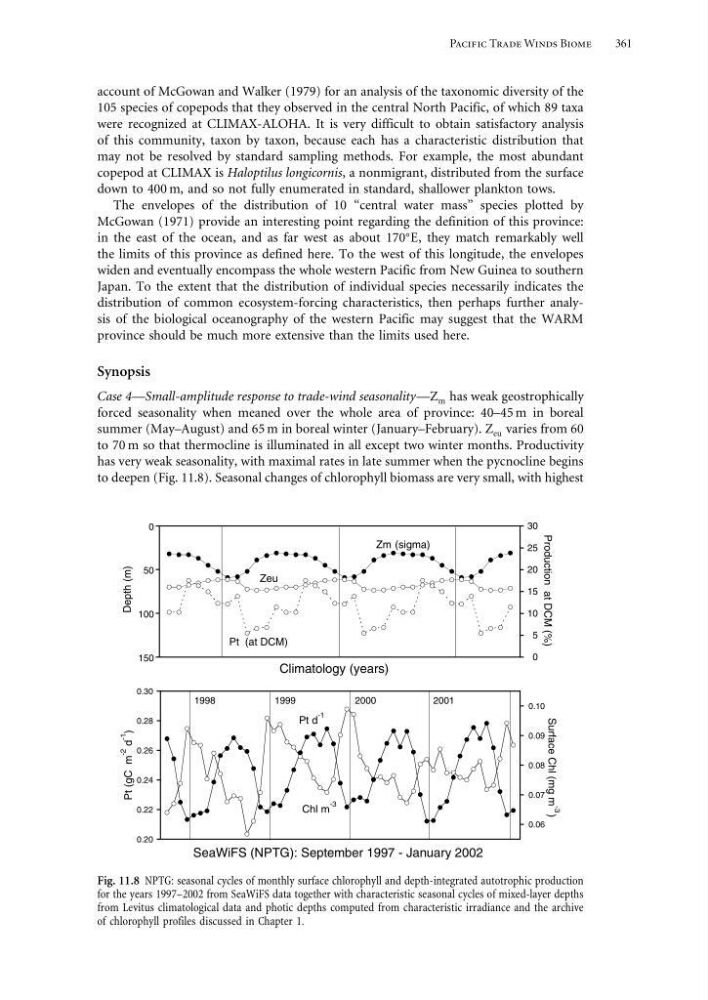
Case 4—Small-amplitude response to trade-wind seasonality—Z m has weak geostrophically
forced seasonality when meaned over the whole area of province: 40–45 m in boreal
summer (May–August) and 65 m in boreal winter (January–February). Z eu varies from 60
to 70 m so that thermocline is illuminated in all except two winter months. Productivity
has very weak seasonality, with maximal rates in late summer when the pycnocline begins
to deepen (Fig. 11.8). Seasonal changes of chlorophyll biomass are very small, with highest
0.20
0.22
0.24
0.26
0.28
0.30
0.06
0.07
0.08
0.09
0.10
SeaWiFS (NPTG): September 1997 - January 2002
Surface Chl (mg m -3
)
Pt d
-1
Chl m
-3
Pt (gC m
-2
d
-1
)
1998
1999
2000
2001
0
50
100
150
0
5
10
15
20
25
30
Climatology (years)
Depth (m)
Production at DCM (%)
Zm (sigma)
Zeu
Pt (at DCM)
Fig. 11.8 NPTG: seasonal cycles of monthly surface chlorophyll and depth-integrated autotrophic production
for the years 1997–2002 from SeaWiFS data together with characteristic seasonal cycles of mixed-layer depths
from Levitus climatological data and photic depths computed from characteristic irradiance and the archive
of chlorophyll profiles discussed in Chapter 1.
361
account of McGowan and Walker (1979) for an analysis of the taxonomic diversity of the
105 species of copepods that they observed in the central North Pacific, of which 89 taxa
were recognized at CLIMAX-ALOHA. It is very difficult to obtain satisfactory analysis
of this community, taxon by taxon, because each has a characteristic distribution that
may not be resolved by standard sampling methods. For example, the most abundant
copepod at CLIMAX is Haloptilus longicornis, a nonmigrant, distributed from the surface
down to 400 m, and so not fully enumerated in standard, shallower plankton tows.
The envelopes of the distribution of 10 “central water mass” species plotted by
McGowan (1971) provide an interesting point regarding the definition of this province:
in the east of the ocean, and as far west as about 170
E, they match remarkably well
the limits of this province as defined here. To the west of this longitude, the envelopes
widen and eventually encompass the whole western Pacific from New Guinea to southern
Japan. To the extent that the distribution of individual species necessarily indicates the
distribution of common ecosystem-forcing characteristics, then perhaps further analysis of the biological oceanography of the western Pacific may suggest that the WARM
province should be much more extensive than the limits used here.
Synopsis
Case 4—Small-amplitude response to trade-wind seasonality—Z m has weak geostrophically
forced seasonality when meaned over the whole area of province: 40–45 m in boreal
summer (May–August) and 65 m in boreal winter (January–February). Z eu varies from 60
to 70 m so that thermocline is illuminated in all except two winter months. Productivity
has very weak seasonality, with maximal rates in late summer when the pycnocline begins
to deepen (Fig. 11.8). Seasonal changes of chlorophyll biomass are very small, with highest
0.20
0.22
0.24
0.26
0.28
0.30
0.06
0.07
0.08
0.09
0.10
SeaWiFS (NPTG): September 1997 - January 2002
Surface Chl (mg m -3
)
Pt d
-1
Chl m
-3
Pt (gC m
-2
d
-1
)
1998
1999
2000
2001
0
50
100
150
0
5
10
15
20
25
30
Climatology (years)
Depth (m)
Production at DCM (%)
Zm (sigma)
Zeu
Pt (at DCM)
Fig. 11.8 NPTG: seasonal cycles of monthly surface chlorophyll and depth-integrated autotrophic production
for the years 1997–2002 from SeaWiFS data together with characteristic seasonal cycles of mixed-layer depths
from Levitus climatological data and photic depths computed from characteristic irradiance and the archive
of chlorophyll profiles discussed in Chapter 1.