

Pacific Westerly Winds Biome
349
0.00
0.25
0.50
0.75
1.00
1.25
0.00
0.20
0.40
0.60
0.80
1.00
SeaWiFS (KURO): September 1997 - January 2002
Surface Chl (mg m -3
)
Pt (gC m
-2
d
-1
)
Pt d
-1
Chl m
-3
1998
1999
2000
2001
0
20
40
60
80
100
120
140
0
5
10
15
20
25
30
Climatology (years)
Depth (m)
Production at DCM (%)
Zm (sigma)
Zeu
Pt (at DCM)
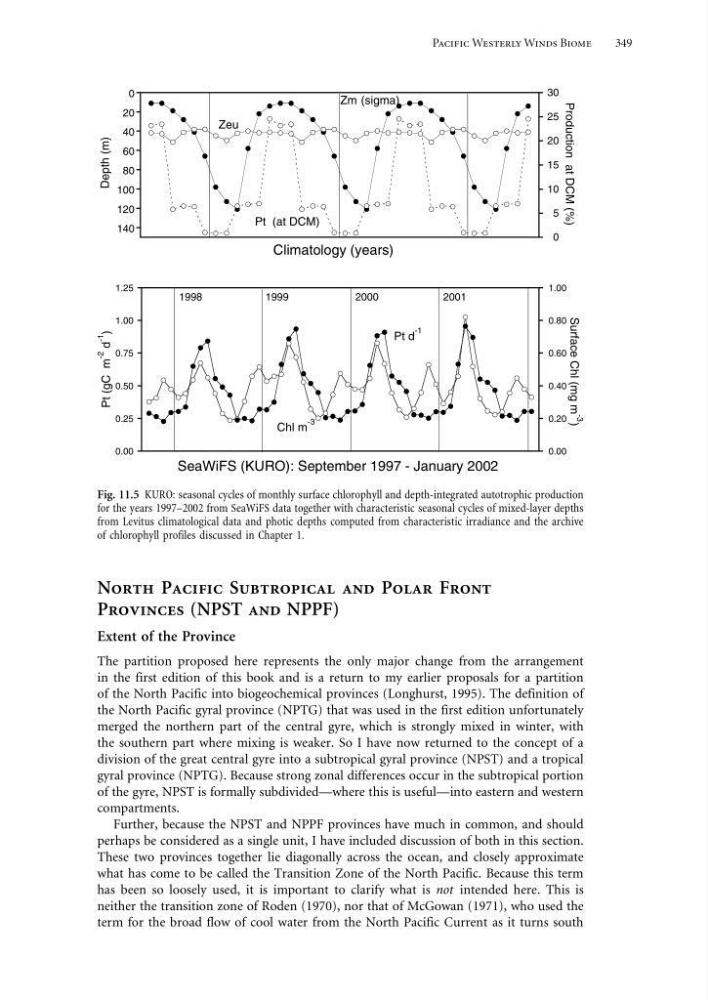
Fig. 11.5 KURO: seasonal cycles of monthly surface chlorophyll and depth-integrated autotrophic production
for the years 1997–2002 from SeaWiFS data together with characteristic seasonal cycles of mixed-layer depths
from Levitus climatological data and photic depths computed from characteristic irradiance and the archive
of chlorophyll profiles discussed in Chapter 1.
North Pacific Subtropical and Polar Front
Provinces (NPST and NPPF)
Extent of the Province
The partition proposed here represents the only major change from the arrangement
in the first edition of this book and is a return to my earlier proposals for a partition
of the North Pacific into biogeochemical provinces (Longhurst, 1995). The definition of
the North Pacific gyral province (NPTG) that was used in the first edition unfortunately
merged the northern part of the central gyre, which is strongly mixed in winter, with
the southern part where mixing is weaker. So I have now returned to the concept of a
division of the great central gyre into a subtropical gyral province (NPST) and a tropical
gyral province (NPTG). Because strong zonal differences occur in the subtropical portion
of the gyre, NPST is formally subdivided—where this is useful—into eastern and western
compartments.
Further, because the NPST and NPPF provinces have much in common, and should
perhaps be considered as a single unit, I have included discussion of both in this section.
These two provinces together lie diagonally across the ocean, and closely approximate
what has come to be called the Transition Zone of the North Pacific. Because this term
has been so loosely used, it is important to clarify what is not intended here. This is
neither the transition zone of Roden (1970), nor that of McGowan (1971), who used the
term for the broad flow of cool water from the North Pacific Current as it turns south
349
0.00
0.25
0.50
0.75
1.00
1.25
0.00
0.20
0.40
0.60
0.80
1.00
SeaWiFS (KURO): September 1997 - January 2002
Surface Chl (mg m -3
)
Pt (gC m
-2
d
-1
)
Pt d
-1
Chl m
-3
1998
1999
2000
2001
0
20
40
60
80
100
120
140
0
5
10
15
20
25
30
Climatology (years)
Depth (m)
Production at DCM (%)
Zm (sigma)
Zeu
Pt (at DCM)
Fig. 11.5 KURO: seasonal cycles of monthly surface chlorophyll and depth-integrated autotrophic production
for the years 1997–2002 from SeaWiFS data together with characteristic seasonal cycles of mixed-layer depths
from Levitus climatological data and photic depths computed from characteristic irradiance and the archive
of chlorophyll profiles discussed in Chapter 1.
North Pacific Subtropical and Polar Front
Provinces (NPST and NPPF)
Extent of the Province
The partition proposed here represents the only major change from the arrangement
in the first edition of this book and is a return to my earlier proposals for a partition
of the North Pacific into biogeochemical provinces (Longhurst, 1995). The definition of
the North Pacific gyral province (NPTG) that was used in the first edition unfortunately
merged the northern part of the central gyre, which is strongly mixed in winter, with
the southern part where mixing is weaker. So I have now returned to the concept of a
division of the great central gyre into a subtropical gyral province (NPST) and a tropical
gyral province (NPTG). Because strong zonal differences occur in the subtropical portion
of the gyre, NPST is formally subdivided—where this is useful—into eastern and western
compartments.
Further, because the NPST and NPPF provinces have much in common, and should
perhaps be considered as a single unit, I have included discussion of both in this section.
These two provinces together lie diagonally across the ocean, and closely approximate
what has come to be called the Transition Zone of the North Pacific. Because this term
has been so loosely used, it is important to clarify what is not intended here. This is
neither the transition zone of Roden (1970), nor that of McGowan (1971), who used the
term for the broad flow of cool water from the North Pacific Current as it turns south