

Indian Ocean Coastal Biome
313
groups (both demersal and pelagic combined) are sardines, Indian mackerel, carangids,
sciaenids, ribbonfish, rays, and penaeid shrimps. On the southern section of this coast,
there is a clear negative relationship between commercial landings during the entire second half of the 20th century and the mean trophic level of the fish landed. This implies
that fishing has induced a significant change in the ecosystem structure of this shelf over
a period of 50 years.
Synopsis
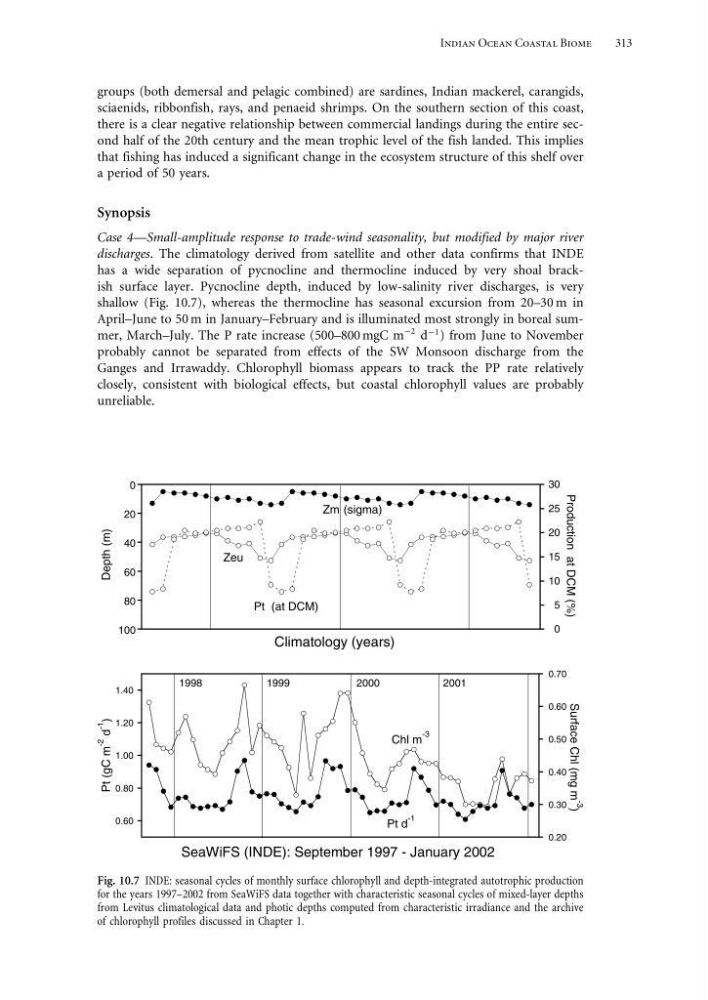
Case 4—Small-amplitude response to trade-wind seasonality, but modified by major river
discharges. The climatology derived from satellite and other data confirms that INDE
has a wide separation of pycnocline and thermocline induced by very shoal brackish surface layer. Pycnocline depth, induced by low-salinity river discharges, is very
shallow (Fig. 10.7), whereas the thermocline has seasonal excursion from 20–30 m in
April–June to 50 m in January–February and is illuminated most strongly in boreal summer, March–July. The P rate increase (500–800 mgC m
−2 d
−1 ) from June to November
probably cannot be separated from effects of the SW Monsoon discharge from the
Ganges and Irrawaddy. Chlorophyll biomass appears to track the PP rate relatively
closely, consistent with biological effects, but coastal chlorophyll values are probably
unreliable.
0
20
40
60
80
100
0
5
10
15
20
25
30
Climatology (years)
Depth (m)
Production at DCM (%)
Zm (sigma)
Zeu
Pt (at DCM)
0.60
0.80
1.00
1.20
1.40
0.20
0.30
0.40
0.50
0.60
0.70
SeaWiFS (INDE): September 1997 - January 2002
Surface Chl (mg m -3
)
Pt (gC m
-2
d
-1
)
Pt d
-1
Chl m
-3
1998
1999
2000
2001
Fig. 10.7 INDE: seasonal cycles of monthly surface chlorophyll and depth-integrated autotrophic production
for the years 1997–2002 from SeaWiFS data together with characteristic seasonal cycles of mixed-layer depths
from Levitus climatological data and photic depths computed from characteristic irradiance and the archive
of chlorophyll profiles discussed in Chapter 1.
313
groups (both demersal and pelagic combined) are sardines, Indian mackerel, carangids,
sciaenids, ribbonfish, rays, and penaeid shrimps. On the southern section of this coast,
there is a clear negative relationship between commercial landings during the entire second half of the 20th century and the mean trophic level of the fish landed. This implies
that fishing has induced a significant change in the ecosystem structure of this shelf over
a period of 50 years.
Synopsis
Case 4—Small-amplitude response to trade-wind seasonality, but modified by major river
discharges. The climatology derived from satellite and other data confirms that INDE
has a wide separation of pycnocline and thermocline induced by very shoal brackish surface layer. Pycnocline depth, induced by low-salinity river discharges, is very
shallow (Fig. 10.7), whereas the thermocline has seasonal excursion from 20–30 m in
April–June to 50 m in January–February and is illuminated most strongly in boreal summer, March–July. The P rate increase (500–800 mgC m
−2 d
−1 ) from June to November
probably cannot be separated from effects of the SW Monsoon discharge from the
Ganges and Irrawaddy. Chlorophyll biomass appears to track the PP rate relatively
closely, consistent with biological effects, but coastal chlorophyll values are probably
unreliable.
0
20
40
60
80
100
0
5
10
15
20
25
30
Climatology (years)
Depth (m)
Production at DCM (%)
Zm (sigma)
Zeu
Pt (at DCM)
0.60
0.80
1.00
1.20
1.40
0.20
0.30
0.40
0.50
0.60
0.70
SeaWiFS (INDE): September 1997 - January 2002
Surface Chl (mg m -3
)
Pt (gC m
-2
d
-1
)
Pt d
-1
Chl m
-3
1998
1999
2000
2001
Fig. 10.7 INDE: seasonal cycles of monthly surface chlorophyll and depth-integrated autotrophic production
for the years 1997–2002 from SeaWiFS data together with characteristic seasonal cycles of mixed-layer depths
from Levitus climatological data and photic depths computed from characteristic irradiance and the archive
of chlorophyll profiles discussed in Chapter 1.