

Indian Ocean Coastal Biome
309
0.00
0.40
0.80
1.20
1.60
2.00
0.00
0.50
1.00
1.50
2.00
2.50
SeaWiFS (INDW): September 1997 - January 2002
Surface Chl (mg m -3
)
Pt (gC m
-2
d
-1
)
Pt d
-1
Chl m
-3
1998
1999
2000
2001
0
20
40
60
80
100
0
5
10
15
20
25
30
35
Climatology (years)
Depth (m)
Production at DCM (%)
Zm (sigma)
Zeu
Pt (at DCM)
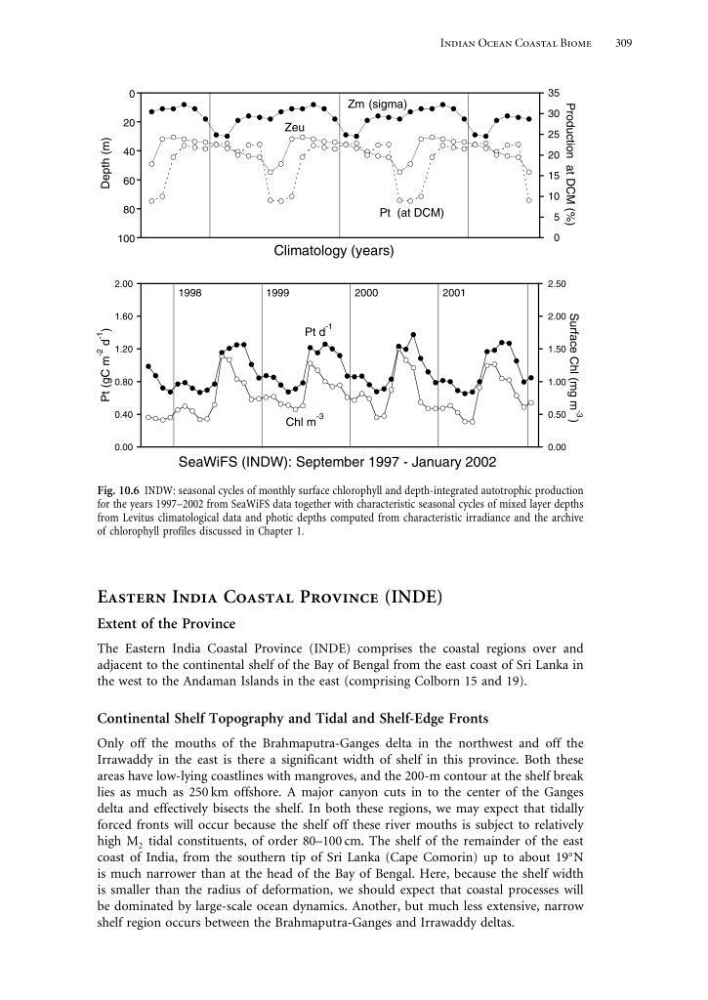
Fig. 10.6 INDW: seasonal cycles of monthly surface chlorophyll and depth-integrated autotrophic production
for the years 1997–2002 from SeaWiFS data together with characteristic seasonal cycles of mixed layer depths
from Levitus climatological data and photic depths computed from characteristic irradiance and the archive
of chlorophyll profiles discussed in Chapter 1.
Eastern India Coastal Province (INDE)
Extent of the Province
The Eastern India Coastal Province (INDE) comprises the coastal regions over and
adjacent to the continental shelf of the Bay of Bengal from the east coast of Sri Lanka in
the west to the Andaman Islands in the east (comprising Colborn 15 and 19).
Continental Shelf Topography and Tidal and Shelf-Edge Fronts
Only off the mouths of the Brahmaputra-Ganges delta in the northwest and off the
Irrawaddy in the east is there a significant width of shelf in this province. Both these
areas have low-lying coastlines with mangroves, and the 200-m contour at the shelf break
lies as much as 250 km offshore. A major canyon cuts in to the center of the Ganges
delta and effectively bisects the shelf. In both these regions, we may expect that tidally
forced fronts will occur because the shelf off these river mouths is subject to relatively
high M 2 tidal constituents, of order 80–100 cm. The shelf of the remainder of the east
coast of India, from the southern tip of Sri Lanka (Cape Comorin) up to about 19
N
is much narrower than at the head of the Bay of Bengal. Here, because the shelf width
is smaller than the radius of deformation, we should expect that coastal processes will
be dominated by large-scale ocean dynamics. Another, but much less extensive, narrow
shelf region occurs between the Brahmaputra-Ganges and Irrawaddy deltas.
309
0.00
0.40
0.80
1.20
1.60
2.00
0.00
0.50
1.00
1.50
2.00
2.50
SeaWiFS (INDW): September 1997 - January 2002
Surface Chl (mg m -3
)
Pt (gC m
-2
d
-1
)
Pt d
-1
Chl m
-3
1998
1999
2000
2001
0
20
40
60
80
100
0
5
10
15
20
25
30
35
Climatology (years)
Depth (m)
Production at DCM (%)
Zm (sigma)
Zeu
Pt (at DCM)
Fig. 10.6 INDW: seasonal cycles of monthly surface chlorophyll and depth-integrated autotrophic production
for the years 1997–2002 from SeaWiFS data together with characteristic seasonal cycles of mixed layer depths
from Levitus climatological data and photic depths computed from characteristic irradiance and the archive
of chlorophyll profiles discussed in Chapter 1.
Eastern India Coastal Province (INDE)
Extent of the Province
The Eastern India Coastal Province (INDE) comprises the coastal regions over and
adjacent to the continental shelf of the Bay of Bengal from the east coast of Sri Lanka in
the west to the Andaman Islands in the east (comprising Colborn 15 and 19).
Continental Shelf Topography and Tidal and Shelf-Edge Fronts
Only off the mouths of the Brahmaputra-Ganges delta in the northwest and off the
Irrawaddy in the east is there a significant width of shelf in this province. Both these
areas have low-lying coastlines with mangroves, and the 200-m contour at the shelf break
lies as much as 250 km offshore. A major canyon cuts in to the center of the Ganges
delta and effectively bisects the shelf. In both these regions, we may expect that tidally
forced fronts will occur because the shelf off these river mouths is subject to relatively
high M 2 tidal constituents, of order 80–100 cm. The shelf of the remainder of the east
coast of India, from the southern tip of Sri Lanka (Cape Comorin) up to about 19
N
is much narrower than at the head of the Bay of Bengal. Here, because the shelf width
is smaller than the radius of deformation, we should expect that coastal processes will
be dominated by large-scale ocean dynamics. Another, but much less extensive, narrow
shelf region occurs between the Brahmaputra-Ganges and Irrawaddy deltas.