

296
Chapter 10: The Indian Ocean
0
20
40
60
80
100
0
5
10
15
20
Climatology (years)
Depth (m)
Production at DCM (%)
Zm (sigma)
Zeu
Pt (at DCM)
0.38
0.57
0.76
0.95
1.14
0.20
0.40
0.60
0.80
1.00
1.20
SeaWiFS (REDS): September 1997 - January 2002
Surface Chl (mg m -3
)
Pt d
-1
Chl m
-3
Pt (gC m
-2
d
-1
)
1998
1999
2000
2001
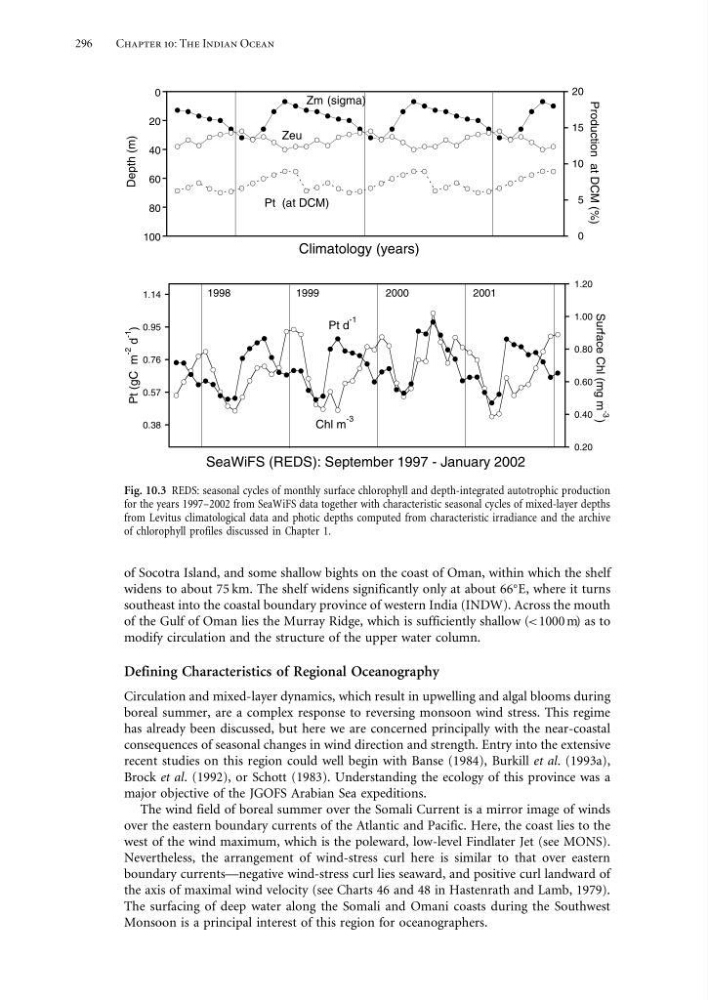
Fig. 10.3 REDS: seasonal cycles of monthly surface chlorophyll and depth-integrated autotrophic production
for the years 1997–2002 from SeaWiFS data together with characteristic seasonal cycles of mixed-layer depths
from Levitus climatological data and photic depths computed from characteristic irradiance and the archive
of chlorophyll profiles discussed in Chapter 1.
of Socotra Island, and some shallow bights on the coast of Oman, within which the shelf
widens to about 75 km. The shelf widens significantly only at about 66
E, where it turns
southeast into the coastal boundary province of western India (INDW). Across the mouth
of the Gulf of Oman lies the Murray Ridge, which is sufficiently shallow (<1000 m) as to
modify circulation and the structure of the upper water column.
Defining Characteristics of Regional Oceanography
Circulation and mixed-layer dynamics, which result in upwelling and algal blooms during
boreal summer, are a complex response to reversing monsoon wind stress. This regime
has already been discussed, but here we are concerned principally with the near-coastal
consequences of seasonal changes in wind direction and strength. Entry into the extensive
recent studies on this region could well begin with Banse (1984), Burkill et al. (1993a),
Brock et al. (1992), or Schott (1983). Understanding the ecology of this province was a
major objective of the JGOFS Arabian Sea expeditions.
The wind field of boreal summer over the Somali Current is a mirror image of winds
over the eastern boundary currents of the Atlantic and Pacific. Here, the coast lies to the
west of the wind maximum, which is the poleward, low-level Findlater Jet (see MONS).
Nevertheless, the arrangement of wind-stress curl here is similar to that over eastern
boundary currents—negative wind-stress curl lies seaward, and positive curl landward of
the axis of maximal wind velocity (see Charts 46 and 48 in Hastenrath and Lamb, 1979).
The surfacing of deep water along the Somali and Omani coasts during the Southwest
Monsoon is a principal interest of this region for oceanographers.
Chapter 10: The Indian Ocean
0
20
40
60
80
100
0
5
10
15
20
Climatology (years)
Depth (m)
Production at DCM (%)
Zm (sigma)
Zeu
Pt (at DCM)
0.38
0.57
0.76
0.95
1.14
0.20
0.40
0.60
0.80
1.00
1.20
SeaWiFS (REDS): September 1997 - January 2002
Surface Chl (mg m -3
)
Pt d
-1
Chl m
-3
Pt (gC m
-2
d
-1
)
1998
1999
2000
2001
Fig. 10.3 REDS: seasonal cycles of monthly surface chlorophyll and depth-integrated autotrophic production
for the years 1997–2002 from SeaWiFS data together with characteristic seasonal cycles of mixed-layer depths
from Levitus climatological data and photic depths computed from characteristic irradiance and the archive
of chlorophyll profiles discussed in Chapter 1.
of Socotra Island, and some shallow bights on the coast of Oman, within which the shelf
widens to about 75 km. The shelf widens significantly only at about 66
E, where it turns
southeast into the coastal boundary province of western India (INDW). Across the mouth
of the Gulf of Oman lies the Murray Ridge, which is sufficiently shallow (<1000 m) as to
modify circulation and the structure of the upper water column.
Defining Characteristics of Regional Oceanography
Circulation and mixed-layer dynamics, which result in upwelling and algal blooms during
boreal summer, are a complex response to reversing monsoon wind stress. This regime
has already been discussed, but here we are concerned principally with the near-coastal
consequences of seasonal changes in wind direction and strength. Entry into the extensive
recent studies on this region could well begin with Banse (1984), Burkill et al. (1993a),
Brock et al. (1992), or Schott (1983). Understanding the ecology of this province was a
major objective of the JGOFS Arabian Sea expeditions.
The wind field of boreal summer over the Somali Current is a mirror image of winds
over the eastern boundary currents of the Atlantic and Pacific. Here, the coast lies to the
west of the wind maximum, which is the poleward, low-level Findlater Jet (see MONS).
Nevertheless, the arrangement of wind-stress curl here is similar to that over eastern
boundary currents—negative wind-stress curl lies seaward, and positive curl landward of
the axis of maximal wind velocity (see Charts 46 and 48 in Hastenrath and Lamb, 1979).
The surfacing of deep water along the Somali and Omani coasts during the Southwest
Monsoon is a principal interest of this region for oceanographers.