

Indian Ocean Coastal Biome
291
20
30
40
50
60
70
80
90
100
0
5
10
15
20
Climatology (years)
Depth (m)
Production at DCM (%)
Zm (sigma)
Zeu
Pt (at DCM)
0.00
0.10
0.20
0.30
0.40
0.50
0.05
0.10
0.15
0.20
0.25
0.30
SeaWiFS (ISSG): September 1997 - January 2002
Surface Chl (mg m -3
)
Pt d
-1
Chl m
-3
1998
1999
2000
2001
Pt (gC m
-2
d
-1
)
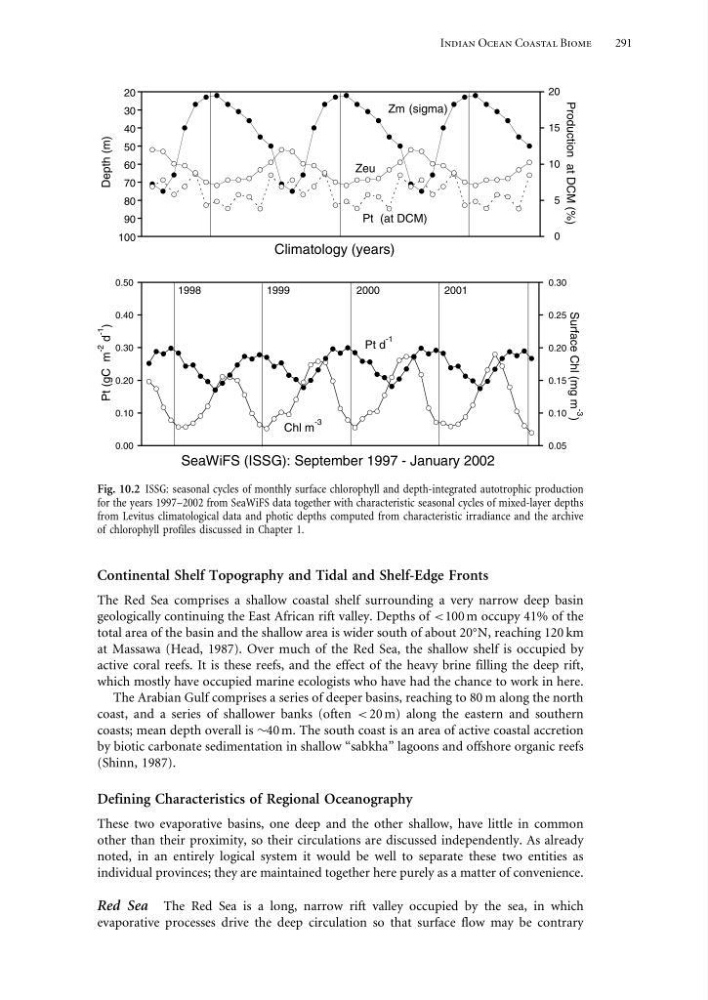
Fig. 10.2 ISSG: seasonal cycles of monthly surface chlorophyll and depth-integrated autotrophic production
for the years 1997–2002 from SeaWiFS data together with characteristic seasonal cycles of mixed-layer depths
from Levitus climatological data and photic depths computed from characteristic irradiance and the archive
of chlorophyll profiles discussed in Chapter 1.
Continental Shelf Topography and Tidal and Shelf-Edge Fronts
The Red Sea comprises a shallow coastal shelf surrounding a very narrow deep basin
geologically continuing the East African rift valley. Depths of <100 m occupy 41% of the
total area of the basin and the shallow area is wider south of about 20
N, reaching 120 km
at Massawa (Head, 1987). Over much of the Red Sea, the shallow shelf is occupied by
active coral reefs. It is these reefs, and the effect of the heavy brine filling the deep rift,
which mostly have occupied marine ecologists who have had the chance to work in here.
The Arabian Gulf comprises a series of deeper basins, reaching to 80 m along the north
coast, and a series of shallower banks (often < 20 m) along the eastern and southern
coasts; mean depth overall is ∼40 m. The south coast is an area of active coastal accretion
by biotic carbonate sedimentation in shallow “sabkha” lagoons and offshore organic reefs
(Shinn, 1987).
Defining Characteristics of Regional Oceanography
These two evaporative basins, one deep and the other shallow, have little in common
other than their proximity, so their circulations are discussed independently. As already
noted, in an entirely logical system it would be well to separate these two entities as
individual provinces; they are maintained together here purely as a matter of convenience.
Red Sea The Red Sea is a long, narrow rift valley occupied by the sea, in which
evaporative processes drive the deep circulation so that surface flow may be contrary
291
20
30
40
50
60
70
80
90
100
0
5
10
15
20
Climatology (years)
Depth (m)
Production at DCM (%)
Zm (sigma)
Zeu
Pt (at DCM)
0.00
0.10
0.20
0.30
0.40
0.50
0.05
0.10
0.15
0.20
0.25
0.30
SeaWiFS (ISSG): September 1997 - January 2002
Surface Chl (mg m -3
)
Pt d
-1
Chl m
-3
1998
1999
2000
2001
Pt (gC m
-2
d
-1
)
Fig. 10.2 ISSG: seasonal cycles of monthly surface chlorophyll and depth-integrated autotrophic production
for the years 1997–2002 from SeaWiFS data together with characteristic seasonal cycles of mixed-layer depths
from Levitus climatological data and photic depths computed from characteristic irradiance and the archive
of chlorophyll profiles discussed in Chapter 1.
Continental Shelf Topography and Tidal and Shelf-Edge Fronts
The Red Sea comprises a shallow coastal shelf surrounding a very narrow deep basin
geologically continuing the East African rift valley. Depths of <100 m occupy 41% of the
total area of the basin and the shallow area is wider south of about 20
N, reaching 120 km
at Massawa (Head, 1987). Over much of the Red Sea, the shallow shelf is occupied by
active coral reefs. It is these reefs, and the effect of the heavy brine filling the deep rift,
which mostly have occupied marine ecologists who have had the chance to work in here.
The Arabian Gulf comprises a series of deeper basins, reaching to 80 m along the north
coast, and a series of shallower banks (often < 20 m) along the eastern and southern
coasts; mean depth overall is ∼40 m. The south coast is an area of active coastal accretion
by biotic carbonate sedimentation in shallow “sabkha” lagoons and offshore organic reefs
(Shinn, 1987).
Defining Characteristics of Regional Oceanography
These two evaporative basins, one deep and the other shallow, have little in common
other than their proximity, so their circulations are discussed independently. As already
noted, in an entirely logical system it would be well to separate these two entities as
individual provinces; they are maintained together here purely as a matter of convenience.
Red Sea The Red Sea is a long, narrow rift valley occupied by the sea, in which
evaporative processes drive the deep circulation so that surface flow may be contrary