

Internal Dynamics of Satellite-Observed Algal Blooms
13
(a)
(b)
2.00
1.75
1.50
1.25
1.00
0.75
0.50
0.25
0.00
0.30
0.25
0.20
0.15
0.10
0.05
0.00
FACTOR
FACTOR
COASTAL
POLAR
TRADES
WESTERLIES
POLAR
TRADES
WESTERLIES
A
A
P
P
S
I
A
A
P
S
P
I
A
A
P
P
I
I
A
A
I
I
P
P
COASTAL
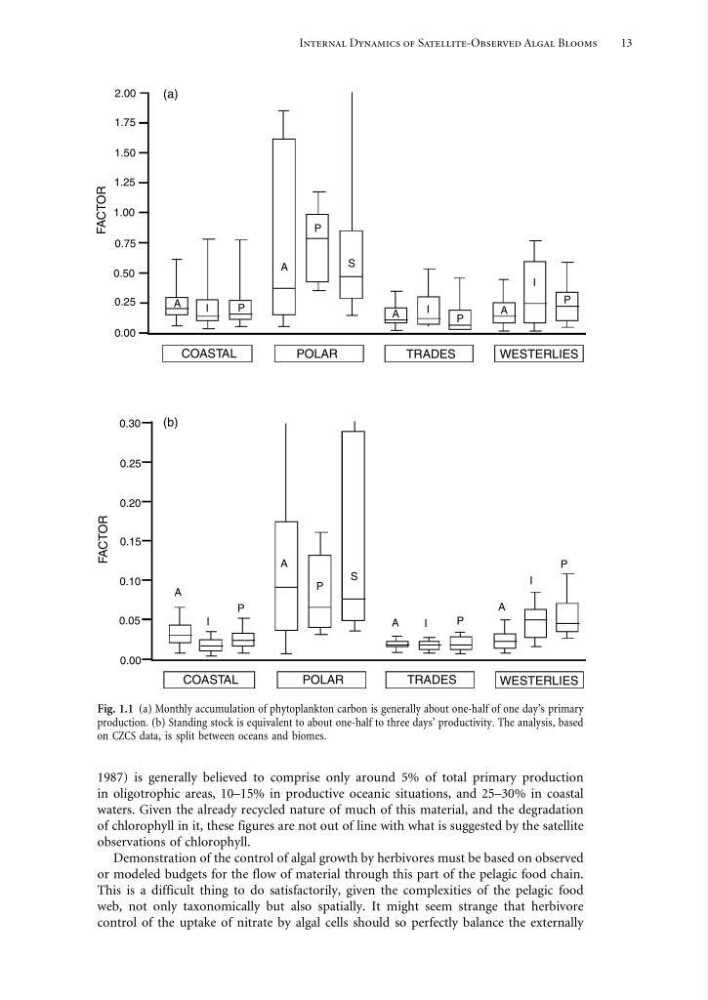
Fig. 1.1 (a) Monthly accumulation of phytoplankton carbon is generally about one-half of one day’s primary
production. (b) Standing stock is equivalent to about one-half to three days’ productivity. The analysis, based
on CZCS data, is split between oceans and biomes.
1987) is generally believed to comprise only around 5% of total primary production
in oligotrophic areas, 10–15% in productive oceanic situations, and 25–30% in coastal
waters. Given the already recycled nature of much of this material, and the degradation
of chlorophyll in it, these figures are not out of line with what is suggested by the satellite
observations of chlorophyll.
Demonstration of the control of algal growth by herbivores must be based on observed
or modeled budgets for the flow of material through this part of the pelagic food chain.
This is a difficult thing to do satisfactorily, given the complexities of the pelagic food
web, not only taxonomically but also spatially. It might seem strange that herbivore
control of the uptake of nitrate by algal cells should so perfectly balance the externally
13
(a)
(b)
2.00
1.75
1.50
1.25
1.00
0.75
0.50
0.25
0.00
0.30
0.25
0.20
0.15
0.10
0.05
0.00
FACTOR
FACTOR
COASTAL
POLAR
TRADES
WESTERLIES
POLAR
TRADES
WESTERLIES
A
A
P
P
S
I
A
A
P
S
P
I
A
A
P
P
I
I
A
A
I
I
P
P
COASTAL
Fig. 1.1 (a) Monthly accumulation of phytoplankton carbon is generally about one-half of one day’s primary
production. (b) Standing stock is equivalent to about one-half to three days’ productivity. The analysis, based
on CZCS data, is split between oceans and biomes.
1987) is generally believed to comprise only around 5% of total primary production
in oligotrophic areas, 10–15% in productive oceanic situations, and 25–30% in coastal
waters. Given the already recycled nature of much of this material, and the degradation
of chlorophyll in it, these figures are not out of line with what is suggested by the satellite
observations of chlorophyll.
Demonstration of the control of algal growth by herbivores must be based on observed
or modeled budgets for the flow of material through this part of the pelagic food chain.
This is a difficult thing to do satisfactorily, given the complexities of the pelagic food
web, not only taxonomically but also spatially. It might seem strange that herbivore
control of the uptake of nitrate by algal cells should so perfectly balance the externally