

272
Chapter 9: The Atlantic Ocean
of total fish biomass, while common hake (Merluccius hubbsi) contributed the second
largest biomass, although today it dominates the fish landings. These two are followed by
southern blue whiting (Micromesistius australis), by pink cuskeel (Genypterus blacodes),
and by various notothenids, such as the semipelagic toothfish (Dissostichus eleginoides).
What seems unusual here is the great abundance of several species of squid; approximately
25% of the entire world catch of around 3 × 10
6 t y
−1 was taken from the shelf of this
province in the late 1990s. One may infer either that the large-scale removal of demersal
fish has created a regime shift, or that the pristine ecology of this shelf was rather
unusual.
Appropriately for such a high-latitude shelf region, two large teleosts, each about
1 m in maximum length and each with a potential longevity of about 15 years, are
dominant in the demersal biomass. As elsewhere, these fish (Macronurus, Merluccius) are
high-trophic-level species, depending largely on amphipods, euphausiids, small fish, and
cannibalism. Hake are critically dependent on the shelf-break, thermohaline, and tidal
fronts discussed earlier. These prevent the larvae from winter spawning in the northern
part of the species range from drifting into subtropical waters; summer spawning sites
in more coastal waters to the south are associated with the thermohaline and tidal fronts
off the Valdes peninsula and in the Gulfs of San Matias and San Jorge. Eggs and larvae
are preferentially distributed in frontal and stratified areas where surface and bottom
temperatures differ by about 4
C. Further, the seasonal migrations of the stock carries
it between the northern and southern frontal regions where nektonic biomass is high
relative to nonfrontal regions.
0
50
100
150
200
250
0
5
10
15
20
25
Climatology (years)
Depth (m)
Production at DCM (%)
Zm (sigma)
Zeu
Pt (at DCM)
0.00
0.40
0.80
1.20
1.60
2.00
0.00
0.50
1.00
1.50
2.00
SeaWiFS (FKLD): September 1997 - January 2002
Surface Chl (mg m -3
)
Pt d
-1
Chl m
-3
1998
1999
2000
2001
Pt (gC m
-2
d
-1
)
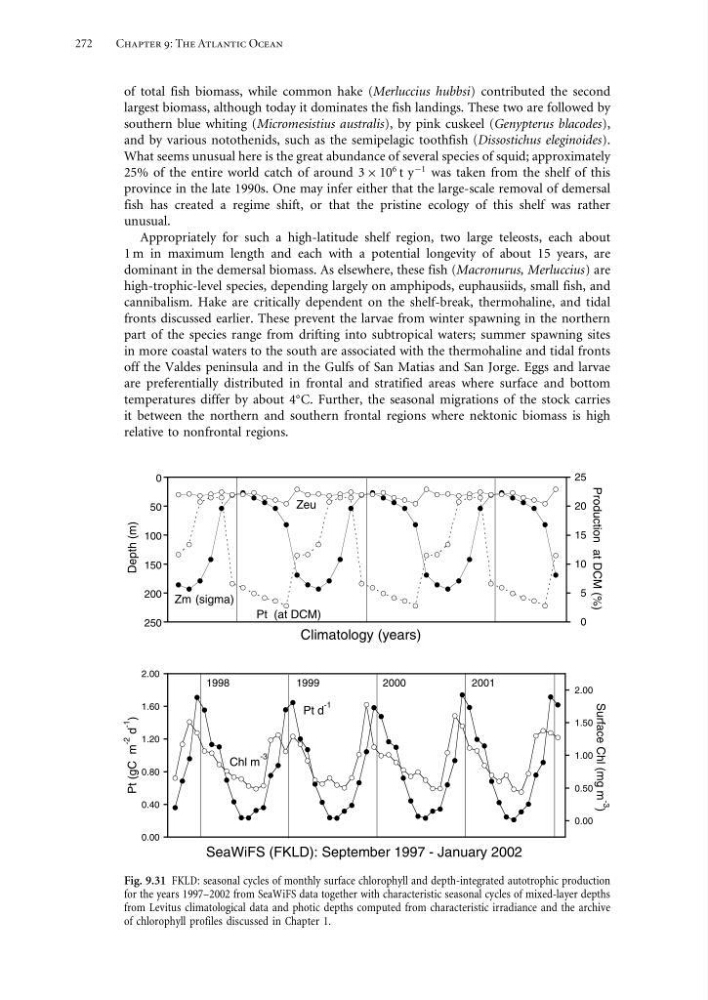
Fig. 9.31 FKLD: seasonal cycles of monthly surface chlorophyll and depth-integrated autotrophic production
for the years 1997–2002 from SeaWiFS data together with characteristic seasonal cycles of mixed-layer depths
from Levitus climatological data and photic depths computed from characteristic irradiance and the archive
of chlorophyll profiles discussed in Chapter 1.
Chapter 9: The Atlantic Ocean
of total fish biomass, while common hake (Merluccius hubbsi) contributed the second
largest biomass, although today it dominates the fish landings. These two are followed by
southern blue whiting (Micromesistius australis), by pink cuskeel (Genypterus blacodes),
and by various notothenids, such as the semipelagic toothfish (Dissostichus eleginoides).
What seems unusual here is the great abundance of several species of squid; approximately
25% of the entire world catch of around 3 × 10
6 t y
−1 was taken from the shelf of this
province in the late 1990s. One may infer either that the large-scale removal of demersal
fish has created a regime shift, or that the pristine ecology of this shelf was rather
unusual.
Appropriately for such a high-latitude shelf region, two large teleosts, each about
1 m in maximum length and each with a potential longevity of about 15 years, are
dominant in the demersal biomass. As elsewhere, these fish (Macronurus, Merluccius) are
high-trophic-level species, depending largely on amphipods, euphausiids, small fish, and
cannibalism. Hake are critically dependent on the shelf-break, thermohaline, and tidal
fronts discussed earlier. These prevent the larvae from winter spawning in the northern
part of the species range from drifting into subtropical waters; summer spawning sites
in more coastal waters to the south are associated with the thermohaline and tidal fronts
off the Valdes peninsula and in the Gulfs of San Matias and San Jorge. Eggs and larvae
are preferentially distributed in frontal and stratified areas where surface and bottom
temperatures differ by about 4
C. Further, the seasonal migrations of the stock carries
it between the northern and southern frontal regions where nektonic biomass is high
relative to nonfrontal regions.
0
50
100
150
200
250
0
5
10
15
20
25
Climatology (years)
Depth (m)
Production at DCM (%)
Zm (sigma)
Zeu
Pt (at DCM)
0.00
0.40
0.80
1.20
1.60
2.00
0.00
0.50
1.00
1.50
2.00
SeaWiFS (FKLD): September 1997 - January 2002
Surface Chl (mg m -3
)
Pt d
-1
Chl m
-3
1998
1999
2000
2001
Pt (gC m
-2
d
-1
)
Fig. 9.31 FKLD: seasonal cycles of monthly surface chlorophyll and depth-integrated autotrophic production
for the years 1997–2002 from SeaWiFS data together with characteristic seasonal cycles of mixed-layer depths
from Levitus climatological data and photic depths computed from characteristic irradiance and the archive
of chlorophyll profiles discussed in Chapter 1.