

Atlantic Coastal Biome
263
Guinea, a “sparid fauna” is absent, and Caranx, Sphyraena, and some Lutjanids occupy the
grounds. It has been suggested that the western Atlantic sparid community, typical of the
eastern coast of the United States and the South American coast south of Cape Frio, lacks
sufficiently illuminated, sufficiently cool subsurface water for these subtropical species to
penetrate through the Caribbean and the Guianian region by tropical submergence—as
they do in the eastern Atlantic.
Synopsis
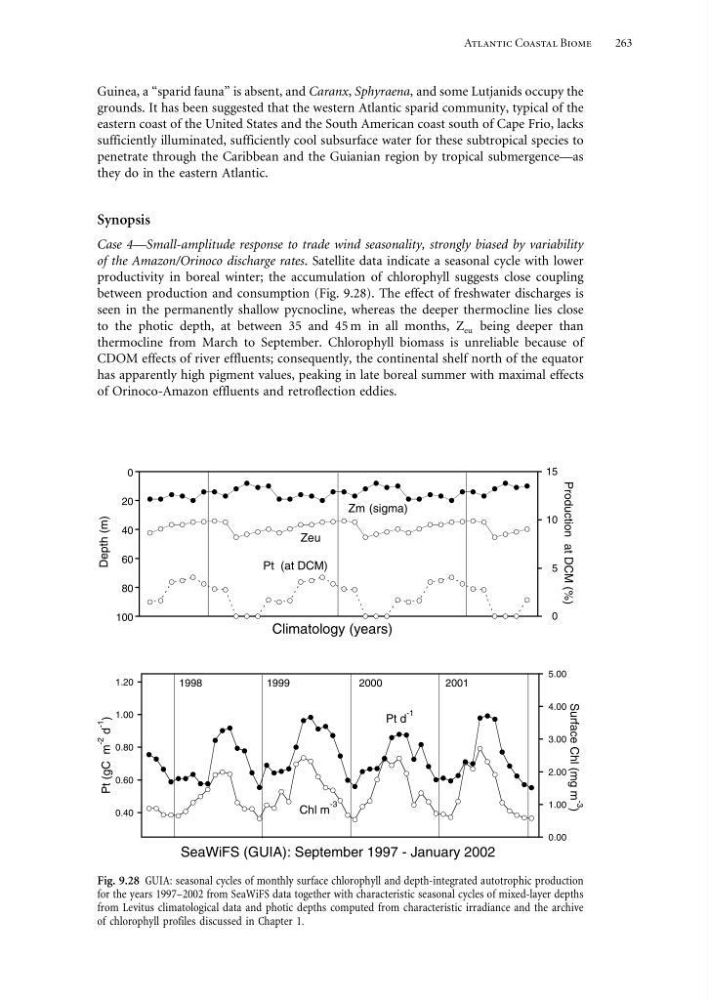
Case 4—Small-amplitude response to trade wind seasonality, strongly biased by variability
of the Amazon/Orinoco discharge rates. Satellite data indicate a seasonal cycle with lower
productivity in boreal winter; the accumulation of chlorophyll suggests close coupling
between production and consumption (Fig. 9.28). The effect of freshwater discharges is
seen in the permanently shallow pycnocline, whereas the deeper thermocline lies close
to the photic depth, at between 35 and 45 m in all months, Z eu being deeper than
thermocline from March to September. Chlorophyll biomass is unreliable because of
CDOM effects of river effluents; consequently, the continental shelf north of the equator
has apparently high pigment values, peaking in late boreal summer with maximal effects
of Orinoco-Amazon effluents and retroflection eddies.
0
20
40
60
80
100
0
5
10
15
Climatology (years)
Depth (m)
Production at DCM (%)
Zm (sigma)
Zeu
Pt (at DCM)
0.40
0.60
0.80
1.00
1.20
0.00
1.00
2.00
3.00
4.00
5.00
SeaWiFS (GUIA): September 1997 - January 2002
Surface Chl (mg m -3
)
Pt d
-1
Chl m
-3
1998
1999
2000
2001
Pt (gC m
-2
d
-1
)
Fig. 9.28 GUIA: seasonal cycles of monthly surface chlorophyll and depth-integrated autotrophic production
for the years 1997–2002 from SeaWiFS data together with characteristic seasonal cycles of mixed-layer depths
from Levitus climatological data and photic depths computed from characteristic irradiance and the archive
of chlorophyll profiles discussed in Chapter 1.
263
Guinea, a “sparid fauna” is absent, and Caranx, Sphyraena, and some Lutjanids occupy the
grounds. It has been suggested that the western Atlantic sparid community, typical of the
eastern coast of the United States and the South American coast south of Cape Frio, lacks
sufficiently illuminated, sufficiently cool subsurface water for these subtropical species to
penetrate through the Caribbean and the Guianian region by tropical submergence—as
they do in the eastern Atlantic.
Synopsis
Case 4—Small-amplitude response to trade wind seasonality, strongly biased by variability
of the Amazon/Orinoco discharge rates. Satellite data indicate a seasonal cycle with lower
productivity in boreal winter; the accumulation of chlorophyll suggests close coupling
between production and consumption (Fig. 9.28). The effect of freshwater discharges is
seen in the permanently shallow pycnocline, whereas the deeper thermocline lies close
to the photic depth, at between 35 and 45 m in all months, Z eu being deeper than
thermocline from March to September. Chlorophyll biomass is unreliable because of
CDOM effects of river effluents; consequently, the continental shelf north of the equator
has apparently high pigment values, peaking in late boreal summer with maximal effects
of Orinoco-Amazon effluents and retroflection eddies.
0
20
40
60
80
100
0
5
10
15
Climatology (years)
Depth (m)
Production at DCM (%)
Zm (sigma)
Zeu
Pt (at DCM)
0.40
0.60
0.80
1.00
1.20
0.00
1.00
2.00
3.00
4.00
5.00
SeaWiFS (GUIA): September 1997 - January 2002
Surface Chl (mg m -3
)
Pt d
-1
Chl m
-3
1998
1999
2000
2001
Pt (gC m
-2
d
-1
)
Fig. 9.28 GUIA: seasonal cycles of monthly surface chlorophyll and depth-integrated autotrophic production
for the years 1997–2002 from SeaWiFS data together with characteristic seasonal cycles of mixed-layer depths
from Levitus climatological data and photic depths computed from characteristic irradiance and the archive
of chlorophyll profiles discussed in Chapter 1.