

260
Chapter 9: The Atlantic Ocean
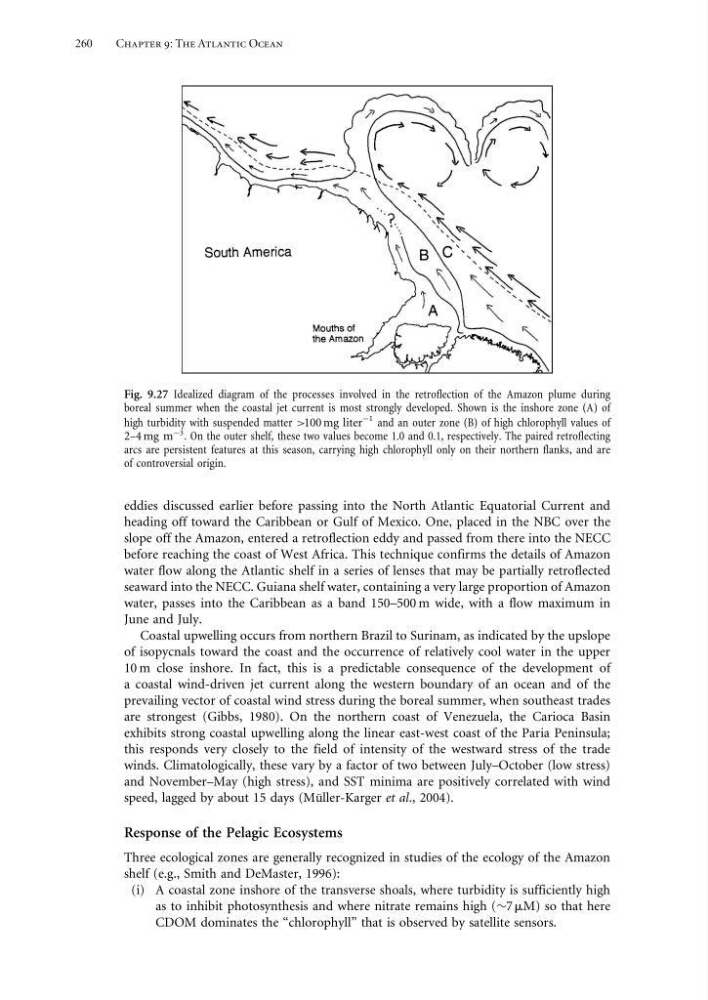
Fig. 9.27 Idealized diagram of the processes involved in the retroflection of the Amazon plume during
boreal summer when the coastal jet current is most strongly developed. Shown is the inshore zone (A) of
high turbidity with suspended matter >100 mg liter
−1 and an outer zone (B) of high chlorophyll values of
2–4 mg m
−3 . On the outer shelf, these two values become 1.0 and 0.1, respectively. The paired retroflecting
arcs are persistent features at this season, carrying high chlorophyll only on their northern flanks, and are
of controversial origin.
eddies discussed earlier before passing into the North Atlantic Equatorial Current and
heading off toward the Caribbean or Gulf of Mexico. One, placed in the NBC over the
slope off the Amazon, entered a retroflection eddy and passed from there into the NECC
before reaching the coast of West Africa. This technique confirms the details of Amazon
water flow along the Atlantic shelf in a series of lenses that may be partially retroflected
seaward into the NECC. Guiana shelf water, containing a very large proportion of Amazon
water, passes into the Caribbean as a band 150–500 m wide, with a flow maximum in
June and July.
Coastal upwelling occurs from northern Brazil to Surinam, as indicated by the upslope
of isopycnals toward the coast and the occurrence of relatively cool water in the upper
10 m close inshore. In fact, this is a predictable consequence of the development of
a coastal wind-driven jet current along the western boundary of an ocean and of the
prevailing vector of coastal wind stress during the boreal summer, when southeast trades
are strongest (Gibbs, 1980). On the northern coast of Venezuela, the Carioca Basin
exhibits strong coastal upwelling along the linear east-west coast of the Paria Peninsula;
this responds very closely to the field of intensity of the westward stress of the trade
winds. Climatologically, these vary by a factor of two between July–October (low stress)
and November–May (high stress), and SST minima are positively correlated with wind
speed, lagged by about 15 days (Müller-Karger et al., 2004).
Response of the Pelagic Ecosystems
Three ecological zones are generally recognized in studies of the ecology of the Amazon
shelf (e.g., Smith and DeMaster, 1996):
(i) A coastal zone inshore of the transverse shoals, where turbidity is sufficiently high
as to inhibit photosynthesis and where nitrate remains high (∼7 M) so that here
CDOM dominates the “chlorophyll” that is observed by satellite sensors.
Chapter 9: The Atlantic Ocean
Fig. 9.27 Idealized diagram of the processes involved in the retroflection of the Amazon plume during
boreal summer when the coastal jet current is most strongly developed. Shown is the inshore zone (A) of
high turbidity with suspended matter >100 mg liter
−1 and an outer zone (B) of high chlorophyll values of
2–4 mg m
−3 . On the outer shelf, these two values become 1.0 and 0.1, respectively. The paired retroflecting
arcs are persistent features at this season, carrying high chlorophyll only on their northern flanks, and are
of controversial origin.
eddies discussed earlier before passing into the North Atlantic Equatorial Current and
heading off toward the Caribbean or Gulf of Mexico. One, placed in the NBC over the
slope off the Amazon, entered a retroflection eddy and passed from there into the NECC
before reaching the coast of West Africa. This technique confirms the details of Amazon
water flow along the Atlantic shelf in a series of lenses that may be partially retroflected
seaward into the NECC. Guiana shelf water, containing a very large proportion of Amazon
water, passes into the Caribbean as a band 150–500 m wide, with a flow maximum in
June and July.
Coastal upwelling occurs from northern Brazil to Surinam, as indicated by the upslope
of isopycnals toward the coast and the occurrence of relatively cool water in the upper
10 m close inshore. In fact, this is a predictable consequence of the development of
a coastal wind-driven jet current along the western boundary of an ocean and of the
prevailing vector of coastal wind stress during the boreal summer, when southeast trades
are strongest (Gibbs, 1980). On the northern coast of Venezuela, the Carioca Basin
exhibits strong coastal upwelling along the linear east-west coast of the Paria Peninsula;
this responds very closely to the field of intensity of the westward stress of the trade
winds. Climatologically, these vary by a factor of two between July–October (low stress)
and November–May (high stress), and SST minima are positively correlated with wind
speed, lagged by about 15 days (Müller-Karger et al., 2004).
Response of the Pelagic Ecosystems
Three ecological zones are generally recognized in studies of the ecology of the Amazon
shelf (e.g., Smith and DeMaster, 1996):
(i) A coastal zone inshore of the transverse shoals, where turbidity is sufficiently high
as to inhibit photosynthesis and where nitrate remains high (∼7 M) so that here
CDOM dominates the “chlorophyll” that is observed by satellite sensors.